
Updated on September 7, 2026.
Coues deer are a tiny desert subspecies of white-tailed deer. Mule deer are a different, larger western species. In Arizona and New Mexico they share the same mountains, and the tag in your pocket often names only one of them. The fastest field marks: a Coues flags a broad white tail and runs; a mule deer shows a rope-like tail with a black tip and stots away on stiff legs. A Coues buck rarely tops 100 pounds. A mule buck in the same state can weigh twice that.
I have hunted Midwest whitetails for 23 years. The first time I glassed a Coues buck at a mile on an Arizona oak slope, my brain filed it as a fawn with a rack. It was not. The Coues deer (Odocoileus virginianus couesi) is a full-grown desert whitetail. The animal on the next ridge was a mule deer (Odocoileus hemionus). Same hunt unit. Different legal wildlife. That mix is why this comparison exists: it is an identification page and a tag page.
Biology lives on the two species profiles. Trip planning lives on Arizona deer hunting and New Mexico deer hunting. The parent list of deer species is the hub. This page is the decision between them.
| Item | Coues deer | Mule deer |
|---|---|---|
| Size | About 30 inches at the shoulder. Bucks rarely over 100 pounds; does average about 65. | Arizona bucks may exceed 200 pounds and stand about 42 inches at the shoulder; does average about 125. |
| Range | Central and southeastern Arizona, southwestern New Mexico, Sonora and Chihuahua. Boone and Crockett’s Coues line in New Mexico is I-40 on the north and the Rio Grande on the east. | Western North America, from the Canadian Rockies into Mexico. In Arizona and New Mexico they occupy far more country than Coues do. |
| Tags / season | Arizona hunt tables often list “antlered whitetail deer.” Late rifles run into December. The Coues rut is late December into January. | Tables list “antlered mule deer” or “any antlered deer.” Typical general rifles are October–November, timed nearer the mule rut. |
| Pressure | Coues permit-tags are often easier to draw than Kaibab or Strip mule tags. Leftover Coues tags still happen. The work is the glass, not the draw. | Trophy mule units eat bonus points. Opening-weekend two-tracks and easy knobs get slammed. |
| Who it is for | Optics-first hunters who will sit a sky-island slope for a 90-pound buck and a long shot. | Hunters who want a classic western mule, more mass, and will wait on points for the Kaibab, the Strip, or northern New Mexico timber. |
| Stay implication | Base in Tucson, Sierra Vista, Payson, or Silver City. Those towns sit under Coues country, not under a Kaibab mule hunt. | Base in Flagstaff, Williams, or Fredonia for Kaibab and high-timber mule hunts. Do not book Tucson for a Strip tag. |
Size numbers above follow Arizona State Parks’ Coues page and the Arizona hunter-education mule deer and Coues summaries. Hunt wording comes from the current Arizona Game and Fish Department hunting regulations. If this page and the booklet disagree, the booklet wins.
Three differences that actually change a decision
1. The tag often names one species
This is the difference that can end a hunt. Arizona Commission Order 2 does not treat “deer” as one animal. Hunt numbers list legal wildlife as antlered mule deer, antlered whitetail deer, or any antlered deer. I have watched people glass a legal-looking buck and then realize the booklet said mule deer. The Coues walks. New Mexico is the same split in a quieter way: mule deer make up about 95 percent of the statewide harvest, and Coues hunts concentrate in the southwest, especially GMUs 23, 24, and 27, per the New Mexico Department of Game and Fish deer page.
If you want Coues specifically, apply for hunts that say whitetail. If you want a mule, do not assume a mixed unit lets you shoot either one. Read the legal-wildlife column twice. Mixed country around Payson and the Mogollon Rim is where that mistake is cheapest to make and expensive to fix.
2. Size changes the shot, the glass, and the pack-out
A Coues buck is not a small mule deer. It is a small whitetail living in big country. At 400 yards it looks like a gray rock with ears. A mule fills the scope. That is why Coues hunting is an optics sport: I glass north slopes and oak pockets, then stalk. A stable 10×42 is the minimum I will carry; a spotting scope saves you the hike to a stump. Pack-out is the consolation prize. A Coues is easier to get to the truck than a mule from the same canyon.
Find 10x42 binoculars on Amazon Amazon associate tag checkcheck-20. We may earn a commission.
3. The calendars do not line up
Mule deer in this region still rut on a classic western clock, peaking in November. Coues breeding season runs late December into January, which is why Arizona prints late whitetail rifles and why a January archery Coues hunt in New Mexico is a different trip than an October mule hunt. Dates move; confirm them in the AZGFD booklet or the New Mexico deer rules before you book a cabin.
How to tell them apart on the mountain
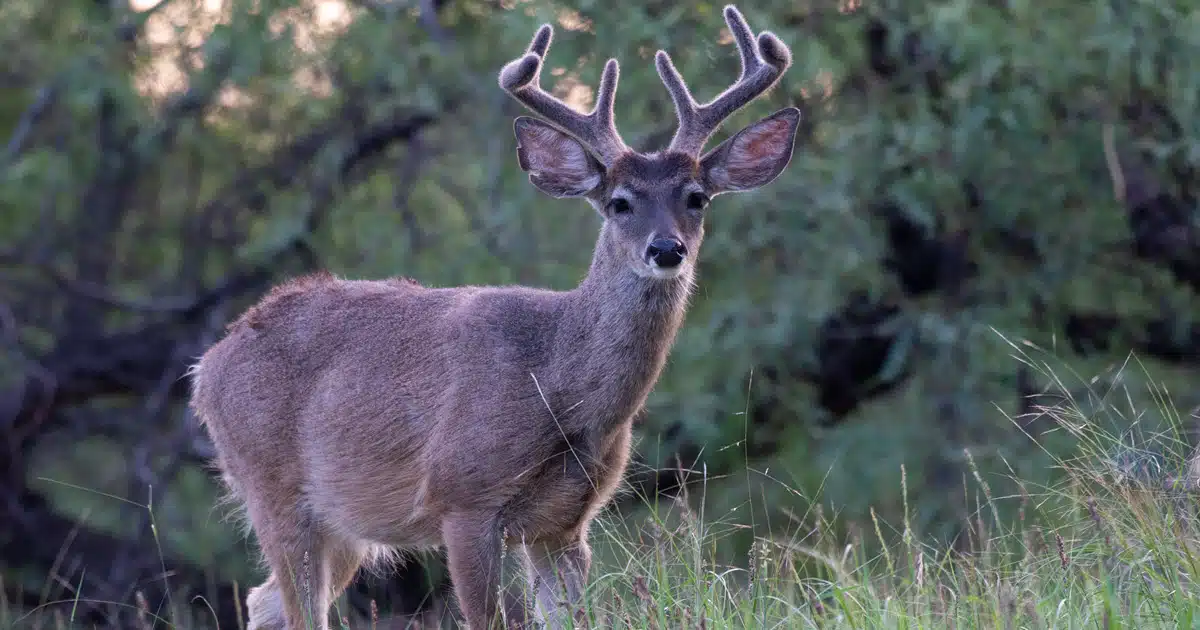
Tail. A Coues has a long, flag-like tail with a white underside. When it is alarmed it raises that flag the way every other white-tailed deer does. A mule deer has a thin, rope-like tail, white with a black tip, hanging against a big white rump. It does not flag. If you want the broader mule-versus-whitetail version of this, use mule deer vs whitetail deer. Coues are the southwestern chapter of that same tail story.
Antlers. Coues bucks grow a whitetail rack: tines come off a main beam. Mule deer antlers fork. Mature mule racks are bifurcated — each beam splits, then splits again. A Coues eight-point is a basket. A mule four-by-four (western count) is a different silhouette even when the animal is too far to judge mass. Boone and Crockett keeps them in separate books for a reason. Typical Coues all-time minimum is 110; typical mule all-time minimum is 190, per the Club’s minimum entry scores. The world’s-record typical Coues is Ed Stockwell’s 144 1/8 from Pima County, Arizona, in 1953. A book mule is a different animal.
Gait. Press a Coues and it runs, tail up. Press a mule and it stots — a stiff-legged, four-footed bound that looks wrong until you have seen it twice. That bound is also why a fleeing mule is easier to keep in the glass than a Coues that has already vanished into oak. Speed numbers live on how fast can deer run; the useful field fact is the style, not the miles per hour.
Ears fool people. Coues ears look huge because the head is small and the ears dump heat. Mule ears are actually larger. Do not ID on ears alone. Coat color is a weak mark too: both go gray in winter. Habitat is a better clue. Coues like oak, chaparral, and pine with openings, often higher on southern Arizona’s sky islands. Mule deer take the sage, juniper, ponderosa, and desert flats. They overlap. That overlap is the whole problem.
Range, records, and what “Coues country” actually means
Coues deer are not “Arizona’s mule deer.” They are a whitetail subspecies named for Army surgeon Elliot Coues, stationed at Fort Whipple. Hunters say “cooz.” The man said “cows.” Arizona State Parks records both. I say cooz in camp and do not argue about it.
The Boone and Crockett category boundary is the cleanest published map of what counts as a Coues for records: central and southern Arizona plus Sonora and Chihuahua, and in New Mexico the Arizona line, the southern state line, the Rio Grande, and I-40. The Club has kept Coues as its own category since 1932 and notes that Coues may occasionally interbreed with mule deer. I have had the opposite problem: calling a small desert mule a Coues because I wanted it to be one.
New Mexico’s Coues herd is real and smaller than Arizona’s. NMDGF has called the southwestern population strong, with the best buck opportunity in GMUs 23, 24, and 27. Mule deer still dominate the statewide kill. A New Mexico deer license is not automatically a Coues license.
Diet is browse and forbs filtered through desert plants. Coues lean on oak and mountain browse; sage-country mule deer eat different shrubs. The wild-diet page is what do deer eat; the whitetail list is what does a white-tailed deer eat.
If you are choosing a trip
Pick the deer first, then the town. Coues: southern and central Arizona sky islands or southwestern New Mexico. Stay in Tucson, Sierra Vista, Payson, or Silver City. Expect a draw, thin air, and a lot of empty glass. Arizona still sells archery deer nonpermit-tags in listed units; those close when harvest limits hit. Rifle Coues is a hunt number. Confirm the table before you tell anyone you can just buy a tag.
Mule: Kaibab Plateau, the Arizona Strip, the White Mountains, or northern New Mexico forests such as Santa Fe and Carson. Stay in Flagstaff, Williams, or Fredonia. Accept bonus points on the famous units. CWD has not been detected in Arizona deer as of the 2025 testing season, per AZGFD’s CWD page; it is present in New Mexico, Utah, Colorado, and California. That is a carcass-import fact, not a reason to skip the state. Seasons and costs belong on the state pages and at deer hunting by state. If you hit a deer on a desert highway, use what to do if you hit a deer.
Key deer are the other tiny whitetail subspecies we cover — Florida, not a hunt. Mule deer have a Pacific-coast lookalike on blacktail deer vs mule deer. This page is the Southwest mix-up.
How do you tell a Coues deer from a mule deer at a distance?
Use the tail and the gait first, then the antlers if it is a buck. Coues flag a broad white tail and run. Mule deer show a black-tipped rope tail and stot. Coues antlers come off a main beam; mule antlers fork. Size helps once you have a rock or a cow in the picture, but size alone will lie to you in heat shimmer.
Are Coues deer just small mule deer?
No. Coues deer are white-tailed deer, Odocoileus virginianus couesi. Mule deer are Odocoileus hemionus. They share habitat in Arizona and New Mexico, which is why people mix them up, but they are different species with different tails, gaits, antlers, and usually different tags. A small desert mule is still a mule.
Can Coues deer and mule deer breed?
Boone and Crockett notes that Coues may occasionally interbreed with mule deer and that a DNA test can be requested on a questionable Coues entry. That is rare enough to be a records footnote, not a field ID method. Do not call an in-between deer a hybrid because the ears look funny. Call it by the tail and the antler plan, then read the tag.
Which is harder to hunt, Coues or mule deer?
Different hard. Drawing a famous Arizona mule tag can take years of bonus points. Finding a Coues buck you can even see often takes more glassing days than a timber-stand hunter is used to. Coues are smaller, grayer, and live in country that swallows them. I would rather draw a Coues tag I can hunt this year than sit another season on a Strip application. Other people want the mule or nothing.


