
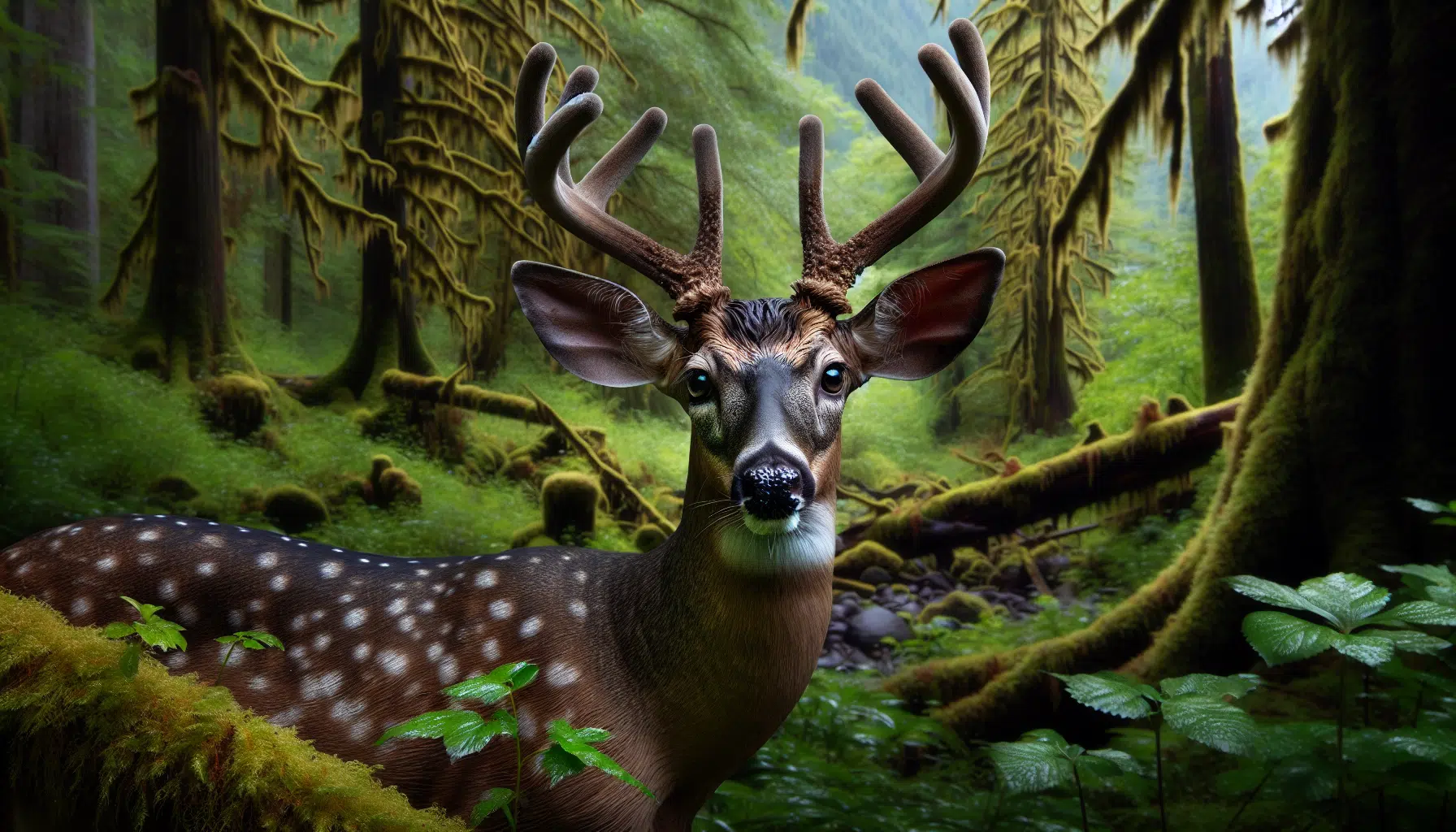
Updated on September 7, 2026. Blacktail deer and mule deer are the same species — Odocoileus hemionus — listed as Least Concern on the IUCN Red List. They are not the same hunt. The tail, the mountain crest, and the tag you buy are what actually change a decision.
The fastest field mark: a blacktail’s tail is wide and dark brown to black across most of the upper surface, with white underneath. A mule deer’s tail is a thin white rope with a black tip, hanging on a large white rump patch. Neither animal flags like a white-tailed deer. That three-way split is on mule deer vs whitetail. The species-level split — coastal blacktail versus the eastern white-tailed deer — is on blacktail deer vs whitetail deer.
| Item | Blacktail deer | Mule deer |
|---|---|---|
| Size | Columbian bucks commonly 100–200 lb. Sitka October weights about 80 lb (does) and 120 lb (bucks); some Sitka bucks exceed 200 lb. | Larger. Adult bucks often 150–250 lb; exceptional northern bucks much heavier. Shoulder height about 3–3.5 ft. |
| Range | Pacific coast: coastal California through western Oregon and Washington into coastal British Columbia. Sitka blacktails in southeast Alaska, with transplants to Yakutat, Prince William Sound, and Kodiak/Afognak. | Interior West: east of the Cascade–Sierra crest, Rockies, Great Basin, and south into Mexico. The species page is mule deer. |
| Tags / season | Washington: any O. hemionus west of the Pacific Crest Trail line is a blacktail. Oregon: western general tag (2026 any-legal-weapon Oct. 3–Nov. 6). California: A and B zones, OTC, often a summer opener. | Washington: same species east of that PCT line. Oregon: eastern hunts are controlled; 2026 is the first year of Deer Hunt Areas, not WMUs. California: X-zone draw for migratory mule deer. |
| Habitat | Wet coastal forest, regenerating cuts, manzanita and oak brush. Visibility is yards, not ridgelines. | Sage, juniper, high basins, and winter range. Glassing country. Many herds migrate. |
| Pressure / who it is for | High on easy two-tracks and August openers; lower in steep brush a half-mile off the road. For hunters who will still-hunt, sit a creek, and take a 40-yard shot in rain. | High on easy glassing knobs opening weekend; lower on drawn units and nasty winter-range breaks. For hunters who will hike, glass, and wait on a 250-yard shot with a backstop. |
| Stay implication | Base in a wet-side town with a grocery, a dryer, and a hanging tree: Forks or Aberdeen, WA; Roseburg or Tillamook, OR; Ukiah, CA. The hunt pages that name those bases are Washington, Oregon, and California. | Base on the dry side: Yakima or Ellensburg, WA; Burns or Pendleton, OR; Bishop or Bridgeport, CA. Same three state pages. Sitka is a ferry-and-skiff hunt on the Alaska deer page. |
There is no live WorldDeer species URL for black-tailed deer in the sitemap. I am not inventing /blacktail-deer/. The encyclopedia parent is deer species. The animal itself is a subspecies of mule deer. Statewide numbers sit on mule deer population by state.
Three differences that actually change a decision
1. The tag follows a line on a map, not the deer in front of you
Biologists treat Columbian black-tailed deer (O. h. columbianus), Sitka black-tailed deer (O. h. sitkensis), and Rocky Mountain mule deer (O. h. hemionus) as subspecies of one species. Along the Cascade crest they hybridize. Intermediate tails and coats are normal. That is not a campfire argument. Oregon’s mule deer plan cites that overlap, and Washington’s hunt pamphlet draws a legal line anyway.
Washington’s 2026 definition, from the WDFW Big Game Hunting Seasons and Rules pamphlet: a black-tailed deer is any Odocoileus hemionus west of a line from the Canadian border south on the Pacific Crest Trail, along the Yakama Reservation boundary to the Klickitat River, then down the Klickitat to the Columbia. East of that line, the same species is a mule deer. You do not get to reclassify a hybrid because the tail looked dark.
Oregon splits it the same way without pretending genetics are tidy. ODFW deer hunting puts Columbian blacktails in the Coast Range and western Cascades on a western general tag. Eastern Oregon mule deer are controlled hunts. Starting in 2026 those mule hunts use Deer Hunt Areas built from collared-herd ranges, not the old WMU map. California tags you by zone, not by subspecies: coastal A and B country is blacktail; east of the Sierra crest and the X zones are mule deer. Confirm the zone on the CDFW deer hunting page before you drive.
2. Shot distance and cover are different sports
I have hunted whitetails for 23 years, starting with my dad in southern Missouri when I was 12. I still split time between a 65-acre lease in Pike County, Illinois and public dirt in the Ozarks. A blacktail in Mendocino brush or a Washington clearcut edge is closer to still-hunting a creek bottom than to a Colorado mule-deer glassing knob. Cover swallows a bad hit. I decide max range before I climb. Bow in timber: 30 yards unless the lane is wide and the deer is calm. Rifle in coastal timber: often inside 100. Eastside mule deer: a backstop and a “no farther than that rock” line, even when the buck is at 280.
Blacktails live in small home ranges. ADF&G radio-collar work on Admiralty Island put Sitka summer and winter ranges at 30 to 1,200 acres, averaging about 200 acres. A mature coastal buck can spend a life in a couple of square miles and be seen a handful of times. Interior mule deer often migrate between high summer range and lower winter range. You hunt the migration and the glassable basin, not a 40-acre alder patch.
Refresh shot placement and the after the shot hub before you pack. I gut-shot a doe in 2007, pushed her too early, and never found her. West-side brush hides a wounded blacktail better than an Ozark oak flat.
3. The rack is the same fork, at a different scale
Both grow bifurcated antlers: the beam forks, and each fork can fork again. That is the species mark, covered on antlers. Scale is the hunt mark. Boone and Crockett keeps three typical categories with three all-time minimums: mule deer 190, Columbia blacktail 135, Sitka blacktail 108. Awards-book floors are 180, 125, and 100. Those numbers are on the B&C minimum-entry chart. Do not reproduce their form. Do use the gap: a “small” interior mule deer can outscore a giant Sitka, which is why the books refuse to dump them in one pile.
ADF&G’s Sitka profile is blunt: normal adult antler development is three points on each side, and very few score more than 110 B&C. Average October live weight is about 80 pounds for adult does and 120 for adult bucks. That is why I size the cooler with how much meat from a deer before I book extra baggage for a Sitka trip.
If you are choosing a trip
Pick the deer, then the state. Do not book a motel first.
Want a still-hunt in rain and brush, OTC, and a compact dark-tailed buck: western Washington, western Oregon, or California A/B. Stay in Forks, Aberdeen, Roseburg, Tillamook, or Ukiah. The public-land how-to is hunting national forest land and the public land deer hunting hub. Destination pages sit under Places. If you are still choosing a state, start at deer hunting by state.
Want glassing, sage, and a bigger-bodied mule deer: east of the crest in those same three states, or a classic interior hunt. Stay in Yakima, Burns, Pendleton, Bishop, or Bridgeport. Oregon east is a draw in 2026. California X zones are a draw. Washington eastside mule deer are a 3-point-minimum rifle hunt in most 100–300 series GMUs. Read the pamphlet, not a forum pin.
Want the smallest, darkest animal in this group, on a boat: Sitka blacktails in southeast Alaska. That is harvest-ticket country, not a Cascade still-hunt. Details live on the Alaska page, not here.
I do not put a lodging shortcode on a species compare. Named towns and stay sentences belong on the state pages that already carry them.
Field marks that are not the tail
Ears: mule deer ears are the namesake — long, mule-like, often with a dark rim. Blacktail ears are shorter. Sitka ears are the shortest of the group.
Rump: mule deer show a large white patch. Columbian blacktails show a smaller one. Sitka rumps are the most subdued, with little white beside a flat, flap-like tail.
Coat: blacktails run darker, especially in winter. Mule deer run paler gray-brown with a bigger face mask. In the Cascade hybrid zone you will see animals that fail every tidy drawing. Trust the legal boundary for the tag. Trust the tail and rump for the photo. Do not argue subspecies with a game warden using a blog.
Gait: mule deer stot — a stiff-legged, four-footed bound that looks like a pogo stick. Blacktails in timber more often sneak or run like a small whitetail. Neither flags. If the rump is a white flag pumping through the alders, you are looking at a whitetail, which Oregon and Washington also hold in pockets.
FAQ
Are blacktail deer just small mule deer?
No. They are subspecies of the same species, not stunted copies. Columbian and Sitka blacktails have darker coats, different tails, shorter ears, smaller antlers, and a coastal-forest ecology. The WAFWA Mule Deer Working Group notes that both blacktail subspecies carry mitochondrial DNA that is very different from interior mule deer. Calling a Sitka a “small muley” is like calling a Coues a “small whitetail” and then packing a 400-yard prairie setup.
Can blacktail and mule deer breed?
Yes. Where ranges meet along the Cascade crest they interbreed and produce fertile offspring with intermediate features. Wildlife agencies still draw a management line — Washington’s Pacific Crest Trail definition, Oregon’s west-versus-east tags — so the hybrid in front of you is scored by location, not by a DNA kit in your pack.
Which is bigger?
Mule deer, by a comfortable margin on both body and antler. A typical interior buck outweighs a typical Columbian blacktail. Sitka blacktails are the smallest: ADF&G’s October averages are about 80 and 120 pounds. Lifespan in the wild is commonly around 10 years; some Sitka deer reach 15. Broader deer longevity is on how long deer live.
Which hunt should I book if I can only do one?
If you have never hunted west of the Mississippi and you want a tag you can buy, hunt western Oregon or western Washington blacktail and accept rain, brush, and a short shot. If you want the classic western postcard and you will apply, hunt an Oregon Deer Hunt Area or a California X zone for mule deer. If you want the animal this page is named for at its most distinct, hunt Sitka country. Sibling identification pages if the deer in front of you is spotted or spotted-and-small: axis vs whitetail and sika vs whitetail.
Sources
Official and used for the facts table: IUCN Odocoileus hemionus (Least Concern, 2015). ADF&G Sitka black-tailed deer (weights, antlers, home range, transplants). WDFW 2026 Big Game Hunting Seasons and Rules (blacktail/mule legal line). ODFW deer hunting and 2026 eastern Oregon Deer Hunt Areas. CDFW deer hunting. Boone and Crockett minimum scores (do not copy the score sheet). WAFWA Mule Deer Working Group.
Parent hub: deer species. Species profile: mule deer. Hunt cluster: deer hunting.


