

White-tailed deer (Odocoileus virginianus) are the most widespread wild ungulate in the Americas, ranging from southern Canada through Central America into northern South America. Typical adults stand 32–40 inches at the shoulder. Globally Least Concern; widely hunted.
Updated on September 7, 2026
This is the deer most people in the eastern and central United States mean when they say “deer.” It is a woodland-and-edge species that learned the farm, the suburb, and the highway median. Among the world’s deer species, it is the one whose biology now sits closest to human daily life — gardens, headlights, hunting seasons, and all.
White-tailed deer facts
Numbers in this table wear a source. Size varies more in this species than in almost any other North American deer: a Key deer buck and a northern farm-country buck are the same species, not the same animal.
| Fact | Figure | Source |
|---|---|---|
| Scientific name | Odocoileus virginianus | IUCN Red List |
| Shoulder height | 80–100 cm (32–40 in) for typical adults; Key deer 25–32 in | Animal Diversity Web; USFWS Key deer |
| Weight range | About 57–137 kg (126–302 lb) for typical adults; Key deer bucks 55–75 lb | ADW; USFWS |
| Range | Southern Canada through most of the United States into Central America and northern South America | IUCN; USFS FEIS |
| Conservation | Least Concern globally (population trend: stable). Key deer federally Endangered. Columbia River Columbian whitetails remain federally Threatened as of 2025 | IUCN 2016; USFWS; USFWS 2025 review |
| Hunted? | Yes. U.S. hunters took 6,194,659 whitetails in the 2024–25 season | NDA 2026 Deer Report |
How to tell a white-tailed deer from a mule deer
Where the two species overlap — the Great Plains, the Rockies’ eastern slope, parts of the Southwest — people mix them up. The fastest field checks are the tail, the ears, the antlers, and the way the animal runs. The full side-by-side is on mule deer vs. whitetail deer; the short version is here.
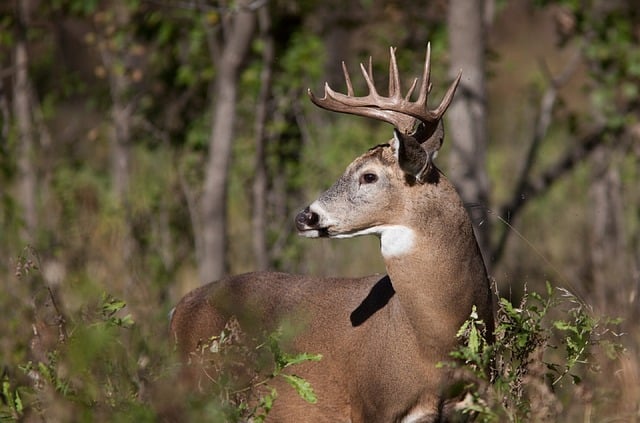
- Tail. A whitetail’s tail is broad and brown on top with a bright white underside. Alarmed, the deer flags it up and bounds away showing a white flash. A mule deer has a rope-like tail, usually white with a black tip, sitting on a larger pale rump patch. It does not flag the same way.
- Ears. Mule deer ears are oversized — mule-like, which is the name. Whitetail ears are smaller and set lower on a narrower face.
- Antlers. A typical whitetail rack grows from a single main beam with tines rising off that beam. Mule deer antlers fork, then fork again (dichotomous). Yearlings of both species can look similar; use the tail.
- Gait. Whitetails gallop and bound. Mule deer often stot — a stiff-legged bounce with all four feet leaving the ground together.
The two can hybridize where ranges meet. Hybrids are uncommon in the wild and tend to fare poorly, according to the U.S. Forest Service Fire Effects Information System review of the species. In the field, treat an odd-looking deer on the plains as a reason to look again, not as a third species.
Elk and moose are not lookalikes. A bull elk stands about five feet at the shoulder and can weigh 700 pounds; a moose is larger still. If the animal in front of you is horse-sized, it is not a whitetail.
The field comparison — size, rump patch, voice, and where each actually lives — is on deer vs elk.
Range and habitat
White-tailed deer are native from the southern Yukon and Northwest Territories across the southern Canadian provinces, through nearly all of the lower 48, and south through Mexico and Central America into northern South America. The FEIS distribution note is the cleanest map in words: rare or absent in Alaska, California, Nevada, and Utah; present in every Canadian province and territory except Nunavut, Newfoundland, and Labrador. Animal Diversity Web puts the southern edge at Bolivia.
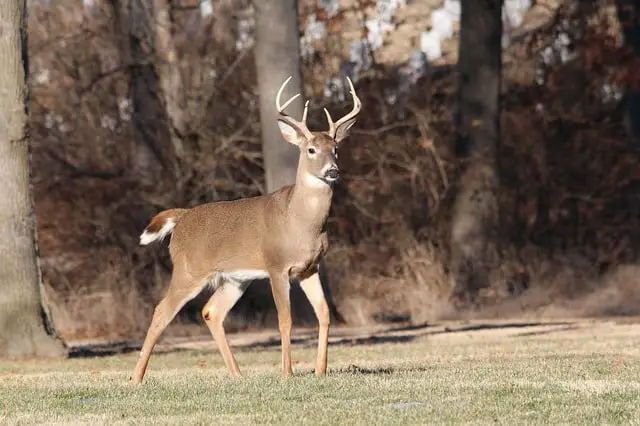
That map is not a single habitat. Northern deer live by snow depth, cedar swamps, and winter yards. Midwestern deer live in the seams between corn, soybeans, and woodlots. Southern deer live in pine, palmetto, and bottomland hardwood. Southwestern Coues deer — a small subspecies — stick to the more mesic woodlands and riparian draws of Arizona, New Mexico, and Mexico. In the arid West generally, whitetails follow cover: cottonwood bottoms, wooded draws, and irrigated edges, while mule deer take the open slopes.
Size follows latitude. A northern adult buck commonly stands near 40 inches at the shoulder and can exceed 200 pounds; a typical Florida buck is closer to 125 pounds. The extreme is the Key deer (O. v. clavium), confined to about two dozen islands in the lower Florida Keys. The U.S. Fish and Wildlife Service lists adult Key deer at 25 to 30 inches at the shoulder, with bucks averaging 55 to 75 pounds and does 45 to 65. That is insular dwarfism, not a different species.
A second subspecies carries a federal listing. The Columbian white-tailed deer (O. v. leucurus) of the lower Columbia River was listed as endangered in 1967. The Douglas County, Oregon population was delisted in 2003 after recovery. The Columbia River distinct population segment was downlisted to Threatened in 2016. A September 2025 USFWS five-year review found about 1,354 deer in that DPS and recommended delisting; as of that review the listing itself had not yet changed. Washington still lists the deer as threatened at the state level.
Whitetails have also been introduced outside the Americas — New Zealand, Finland, parts of the Caribbean, and elsewhere — and those populations are real, but they are not the native story. The native story is edge. The species does best where forest meets opening: a cut, a field, a marsh, a suburban lawn. Closed old-growth is poor deer range. The 19th- and 20th-century clearing of eastern forests, the later return of second-growth, and the conversion of prairie to grain all expanded the grocery aisle. Predators did not expand with it at the same rate. That is why a species that was scarce in much of the East around 1900 is now the most numerous large wild mammal in the United States.
On Maryland’s Eastern Shore the native animal shares counties with introduced sika deer. They do not hybridize. The field ID, tags, and hunt split are on sika deer vs. whitetail deer.
Home ranges are small by ungulate standards. Animal Diversity Web puts many at a square kilometer or less. Bucks range farther in the rut; does shrink their range around fawning. In deep-snow country, deer may yard — concentrate in cedar, hemlock, or other thermal cover — rather than migrate long distances the way some mule deer and elk herds do. Some northern and mountain populations do make seasonal moves. Most eastern deer do not.
Diet by season
A white-tailed deer is a browser first and a grazer second. The full wild-diet picture lives on what do deer eat; the seasonal pattern below is the species version.
Spring. Does are pregnant or newly lactating. Deer hit new green growth hard: forbs, grasses, emerging leaves, and agricultural shoots. This is the season when a suburban hosta bed becomes a protein bar. If you are trying to keep plants, start here: deer eat hostas, often to the ground, and they are not browsing them by accident.
Summer. Leaves, forbs, mushrooms, berries, and crop edges. Acorns have not dropped yet in most of the range, so deer are on herbaceous plants and the tender ends of shrubs. Fawns begin nipping vegetation within days of birth and are fully ruminant at about two months. Heat pushes feeding toward dawn and dusk.
Fall. Mast. White oak and red oak acorns, beechnuts, apples, persimmons, and waste grain can dominate the diet where they exist. A good acorn year shows up later in body weights; the FEIS review cites Georgia work in which mast crops explained a large share of year-to-year weight change. This is also when tulip bulbs get planted in yards and, shortly after, get dug. Fall is the season of both the rut and the garden raid.
Winter. Woody browse: maple, birch, aspen, dogwood, blackberry canes, cedar, and whatever agricultural leftover is still standing. Conifers matter in the North when herbaceous food is buried. Deer lose weight through a northern winter even on adequate browse; the question is how much. Deep snow that reaches roughly 16 inches — about 70 percent of chest height — makes travel expensive, which is why yards form in cover rather than in the open food plots of November.
In towns, the seasonal menu is your landscaping. Hostas, tulips, roses, arborvitae, and young fruit trees are reliable. The practical response is not a spray bottle; it is the fence-and-plant strategy on the deer-proof garden guide.
Reproduction and fawns
The northern rut is a fall event. In the Northeast and Midwest, most breeding happens in November. Photoperiod sets the clock; nutrition can shift it by days. A doe that is not bred recycles about 28 days later. Farther south, the season stretches, and in parts of the tropical range breeding is not locked to a single month. The phase-by-phase northern version is on the deer rut explained.
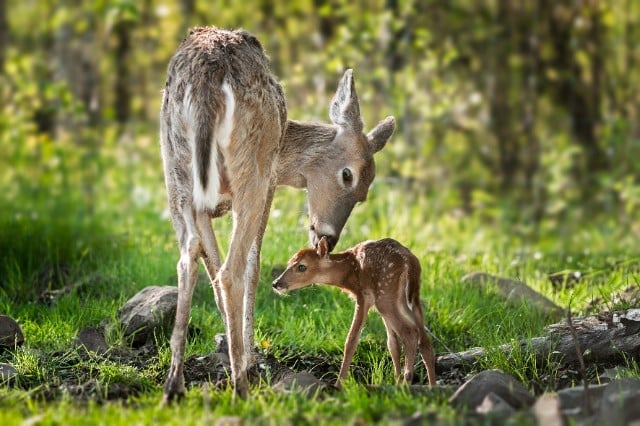
Gestation is about 200 days (published ranges run roughly 187–222). Fawns drop in late May and June across most of the United States. A first-time mother usually has one; a healthy adult doe on good feed usually has twins; triplets happen in well-fed herds. That is the whole answer most people need; the numbers, age effects, and exceptions are on how many fawns do deer have.
A newborn is called a fawn. Birth weights in the FEIS synthesis run about 4.4–14.6 pounds for males and 3.5–8.6 pounds for females, with singletons heavier than twins. They can stand within hours. For the first weeks they do not follow the doe. She beds them apart, visits a few times a day to nurse, and eats their waste so the bed does not smell. The spots are camouflage, not decoration; that mechanism is on why fawns have spots. The spots fade with the first winter coat — see when fawns lose their spots.
If you find a fawn alone, it is probably not abandoned. Leave it. The how-to, and the few cases that do need a call to a rehabilitator, are on what to do if you find a fawn. The naming question — fawn, not “baby deer” as a technical term, and not Bambi as a sex — is what is a baby deer called. A female is a doe; that vocabulary is on what is a female deer called.
Fawns nurse for eight to ten weeks and stay with the doe into the next year. Young bucks usually leave as yearlings; many young does stay longer. That dispersal of yearling bucks is one reason a neighborhood can grow a new buck every fall even if nobody “has deer.”
Antler cycle
Only males grow antlers in this species, with rare documented exceptions. If you are looking at a female with a rack, read do female deer have antlers before assuming she is a different animal. Reindeer are the deer in which both sexes routinely grow them; whitetails are not.
The annual cycle, in the North:
- Late winter. Hard antlers drop. Timing runs January through March, earlier for many mature bucks, later for some yearlings. Why they drop is a testosterone story; the page for that is why deer shed their antlers. Finding the sheds is shed antlers.
- Spring. Growth starts. Pedicles swell; velvet-covered bone grows fast. Calendar: when deer start growing antlers.
- Summer. Velvet supplies blood. Diet and age set the ceiling, not the number of points alone. Antlers do not automatically get bigger every year; nutrition and injury matter. See do deer antlers get bigger each year and the overview at deer antlers.
- Late summer to early fall. Bone hardens; velvet is rubbed off. Velvet shedding is a few days of messy, itchy work, not a season.
- Fall. Hard antlers are tools for rank and for the rut, not a precise age tag. A spike can be a yearling or a poorly fed older buck.
They grow back. That is the definition of antlers as opposed to horns. The short version is on do deer antlers grow back.
Predators
A healthy adult whitetail in farm country has fewer natural predators than the same species had in 1800. That is not the same as having none. The list, and who actually kills fawns versus adults, is on what eats deer.
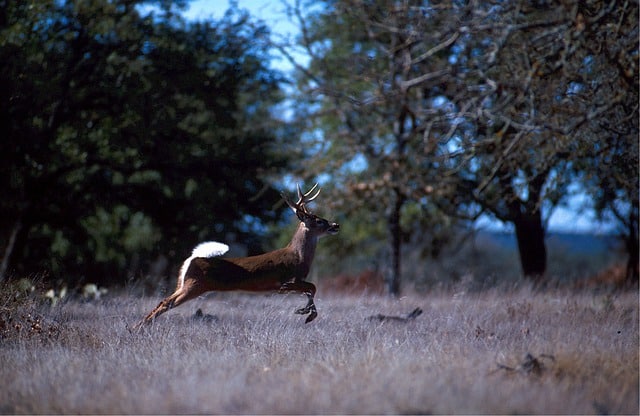
Gray wolves still take deer where wolves remain: the Upper Midwest, the northern Rockies, parts of Canada. Coyotes kill fawns everywhere in the range and some adults, especially in deep snow or poor condition. Mountain lions take deer in the West and, increasingly, in recolonizing pockets of the East. Black bears prey on fawns in spring. Bobcats take fawns. In the South, alligators take deer that come to water. In the Neotropics, jaguars are still on the list. Dogs, including free-ranging pets, kill fawns and chase adults.
The deer’s answers are smell, speed, and the white flag. Animal Diversity Web cites bounds of about 30 miles per hour through cover. They swim well and will take to water to put a barrier behind them. Fawns freeze. Adults snort, stomp, and leave. The flag is both an alarm to other deer and a “I see you, chase is pointless” signal to a predator; the behavior page is why deer have white tails.
People now kill more white-tailed deer than any wild predator does. That is management, not a footnote, and it belongs in the next section rather than in a hunt pamphlet wrapped around this page.
People: hunting, yards, roads, and disease
White-tailed deer are the most hunted big-game animal in the United States. The National Deer Association’s 2026 Deer Report (data from the completed 2024–25 season) recorded 6,194,659 whitetails harvested — 3,047,741 antlered bucks and 3,146,918 antlerless deer. That harvest is the fifth-highest in the modern record and the highest since 2020. Texas still holds the largest estimated herd the NDA could compile, at just over 5 million; Wisconsin’s estimate was 2.1 million. Those figures are agency estimates, not a census, and several states did not report a population number, so there is no honest single “North American total” to put in a box.
In the Texas Hill Country the same pasture can hold native whitetails and introduced axis deer. Spots on an adult, a dark dorsal stripe, and year-round hard antlers are axis, not a late fawn — the side-by-side is axis deer vs. whitetail deer.
Hunting here is how most states keep a highly productive deer population from eating itself out of cover and out of the next winter. It is not the only tool, and it is not the subject of this page. The how-to hub is deer hunting. For a single-state picture of how that plays out on the ground — farm country, the Upper Peninsula, public forest, and suburban units — use Michigan deer hunting rather than treating this species profile as a season guide. Michigan is typical of the Midwest problem set: too many deer in some agricultural and suburban units, harder hunting in big woods, and a public that meets deer as often on a road as in a stand.
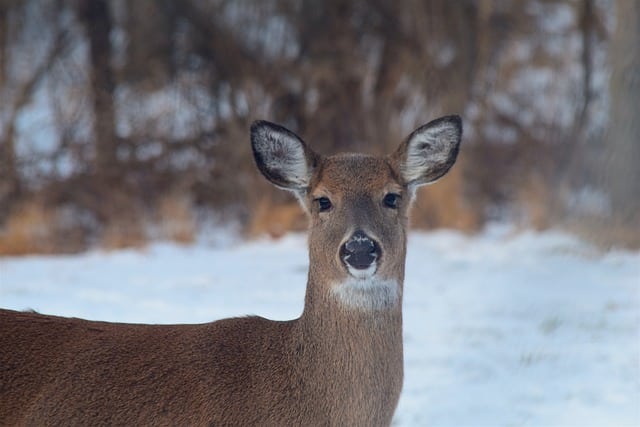
In towns the conflict is browse and glass. A doe and two fawns can unmake a perennial bed in a night. The plants they prefer are not a mystery: hostas, tulips, daylilies, roses, yews, arborvitae. Repellents buy time. Eight-foot fences and unpalatable planting keep it. That is the job of deer-proof garden, not of this encyclopedia entry.
On roads, the conflict is kinetic. Whitetails are crepuscular; most collisions happen at dusk, dawn, and after dark in fall, when the rut puts bucks on their feet in daylight they would otherwise skip. If you hit one, the practical sequence — safety, reporting, insurance, what not to do with a carcass — is what to do if you hit a deer.
Disease is the long problem. Chronic wasting disease is a prion disease of cervids, fatal, and now present in much of the core whitetail range. You cannot diagnose it from a truck window with certainty, but the field signs and the testing logic are on CWD deer symptoms. Hemorrhagic diseases (EHD and bluetongue) kill deer in late-summer outbreaks, especially along rivers after a dry spell. Deer also host blacklegged ticks. They do not “give you Lyme” the way a cartoon would have it: the bacterium cycles through ticks and reservoir hosts, with deer as a major tick-transport animal. Clearing deer does not automatically clear Lyme; treating the ecology as a single villain does not match the research.
Lifespan in the wild is short for most individuals. Animal Diversity Web puts typical wild life at about two to three years, with few past ten and a documented wild maximum around 20. Hunting, winter, vehicles, and coyotes remove the young and the old first. Captive deer live longer. The broader deer-family numbers are on how long deer live; weights across species are on how much a deer weighs.
White-tailed deer compared with other deer
If you are booking a western mule hunt instead of a Midwest farm-timber sit, the tag, terrain, and shot-window comparison is on mule deer vs. whitetail deer.
Six comparisons already exist on this site. Use them instead of a second species page:
- Mule deer vs. whitetail deer — the native western lookalike. Tail, ears, antlers, gait, and habitat. If you hunt or watch deer west of the Missouri, start there.
- Blacktail deer vs. whitetail deer — different species, almost no shared range. The Pacific-coast blacktail hunt is not a whitetail hunt with rain.
- Axis deer vs. whitetail deer — the spotted exotic. Adult axis (chital) keep their spots; adult whitetails do not. Axis are established in Texas and a few other places.
- Sika deer vs. whitetail deer — not a close relative. Sika are Asian Cervus, kin to elk, and they bugle. The U.S. overlap is mainly Maryland’s Eastern Shore.
- Fallow deer vs. whitetail deer — the palmate-antlered European exotic. Adult fallow keep spots (and four color morphs); adult whitetails do not. Overlap is mostly Texas ranches.
- Deer vs elk — elk are much larger, herd animals with a straw rump and a September bugle. Not a lookalike.
Within the species, treat Key deer and Coues deer as subspecies pages, not as separate wild species. They are white-tailed deer with a geography problem — islands in one case, desert mountains in the other.
FAQ
These questions already have their own pages. The lines below are the pointer, not a rewrite.
How many fawns do white-tailed deer have?
One for most first-time mothers; twins for a healthy adult doe; triplets on excellent feed. Full numbers and the nutrition effect: how many fawns do deer have.
What is a baby deer called?
A fawn. A female is a doe; a male is a buck. Vocabulary and the exceptions: what is a baby deer called.
Why do fawns have spots?
Camouflage. The white spots break up the outline of a bedded fawn in dappled light. They are not retained into adulthood in this species. Mechanism: why fawns have spots. Timing of the molt: when fawns lose their spots.
Do female white-tailed deer have antlers?
Almost never. Antlered does occur as rare hormonal or genetic exceptions. The rule, the exceptions, and how that differs from reindeer: do female deer have antlers.
How much does a white-tailed deer weigh?
It depends on sex, age, and latitude. Typical adults fall roughly between 90 and 300 pounds; Key deer are much lighter. Across-species table: how much does a deer weigh. Newborns: how much does a fawn weigh.
What should I do if I find a fawn?
Leave it unless it is clearly injured or the doe is known dead. A lone bedded fawn is normal. Step-by-step: what to do if you find a fawn.
Sources
- Gallina, S. and Lopez Arevalo, H. 2016. Odocoileus virginianus. The IUCN Red List of Threatened Species 2016: e.T42394A22162580. Least Concern; population trend stable. Assessed 20 June 2015.
- Innes, Robin J. 2013. Odocoileus virginianus, white-tailed deer. Fire Effects Information System, U.S. Forest Service. Taxonomy, distribution, reproduction, diet, predators, home range.
- Dewey, T. 2003. Odocoileus virginianus. Animal Diversity Web, University of Michigan. Shoulder height 80–100 cm; mass 57–137 kg; gestation; lifespan.
- U.S. Fish and Wildlife Service. Key deer (Odocoileus virginianus clavium). Shoulder height, weights, range, Endangered status.
- U.S. Fish and Wildlife Service. 9 September 2025. Columbian white-tailed deer: a conservation comeback. Columbia River DPS estimate (~1,354) and recommended delisting; listing still in force at time of that review.
- National Deer Association. January 2026. 2026 Deer Report. 2024–25 U.S. harvest 6,194,659; state population estimates including Texas 5,045,119 and Wisconsin 2,100,000.
Updated on September 7, 2026




