
Updated on September 7, 2026.
| Blacktail deer | White-tailed deer | |
|---|---|---|
| Size | Columbian blacktail bucks commonly 100–200 lb live; Sitka often 100–150. NDA: adult bucks average up to about 140 lb. Compact, built for brush. | Typical adults about 90–300 lb. Northern farm bucks can exceed that; Key deer bucks 55–75 lb. Longer-legged, built for edges. |
| Range | Pacific coast only: coastal California through western Oregon and Washington into B.C.; Sitka blacktails in southeast Alaska. East of the Cascade–Sierra crest they become mule deer, not whitetails. | Southern Canada through most of the U.S. into Central America and northern South America. No native California hunt. In WA/OR they live east of the Cascades, plus two tiny Columbian-whitetail pockets west of the crest. |
| Habitat / season | Coastal forest, clearcuts, salal, poison oak. Washington 2026 modern-firearm blacktail general: Oct. 17–Nov. 1 west of the crest. California A-zone opens in midsummer heat. | Woods, farms, suburbs. Washington 2026 modern-firearm whitetail general: Oct. 17–30 in northeast GMUs 101–124. Midwest seasons run into the November rut. California has no whitetail hunt. |
| Pressure | High on easy two-tracks and the A-zone August opener. Low on steep brush a quarter-mile off the road. A mature buck may live in one drainage and be seen a handful of times. | High wherever people live. This is the deer in headlights, gardens, and opening-morning parking lots. Collision risk is a real mortality source, not a footnote. |
| Who it is for | Still-hunters who accept rain, 40-yard shots, and a deer that will not walk a bean-field lane. If you want the Pacific-coast hunt, start with Washington, Oregon, or California — not a Midwest lease. | The default North American deer. Stand hunters, farmland, suburbs, and almost every state east of the Rockies. If you want a whitetail trip, pick a state page, not a coastal motel. |
| Stay implication | Base on the wet side: Forks or Port Angeles for the Olympics, Brookings for the Oregon coast, Ukiah for California A-zone brush. Roseburg if you are in Umpqua country. Cathlamet if the trip is to see Columbian whitetails, not to shoot a blacktail. | A whitetail trip is a different map. Do not book Ukiah or Forks for a white-tailed deer. Use the state guides under deer hunting by state and sleep where that hunt actually happens. |
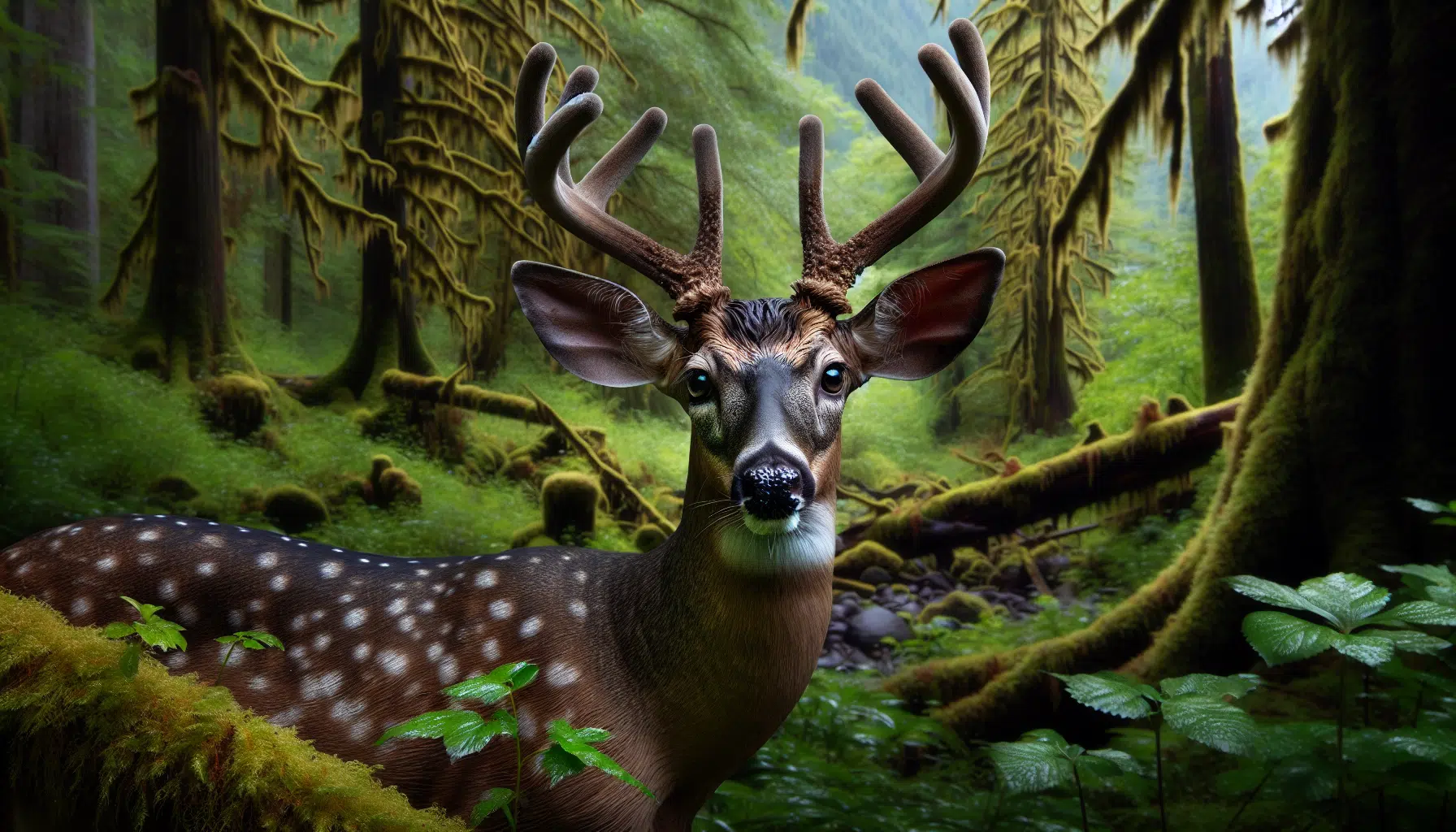
Blacktail deer and white-tailed deer are not two names for the same animal. Columbian Odocoileus hemionus columbianus and Sitka O. h. sitkensis are coastal subspecies of mule deer. White-tailed deer are a different species, Odocoileus virginianus. Tail, antlers, gait, and map all disagree. The white-tailed deer profile is the biology page; this page is the decision: which deer you are looking at, and which trip you are booking.
I grew up on Missouri and Illinois whitetails. The first blacktail I hunted was not a dark-tailed version of those bucks. It was a different sport: salal in the face, a 30-yard window, and a deer that does not flag. If you came from blacktail vs mule deer, you already know those two are the same species. Whitetails are the other Odocoileus. That split changes a tag, a rifle setup, and a motel town.
Three differences that change a decision
1. The map, not the coat
People mix these two up because both are medium brown deer with antlers. The useful fact is geographic. California Department of Fish and Wildlife manages two deer subspecies: black-tailed deer and mule deer. There is no native white-tailed deer hunt. An A or B zone tag is a blacktail. That hunt: deer hunting in California.
Washington draws a legal line. Under WAC 220-415, a black-tailed deer is any Odocoileus hemionus west of the Pacific Crest Trail (then the Yakama boundary and the Klickitat to the Columbia). East of that line you are in mule deer and white-tailed deer country. Northeast Washington — Pend Oreille, Stevens, Ferry, Colville — is a whitetail hunt. The 2026 modern-firearm table: blacktail Oct. 17–Nov. 1 in western GMUs; white-tailed deer Oct. 17–30 in GMUs 101, 105, 108, 111, 113, 117, 121, and 124. Statewide: Washington State deer hunting.
Oregon is the same west–east split, plus Columbian white-tailed deer in Douglas County and along the lower Columbia. Western Oregon is blacktail. Northeastern Oregon (Wallowa, Grande Ronde, the Blues) holds the ordinary northwest whitetail. Trip planning: Oregon deer hunting. Sitka blacktails in southeast Alaska are still hemionus. Hawaii’s Kauaʻi herd is an introduced Columbian blacktail, on deer hunting in Hawaii, not a whitetail page.
2. Tail, antlers, and the way it leaves
Where both could exist — rare — identification is a legal problem. ODFW publishes a side-by-side for Columbian white-tailed deer and blacktails because they share some western Oregon habitat. WDFW uses the same marks on the lower Columbia.
The tail is the name. A blacktail’s tail is wide and dark brown to black across most of the upper surface, white underneath, and it stays down when the deer runs. A whitetail’s tail is longer, brown on top, and it flags: white underside and rump as it bounds. That flag is the deer most Americans know from a road ditch. After a collision: what to do if you hit a deer — almost always a whitetail page, because that is the suburban deer.
Antlers follow the species line. Blacktails wear mule-deer architecture: the beam forks, and the forks can fork again. Whitetail tines rise unbranched off a single main beam that sweeps out and forward. Boone and Crockett keeps them in separate books. Awards / all-time typical minimums: Columbia blacktail 125 / 135, Sitka blacktail 100 / 108, whitetail 160 / 170. Do not score a coastal blacktail against a Wisconsin whitetail and call it small. Different category on purpose.
Gait is the third mark. Blacktails, like other mule deer, often stot — a stiff-legged bounce. Whitetails gallop and flag. Ears sit between a whitetail’s and a Rocky Mountain mule deer’s. The metatarsal gland is long and dark on blacktails, a small round patch on whitetails. ODFW and WDFW put that gland on the ID card because a wrong shot at a Columbian whitetail in the Umpqua or on the Columbia bottoms is not a “close enough” story.
3. The hunt does not translate
A Pike County, Illinois, sit over a bean field is a white-tailed deer hunt. An August walk through Mendocino manzanita is a blacktail hunt. Packing one plan into the other is how you go home with groceries.
Blacktails live in cover measured in feet. Still-hunt, rattle less, shoot shorter, and accept that a buck may live in a couple of square miles of salal. Rain is the weather, not a cancellation. California’s A-zone rifle opener is heat and poison oak, not a November rut sit. Western Washington and Oregon general seasons are October into early November on industrial-forest gates and national-forest two-tracks. Woods how-to: public land deer hunting.
Whitetails are the edge animal: farms, suburbs, oak flats. Stands, food plots, November rut, rattling that actually works. They are also the collision species and the garden species. Diet overlap with people is a whitetail problem in most of the country; wild diet: what do deer eat. Choosing a state: deer hunting by state, not a blacktail motel in Forks. The Rockies lookalike is a mule deer even though it shares a species with the blacktail: mule deer vs whitetail. Do not collapse all three into “western deer.”
Where they actually overlap
Almost nowhere. That is the fact most comparison articles bury under a coat-color paragraph.
The honest overlap is the Columbian white-tailed deer (O. v. leucurus), the westernmost whitetail subspecies. Two populations:
- Douglas County, Oregon (Umpqua). Delisted from the federal Endangered Species Act in 2003. ODFW has run controlled hunts on the North Bank Habitat Management Area since 2006. This is the one western-Oregon place a hunter can legally be looking at both a blacktail and a Columbian whitetail on the same trip. Use the ODFW identification graphic before the season, not after a shot.
- Lower Columbia River. Islands and mainland in Clark, Cowlitz, and Wahkiakum counties, Washington, and Clatsop, Columbia, and Multnomah counties, Oregon. Federally threatened (downlisted from endangered in 2016). USFWS estimated about 1,354 deer in this DPS in 2025 and recommended delisting; that is not a final rule. Washington still lists them as state-threatened. No general season. WDFW’s 2026 pamphlet: Columbian white-tailed deer cannot be harvested, including animals around Ridgefield NWR and GMU 564. The refuge town is Cathlamet. You go there to see them, not to tag them.
Outside those pockets, “both species in Oregon or Washington” usually means you crossed the Cascades. West side: blacktail. East side: mule deer and, in the northeast, white-tailed deer. A hunter in Colville is not hunting the same deer as a hunter in Forks.
Hybrids exist. Blacktails hybridize freely with mule deer along the Cascade crest — same species, expected. Whitetail × blacktail and whitetail × mule deer hybrids are documented but uncommon; survival of those crosses is poor compared with the blacktail–mule mix. Do not use “they can hybridize” as a reason to skip identification. In the Columbia bottoms it can be a listed animal.
If you are choosing a trip
Choose the deer first. The town follows.
If the deer is a Columbian blacktail, sleep on the wet side. Forks, WA and Port Angeles, WA put you on Olympic Peninsula timber; grocery and a processor matter more than a waterfront view. Brookings, OR is the south-coast blacktail base. Roseburg, OR is the Umpqua hub: blacktails in the hills, and the only western-Oregon place a legal Columbian-whitetail controlled hunt exists. Ukiah, CA is the A-zone town I actually use — August heat, poison oak, OTC tag. Cathlamet, WA is the Columbia River watch-town for Columbian white-tailed deer around Julia Butler Hansen Refuge. Not a blacktail camp, and not a place you book to shoot a whitetail.
If the deer is a white-tailed deer, do not book those towns. Fly toward the state you actually drew or drove to. The species encyclopedia sits under deer species. The hunt encyclopedia starts at deer hunting by state.
FAQ
Are blacktail deer and whitetail deer the same species?
No. Blacktails are subspecies of mule deer (Odocoileus hemionus). Whitetails are Odocoileus virginianus. Same genus, different species. Blacktails and mule deer interbreed along the Cascade crest because they are the same species. Coastal-versus-interior split: blacktail deer vs mule deer.
Where do blacktail and whitetail ranges overlap?
Barely. The real overlap is Columbian white-tailed deer in the Umpqua basin (Douglas County, Oregon) and along the lower Columbia River in southwest Washington and northwest Oregon. Ordinary white-tailed deer in Washington and Oregon live east of the Cascades, where the west-side deer is a mule deer, not a blacktail. California has blacktails and mule deer, not a native whitetail hunt.
Can I hunt both in Washington, Oregon, or California?
California: blacktail (and mule deer), no white-tailed deer season. Washington: blacktail west of the crest, white-tailed deer in the northeast (and some other eastern units), no hunt for the listed Columbian white-tailed deer on the lower Columbia. Oregon: blacktail west, ordinary whitetails in the northeast, plus tightly controlled Columbian-whitetail opportunity in Douglas County. Confirm the current pamphlet before you buy a tag. Seasons move.
How do I tell a Columbian whitetail from a blacktail in western Oregon or Washington?
Tail first: brown and flagging on the whitetail, blackish and held down on the blacktail. Then antlers (main-beam tines versus forked mule-deer antlers), white eye rings on the Columbian whitetail, smaller ears, and a small round metatarsal gland versus a long dark one. ODFW’s identification article exists because hunters have mixed them up. On the Columbia River, a Columbian whitetail is still federally threatened. Do not shoot and then argue taxonomy.
Sources
- California Department of Fish and Wildlife. Deer. Two subspecies in California: black-tailed deer (O. h. columbianus) and mule deer (O. h. hemionus).
- Washington Administrative Code 220-415. Legal definition of black-tailed deer west of the Pacific Crest Trail; 2026 general-season date bands.
- Washington Department of Fish and Wildlife. 2026 Big Game Hunting Seasons and Rules and the 2026 deer general seasons table. Blacktail Oct. 17–Nov. 1; white-tailed deer Oct. 17–30 in GMUs 101–124. Columbian white-tailed deer not legal to harvest.
- Washington Department of Fish and Wildlife. Columbian white-tailed deer. State-threatened; federal ESA threatened on the lower Columbia.
- U.S. Fish and Wildlife Service. 9 September 2025. Columbian white-tailed deer: a conservation comeback. Columbia River DPS ~1,354 (2025); delisting recommended, not final. Douglas County population delisted 2003; Columbia River downlisted endangered → threatened in 2016.
- Oregon Department of Fish and Wildlife. Identifying Columbian white-tailed and black-tailed deer. Field marks and North Bank Habitat Management Area hunts since 2006.
- Boone and Crockett Club. Minimum entry scores. Typical Columbia blacktail 125 / 135; typical Sitka blacktail 100 / 108; typical whitetail 160 / 170 (Awards / All-time).
- IUCN Red List. Odocoileus virginianus. Least Concern; range through the Americas.
- National Deer Association. January 2026. 2026 Deer Report. Adult blacktail bucks average up to ~140 lb; 2024–25 U.S. deer harvest context.
Parent hub: deer species. Related compares: blacktail vs mule deer, mule deer vs whitetail, axis vs whitetail, sika vs whitetail.


