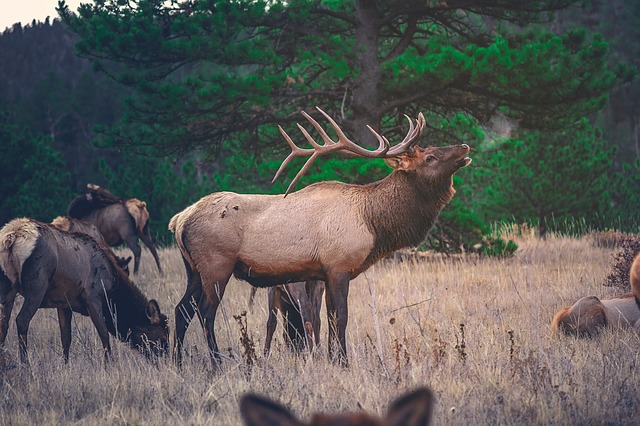
Elk are deer — the second-largest living member of the family Cervidae — but the animal most North Americans mean by “deer” is a white-tailed deer. A typical Yellowstone bull elk stands about five feet at the shoulder and weighs about 700 pounds; a typical adult whitetail stands 32 to 40 inches and weighs 126 to 302 pounds. Size, the straw-colored rump, and the September bugle are the fastest tells.
Updated on September 7, 2026.
This page is the side-by-side. The full species profiles live on elk and white-tailed deer. If the animal in front of you is palmate-antlered and horse-high, that is a moose — use elk vs moose instead. If it is a European red stag, use red deer vs elk.
| Feature | Elk (wapiti) | White-tailed deer |
|---|---|---|
| Size | Bulls about 5 feet at the shoulder | Typical adults 32–40 inches at the shoulder |
| Weight | Bulls about 700 lb; cows about 500 lb; calves about 30 lb at birth | Typical adults 126–302 lb; fawns about 3–6 lb at birth |
| Range | Western mountains of the U.S. and Canada, plus reintroduced eastern herds | Southern Canada through most of the U.S. into Central and northern South America |
| Habitat | Meadows, parkland, montane forest; many herds migrate seasonally | Forest edge, farmland, suburbs, swamps; home ranges often about a square kilometer |
| Social / voice | Herds; bulls bugle in September–October and hold harems | Small groups; quiet grunts and snorts; bucks tend one doe at a time |
| Who this is for | ID in the Rockies or a national park; elk tag vs deer tag; collision mass | The default “deer” east of the plains, and most highway strikes |
Numbers in the table wear sources at the bottom of this page. Size in both species moves with latitude and subspecies: a Roosevelt bull on the Olympic Peninsula is a different animal from a Tule elk in California, and a Key deer is a white-tailed deer that would stand under a northern farm buck’s chest.
Three differences that actually change a decision
1. Size, and what that does to a hunt or a car
Yellowstone’s field card is the cleanest public number: bulls about 700 pounds and about five feet at the shoulder; cows about 500 pounds and shorter; calves about 30 pounds at birth. A typical healthy bull grows antlers 55 to 60 inches long, just under six feet wide, about 30 pounds the pair. Adult white-tailed deer, on Animal Diversity Web, stand 80 to 100 cm (32 to 40 inches) at the shoulder and weigh 57 to 137 kg (126 to 302 pounds). A six-month elk calf is already in the weight class of a grown whitetail doe.
That gap changes gear, meat, and recovery. An elk hunt is a packing problem. A deer hunt in farm country is often a drag to the truck. On the road, mass is the difference between a salvageable bumper and a totaled vehicle; if you hit either animal, start with what to do after you hit a deer rather than guessing from a forum. How fast they can close that gap is on how fast elk run and how fast deer run — do not treat those child pages as the same number.
2. Range, tags, and whether both animals even live there
White-tailed deer occupy almost the entire inhabited map of the United States. The IUCN range note runs from southern Canada through Mexico into northern South America. They are rare or absent in a handful of arid western states; everywhere else, “deer” is this species. The National Deer Association’s 2026 Deer Report puts Texas alone above 5 million animals (5,045,119) and Wisconsin at 2.1 million. U.S. hunters took 6,194,659 whitetails in the 2024–25 season. That is not an elk number. Elk do not live in that density on that map.
Elk today are a western mountain animal with a few reintroduced eastern herds. Yellowstone holds 10,000 to 20,000 in summer across six or seven herds, and fewer than 2,000 inside the park in winter; the Greater Yellowstone Ecosystem holds about 30,000 to 40,000. State-by-state counts belong on elk population by state, not here. If you are planning a Colorado public-land deer hunt, elk may share the same forest on a different license — that split is on Colorado deer hunting. Do not pack an elk tag plan onto an Ohio deer opener, and do not assume a Yellowstone meadow is a whitetail hunt.
3. Herds and bugles versus a quiet, small home range
Elk are social. Cows, calves, and yearlings run in herds. Bulls gather harems in September and October and announce themselves with a bugle you can hear from a long way off. The call, the timing, and the mistakes people make trying to imitate it live on elk bugle sound. Many Rocky Mountain and Roosevelt herds also migrate between high summer range and lower winter range. That is a trip, not a woodlot.
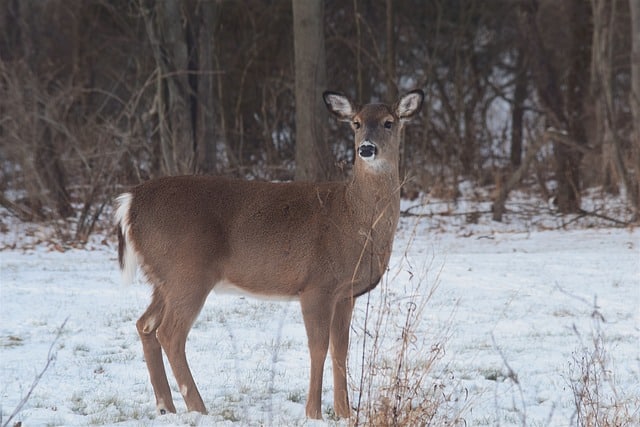
White-tailed deer are the opposite working animal. Animal Diversity Web puts a typical home range at about a square kilometer or less. They do not hold harems. A buck tends one doe, then another. The sounds you actually hear are grunts, bleats, and an alarm snort; the visual signal is the raised white tail. Diet is browse-heavy and local — buds, twigs, forbs, crops — which is why the same species is a garden pest in the suburbs and a woodland deer two miles away. What they eat, season by season, is on what a white-tailed deer eats. Elk graze more grass and forbs in the open and still browse; the menu that builds 700-pound bulls is on what elk eat.
Elk are deer. “Deer” is not one species.
Among the world’s deer species, elk sit in the Old World genus Cervus as Cervus canadensis. White-tailed deer sit in the New World genus Odocoileus as Odocoileus virginianus. They cannot hybridize. Elk can hybridize with red deer in captivity, which is why ranch genetics get messy; that is a red deer vs elk problem, not a whitetail problem.
Two naming traps. First, in British and European English, “elk” means moose (Alces alces). North American elk are wapiti — a Shawnee word Yellowstone glosses as “white deer” or “white-rumped deer.” Second, people use “deer” for whatever cervid they grew up with. East of the plains that is a whitetail. In mule deer country it is often a mule deer. In a national park meadow in September it is often an elk. The animals are not interchangeable, and the licenses are not either.
How to tell them apart in the field
If you have a clear look, you will not need a table. Use this order.
Rump, tail, and coat
Elk of both sexes wear a light beige or straw rump patch and a short tail. The neck, head, belly, and legs run darker; in winter the neck hair thickens into a mane. Summer coats are more even reddish-brown. White-tailed deer have a long tail, brown on top, white underneath, and they raise it like a flag when they bolt. There is no straw rump panel on a whitetail. Adult whitetails are not spotted. Fawns are. If you are looking at spots on an adult in Texas, you may have an axis deer — that compare is already written.
Antlers
Only males grow them in both species. A typical mature bull elk is a six-by-six: a long main beam with tines coming off it, 55 to 60 inches long on a healthy Yellowstone animal. Whitetail bucks grow a main beam that sweeps out, up, and forward, with tines standing off that beam. The rack is smaller in mass and spread. Mule deer antlers fork (bifurcate) instead; if the confusion is mule versus whitetail, not elk, use mule deer vs whitetail.
Tracks
Whitetail tracks are the familiar split-heart print. Elk tracks are larger, rounder, and more parallel in the two halves — closer to a yearling cow than to a deer. Do not ID a species from one print in mud if the rest of the animal is still in front of you. Print shape, stride, and a size comparison live on deer tracks.
Calves and fawns
Elk cows usually drop a single calf in late May or June. Yellowstone puts birth weight at about 30 pounds. Whitetail does commonly have twins after the first pregnancy; Animal Diversity Web lists one to three young, averaging two, after a 6.5-month gestation, with newborns 1.5 to 2.5 kg (about 3 to 6 pounds). Litter size and nutrition belong on how many fawns do deer have, not in a longer paragraph here.
What about mule deer?
In the western United States the animal people call “deer” next to an elk is often a mule deer, not a whitetail. A mature Rocky Mountain mule buck commonly lands in the 150 to 300 pound band — still far below an elk. Ears, tail, gait, and antler fork belong on mule deer vs whitetail.
FAQ
Are elk a type of deer?
Yes. Elk are cervids, family Cervidae, species Cervus canadensis. They are not a separate family, and they are not moose. Moose are the largest deer; elk are second. The parent encyclopedia is types of deer.
Which is bigger, a deer or an elk?
An elk. A Yellowstone bull is about five feet at the shoulder and about 700 pounds; Great Smoky Mountains notes some bulls to 1,000 pounds and cows to 600. A typical adult white-tailed deer is 32 to 40 inches at the shoulder and 126 to 302 pounds. Northern farm-country bucks can be heavy for the species and still would not be mistaken for a cow elk standing next to them. More measurements: how big is an elk and how much a deer weighs.
Can you hunt deer and elk on the same trip?
Only where both species are legal on the unit you are standing in, and only with the right tags. Overlap is real in parts of the Rockies, the northern plains, and a few reintroduction states. Seasons, weapons, and quotas are not the same. Confirm the current table on that state’s wildlife agency page before you buy a second license. A deer tag does not harvest an elk.
Why do some people call a moose an elk?
Because in Europe, “elk” is the name for Alces alces — the animal North America calls moose. North American elk are wapiti. If the animal has a bell under the throat and palmate antlers, it is a moose. Side-by-side: elk vs moose.
Sources
- National Park Service, Yellowstone: Elk — bull and cow weights and shoulder height, calf birth weight, antler size, summer and winter counts, scientific name, European naming note, rut timing.
- National Park Service, Rocky Mountain: Elk — daily forage (~20 pounds), wild lifespan 10–13 years, calves ~30 pounds.
- National Park Service, Great Smoky Mountains: Elk — second-largest cervid; some bulls to 1,000 pounds, cows to 600; 4.5 to 5 feet at the shoulder.
- Animal Diversity Web: Odocoileus virginianus — shoulder height, mass, home range, litter size, gestation, 30 mph bound.
- IUCN Red List: White-tailed Deer — Least Concern; native range through the Americas.
- National Deer Association, 2026 Deer Report — Texas and Wisconsin population estimates; 2024–25 U.S. harvest of 6,194,659.
No single continent-wide elk head count is published here. Herd numbers move; they belong on the elk-population page and on the agency that counted them.
Related reading
Updated on September 7, 2026.