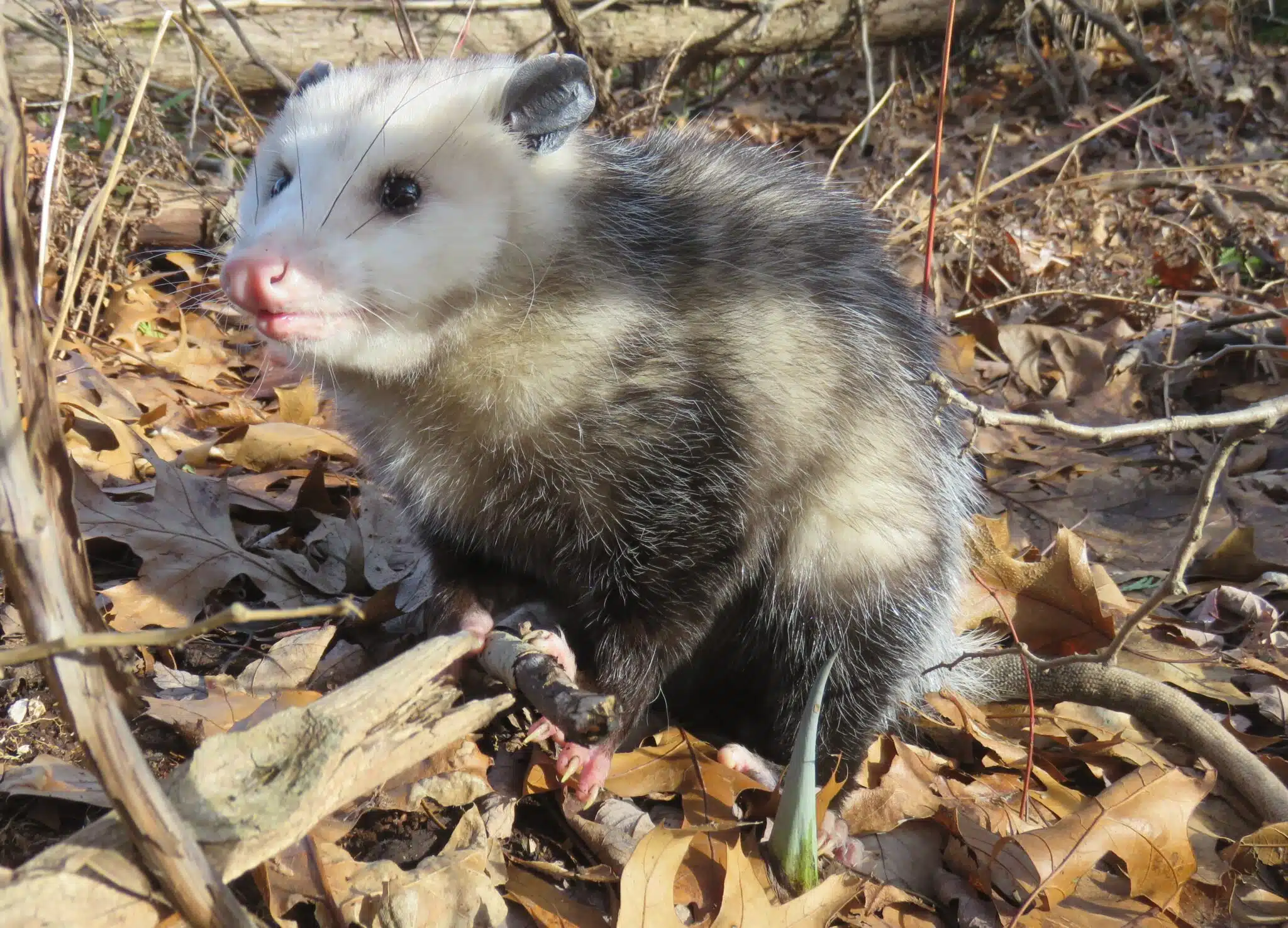
If you see a possum during the day, the answer is usually: nothing. Daytime opossum sightings are normal — cold weather, food scarcity, a disturbed den, or a nursing mother’s calorie needs all push healthy opossums into daylight — and unlike raccoons and skunks, a daytime possum carries almost no rabies implication. Keep pets back, leave the animal alone, and it will move on. The only sightings that call for action are an animal that’s injured, genuinely stuck, or showing real neurological signs — and “playing dead” doesn’t count.
The daytime-sighting alarm exists for good reason with some species: a stumbling midday raccoon or skunk deserves caution, because both are major rabies reservoirs. The opossum inherited that alarm without earning it. Here’s how to read a daylight possum correctly, what to do in each scenario you’re likely to meet, and the handful of situations that justify a phone call.
Why a Healthy Possum Is Out in Daylight
Opossums are nocturnal by preference, not by rule, and their daily budget forces exceptions more often than most nocturnal mammals:
- Winter economics. Opossums don’t hibernate, store no food, and wear thin fur with naked ears and tails that frostbite easily. On freezing nights, foraging shifts into the warmer daylight hours — a January or February daytime possum is the single most common version of this sighting, and it’s simply an animal balancing its books.
- A disturbed den. Opossums rotate among temporary dens; when a dog, a construction crew, or another animal rousts one at noon, it has to commute in daylight to the next option.
- Nursing mothers. A female with a pouch full of joeys — or a back covered in riders — needs calories around the clock and forages accordingly.
- Rich pickings. Trash day, fallen fruit, a neighbor’s outdoor pet-feeding schedule: opossums adjust their hours to reliable food like any sensible scavenger.
None of this reflects illness. The species’ famously low rabies incidence — often attributed to its low body temperature, though the mechanism isn’t settled — means the daytime-equals-rabid heuristic simply doesn’t transfer from raccoons to opossums; our guide to whether possums are dangerous walks through the full (short) risk list.
Season sets the odds. In the warm months, daytime sightings skew toward displaced animals and working mothers; from December through February they’re overwhelmingly about calories, and in northern states a sunny winter afternoon is practically opossum rush hour. If your sighting is a cold-season one, you can raise your confidence that nothing whatsoever is wrong from “high” to “nearly certain.”
What to Do, Scenario by Scenario
| What you’re seeing | What it likely means | What to do |
|---|---|---|
| Possum ambling across the yard at midday | Commuting or foraging, most often in cold weather | Nothing — keep dogs in for a few minutes and let it pass |
| Possum motionless with bared teeth, drooling | Involuntary ‘playing dead’ — a fear response, not illness | Walk away; it will recover and leave within minutes to a few hours |
| Possum in the garage, shed, or window well | Wandered in, can’t find the exit | Open the door, dim the lights, give it until evening; a rough plank ramp rescues window-well cases |
| Possum under the deck or porch | Temporary den; occupancy usually lasts days | Wait it out, then skirt the structure if you’d rather not repeat it |
| Small possum alone, less than about 7 inches (body) | Possibly orphaned joey | Call a licensed wildlife rehabilitator before intervening |
| Possum by a dead adult on the road | Joeys can survive in a dead mother’s pouch | If safe, report it to a rehabilitator — do not handle bare-handed |
| Circling, staggering, dragging limbs, unresponsive to noise | Injury or (rare) neurological illness | Keep everyone away; call animal control or a rehabilitator |
The through-line: the opossum handles almost every situation itself if given room and a few hours. It cannot jump, digs poorly, and sees badly in bright light, so a daylight opossum often looks more impaired than it is — squinting, slow, hesitant. Slow and squinting is the species; circling and collapse is a problem.
Healthy or Sick? A 30-Second Read
- Normal for the species: slow, deliberate walk; squinting in bright light; freezing in place when noticed; hissing or gaping if approached; keeling over motionless under real pressure. None of these is illness — this is just what an opossum looks like.
- Worth watching: visible injuries, heavy limping, an animal that stays in the open for many hours without moving on.
- Genuinely concerning: walking in circles, staggering or falling sideways, dragging hindquarters, twitching, complete indifference to loud noise at close range, or aggression without being cornered. These suggest injury, poisoning, or neurological disease — keep people and pets away and call animal control or a rehabilitator.
Notice that the concerning list is behavioral, not cosmetic. Opossums routinely look rough — ragged ears and kinked tail-tips from frostbite, scars, patchy fur — because they live hard, short lives. A beat-up-looking opossum walking competently is fine; a sleek one circling in the driveway is not.
The Playing-Dead Trap
The most consequential daytime mistake is misreading tonic immobility. A terrified opossum keels over into a state that imitates death with unsettling commitment: stiff or limp body, drawn-back lips, extruded tongue, shallow breathing, glassy eyes, and a corpse-like smell from its glands. People bag, bury, or dispose of these “dead” animals — sometimes with a pouchful of living joeys aboard. The rule: any intact, unmarked “dead” opossum in your yard gets a few undisturbed hours before you reach for the shovel. If it’s genuinely dead, nothing is lost; if it isn’t, it will be gone by evening. (An animal that is clearly injured or struck by a car is a different case — that’s a call to a wildlife rehabilitator or animal control, not a wait.)
Prevention beats every scenario above: close the garage at dusk, block pet doors at night, cover window wells, and cap the ground-level food supply — pet bowls, spilled seed, open compost — that writes your address into the neighborhood’s opossum route in the first place.
The one modern wrinkle worth adding: the doorbell camera has multiplied daytime possum “emergencies” without multiplying actual emergencies. A clip of a slow, squinting animal crossing the drive at 2 p.m. now travels the neighborhood group chat in minutes, usually gathering rabies speculation as it goes. If that clip is yours, you now know how to caption it: a healthy opossum, running errands in daylight for ordinary reasons, requiring nothing from anyone.
Found a Baby Possum?
Joeys ride in the pouch for about two months and then on the mother’s back, and the bumps of suburban life — dogs, fences, cars — regularly dismount one. A joey whose body (not counting tail) is shorter than roughly seven inches is unlikely to survive alone and needs a licensed wildlife rehabilitator; one longer than that is generally an independent juvenile that needs nothing but to be left alone. Two firm rules either way: don’t try to raise a joey yourself (it’s illegal without a permit in most states, and rehabber diets are hard to imitate — improvised feeding kills joeys), and don’t handle any opossum bare-handed. If you must move a joey out of immediate danger, use gloves or a towel, put it in a ventilated box somewhere dark and quiet, offer no food or milk, and make the call.
If the animal was carrying young, you may witness the strangest version of the rescue: a mother recovering from tonic immobility, gathering scattered joeys that crawled off during the episode. Give that scene the widest berth of all — she will collect them faster without an audience, and every joey that reboards is one that won’t need a rehabilitator.
Keeping the Encounter Uneventful
A daytime possum encounter goes wrong in only a few ways, all preventable. Hold the dog — dogs cause the vast majority of injuries in these meetings, nearly all of them to the opossum, though a defensive scratch is possible and any pet-wildlife contact merits a vet call. Don’t corner the animal against a wall or fence while “helping” it leave; an opossum with an exit uses it. Don’t feed it, which converts a passing visitor into a habituated regular. And resist relocation: beyond being unnecessary — opossums are self-limiting guests that move on within days — trapping and moving wildlife without authorization is restricted or illegal in many states, and relocated opossums fare poorly. If an animal genuinely must be removed, that’s what licensed wildlife control operators and rehabilitators are for.
It’s also worth remembering what the visitor is doing between sightings: patrolling for carrion, slugs, insects, and rodents on a route that includes your yard a few nights a week. The daytime cameo is the exception in a working life you otherwise never see — the same hidden-in-plain-sight quality as the raccoons sleeping out the day in dens a few properties away.
Common Questions About Daytime Possums
Does a possum out during the day have rabies?
Almost certainly not. Rabies is exceptionally uncommon in opossums — they account for a tiny share of rabid animals reported nationally — and daytime activity alone is not a rabies sign in any species, least of all this one. The signs that would actually warrant concern are neurological: circling, staggering, limb dragging, unprovoked aggression, or total unresponsiveness. Absent those, a daylight possum is a hungry possum.
Will a daytime possum hurt my dog or cat?
The risk runs overwhelmingly the other way. Opossums bluff, freeze, or flee; dogs injure or kill opossums routinely, while cats and opossums generally ignore each other. Bring pets in until the visitor moves on — a matter of minutes, usually — and if a scuffle does happen, check the dog for scratches and call your vet, mainly to discuss cleaning and leptospirosis coverage.
How long will a possum stay in my yard?
Hours, usually; days, occasionally. Opossums are semi-nomadic, rotating among several dens and rarely using one for more than a few consecutive nights. Even one denned under a deck typically relocates within a week on its own. If you want to speed the process, remove ground-level food and add light and noise near the den — and skirt the space with hardware cloth after it leaves.
What should I do with a possum that died in my yard?
First, be sure — give an unmarked animal a few quiet hours, because tonic immobility imitates death convincingly. A genuinely dead opossum should be handled like any wildlife carcass: gloves or an inverted bag, double-bag it, and follow your municipality’s disposal rules (many allow sealed household disposal; some prefer a pickup call). Check a dead female’s pouch region for movement first — surviving joeys are a real possibility, and a rehabilitator will take them.
Related Reading
- The Wonderful World of Opossums — the full portrait of the animal behind the sighting
- Are Raccoons Dangerous? — the daytime visitor that does warrant more caution