
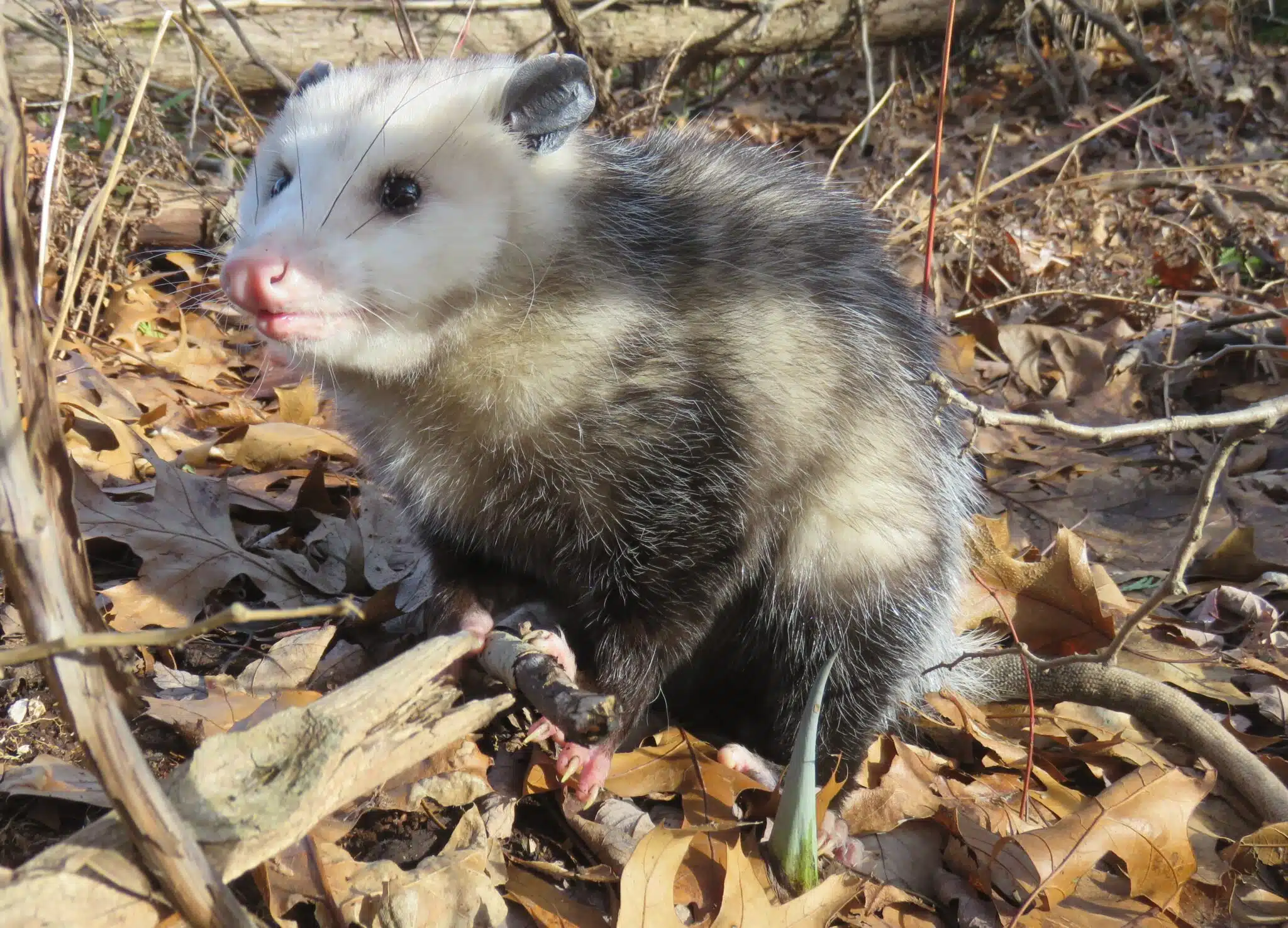
No — possums are among the least dangerous wild animals in North America. They rarely bite, they bluff rather than fight, rabies is exceptionally uncommon in opossums, and their response to real danger is to faint dead away rather than attack. The hissing, drooling, open-mouthed display that frightens people is theater from a slow animal with no other cards to play. The real (and modest) concerns are disease transmission to pets — particularly a parasite dangerous to horses — and basic wild-animal common sense: don’t handle them.
Few backyard animals suffer a worse gap between reputation and reality. The rat-like tail, the 50 teeth, the midnight compost raids — everything about the Virginia opossum reads as menacing, and nearly all of it is harmless. Here’s an honest accounting of what an opossum can and can’t do to you, your children, your pets, and your livestock.
The Scary Display Is a Bluff
Corner an opossum and it will gape, showing all 50 teeth, hiss like a leaky valve, and drool extravagantly. Every part of this is bluff. Opossums are slow, mild, and solitary; they can’t afford injury and know it. Wildlife rehabilitators handle them more casually than almost any other adult wild mammal for a reason: an opossum’s genuine repertoire is threat display, retreat, and — if neither works — involuntary collapse.
That collapse is the famous “playing possum.” It isn’t a decision. Under extreme threat an opossum drops into a catatonic state — limp body, lolling tongue, slowed breathing, eyes glazed, foul-smelling fluid from the anal glands — that can last from a few minutes to a few hours, and the animal has no more control over it than you have over fainting. The display is so convincing that well-meaning people bury or bag “dead” opossums that would have walked away by morning; give any apparently dead, unmarked opossum a few quiet hours before doing anything at all.
Why carry 50 teeth and never really use them? Because the opossum’s evolutionary bet is on defense by theater rather than force. The gape-and-hiss maximizes apparent ferocity at zero cost; the drool exaggerates the impression of sickness; and if the bluff fails, tonic immobility exploits the fact that many predators lose interest in prey that appears long dead and foul. It’s a survival strategy from an ancient lineage — the opossum family predates most modern carnivores — and it works well enough that the species has expanded its range northward for a century straight. None of it required being dangerous.
Do Possums Bite?
They can — anything with a mouth can — but opossum bites on humans are rare and almost always the result of handling: someone picking up a “tame” animal, hand-feeding it, or grabbing one to move it. An unhandled opossum walking through your yard poses essentially no bite risk to you or your children. The rule is the same as for all wildlife: watch, enjoy, don’t touch. If a bite does happen, wash it thoroughly with soap and water and call your doctor and local health department — standard practice after any wild-mammal bite, even from a low-risk species.
Rehabilitators also point out how the fear misreads the animal’s posture. An opossum that freezes and gapes at you is not squaring up — it’s stalling, hoping you’ll lose interest before its slow legs are put to the test. Take one step back and the standoff ends; the animal turns and waddles for the nearest cover at a pace that settles any question about its menace.
What About Rabies?
Here the opossum stands apart from its backyard neighbors. Any mammal can contract rabies, but opossums are found rabid only rarely — strikingly so compared with the true reservoir species. Researchers often point to the opossum’s low body temperature (around 94–97°F) as a poor environment for the virus, though the full explanation isn’t settled; what’s well documented is the outcome, with opossums making up a tiny fraction of rabid animals reported in the U.S. each year. Contrast that with raccoons, skunks, foxes, and bats — the CDC’s list of primary wildlife rabies reservoirs — covered in our guide to raccoon danger and rabies. None of this makes handling an opossum smart (rare is not never, and bites carry ordinary infection risks regardless), but a daytime opossum sighting should not trigger the rabies alarm a staggering raccoon would.
One myth worth retiring while we’re here: mother opossums don’t carry babies hanging from their tails, and adults don’t sleep hanging by them. The prehensile tail steadies climbs and hauls bedding material into dens like a fifth hand — a wonderful piece of equipment, but no hazard to anyone.
The Real Risks, Ranked
| Concern | Who’s at risk | How real is it? |
|---|---|---|
| EPM (Sarcocystis neurona) | Horses | The most serious opossum-linked disease: parasite eggs shed in opossum droppings can contaminate feed and cause neurologic disease in horses — keep feed rooms and hay sealed |
| Leptospirosis | Dogs, occasionally people | Bacterial infection spread via urine-contaminated water and soil; vaccination available for dogs |
| Fleas, ticks, mites | Pets and yards | Opossums carry ectoparasites like any wild mammal; routine pet flea/tick prevention covers it |
| Bites and scratches | People who handle them | Rare, defensive, handling-driven; essentially zero risk if you don’t touch |
| Rabies | Anyone bitten | Exceptionally uncommon in opossums, but any bite still warrants washing and a medical call |
| Property damage | Homeowners | Minimal — opossums dig little, chew little, and usually den a few nights and move on |
The EPM row is the one that changes behavior for a specific audience: horse owners. Equine protozoal myeloencephalitis is a genuinely serious neurologic disease, opossums are the parasite’s definitive host, and the practical defense is denying opossums access to feed — sealed grain bins, covered hay, pet food out of the barn, and water troughs cleaned regularly. If you keep horses, an opossum in the feed room is a real problem; everywhere else on the property, it’s a guest.
For everything in the table, ordinary hygiene does the heavy lifting: wash hands after outdoor work, keep pet vaccinations current, gloves for droppings or carcasses, and no bare-handed contact with any wild mammal. Any bite or scratch that does break skin gets washed thoroughly and mentioned to a doctor — not because opossums are high-risk, but because puncture wounds from any animal can infect, and tetanus status matters more than species.
Are Possums Dangerous to Dogs and Cats?
Face-offs between pets and opossums are common and remarkably bloodless. Cats and opossums generally ignore each other, sometimes eating from the same dish in shifts; an opossum won’t attack a cat, and most cats find a hissing, gaping opossum uninteresting. Dogs are the aggressors in nearly every real incident — a dog that grabs an opossum can injure or kill it, and can take defensive scratches or a bite in the process. Any pet wound from wildlife deserves a vet call, and dogs in opossum country should be current on leptospirosis vaccination where their vet recommends it. But the headline is the direction of the danger: in a dog-versus-opossum encounter, the animal at serious risk is the opossum.
Chickens sit in a middle category: opossums are mostly egg thieves, and a coop tight enough to stop raccoons is more than tight enough here — details in our full guide to the opossum diet.
It helps to see where the opossum sits among the animals sharing its shift. The raccoon is stronger, smarter with its hands, and a genuine rabies reservoir; the skunk carries both the rabies concern and a chemical deterrent; the opossum carries neither strength, spray, nor any meaningful rabies load. Of the three midnight regulars, it is unambiguously the safest to have around — which is worth remembering the next time the flashlight catches a white face and a hairless tail on the fence and your instincts vote otherwise.
Living with Possums: The Practical Rules
- Don’t handle opossums — not adults, not “abandoned” babies (call a wildlife rehabilitator; joeys found on a dead mother can often be saved by professionals).
- Don’t feed them, deliberately or via porch kibble and open garbage; a fed opossum is a resident opossum, and residency is where conflicts start.
- Supervise dogs at night if opossums frequent the yard — for the opossum’s sake more than the dog’s.
- Horse owners: seal all feed, hay, and grain against wildlife access.
- Leave a passing opossum alone — it patrols, cleans up, and moves on within days.
For a fuller sense of what these animals actually are — the continent’s only marsupial, a lineage older than the deer family, equipped with a pouch, a prehensile tail, and thirteen nipples — our profile of the wonderful world of opossums makes the case that the correct backyard response to an opossum is mild gratitude.
The scale of the non-threat is easiest to see from the other side of the ledger: cars, dogs, and winter kill opossums by the millions, and the species absorbs it with a short generation time and big litters. In every statistical sense, the dangerous crossing in a human-opossum encounter is the one the opossum makes — across our roads, past our pets, through our fences. We are the hazard in this relationship, and by a wide margin.
Common Questions About Possum Danger
Will a possum attack my child?
No documented pattern of such a thing exists. Opossums flee or freeze when approached; the only scenario that produces contact is a person cornering, grabbing, or hand-feeding the animal. Teach children the universal rule — observe wildlife, never touch — and an opossum in the yard is a zoology lesson, not a threat.
Is possum poop dangerous?
It’s the one output worth respecting, chiefly for horses: opossum droppings can carry the parasite that causes EPM, and can also harbor bacteria like leptospira and salmonella. Around barns, exclude opossums from feed entirely. In an ordinary yard, wear gloves, bag droppings, and wash up — the same sensible hygiene any wild-animal droppings call for, without the special alarm raccoon latrines deserve.
Are possums aggressive toward other pets like rabbits?
Opossums won’t tangle with anything that can fight back, but outdoor rabbits and poultry are prey-adjacent: a hutch or coop with gaps, unlatched doors, or flimsy wire invites nighttime investigation. Solid hardware-cloth construction ends the question for opossums — and for the raccoons and skunks working the same night shift.
Should I call someone about a possum in my yard?
Only if the animal is injured, tangled, or trapped somewhere it can’t leave, in which case call a licensed wildlife rehabilitator or your local animal control. A healthy opossum passing through needs nothing from you and will usually be someone else’s yard guest within the week. Wildlife regulations vary by state, and in most places opossums may not be trapped and relocated without authorization — one more reason the do-nothing option is usually also the legal one.
Related Reading
- What Do Possums Eat? — the scavenger diet behind the nighttime visits
- Are Raccoons Dangerous? — the neighbor that actually earns the rabies caution
- What Do Skunks Eat? — the third member of the backyard night shift