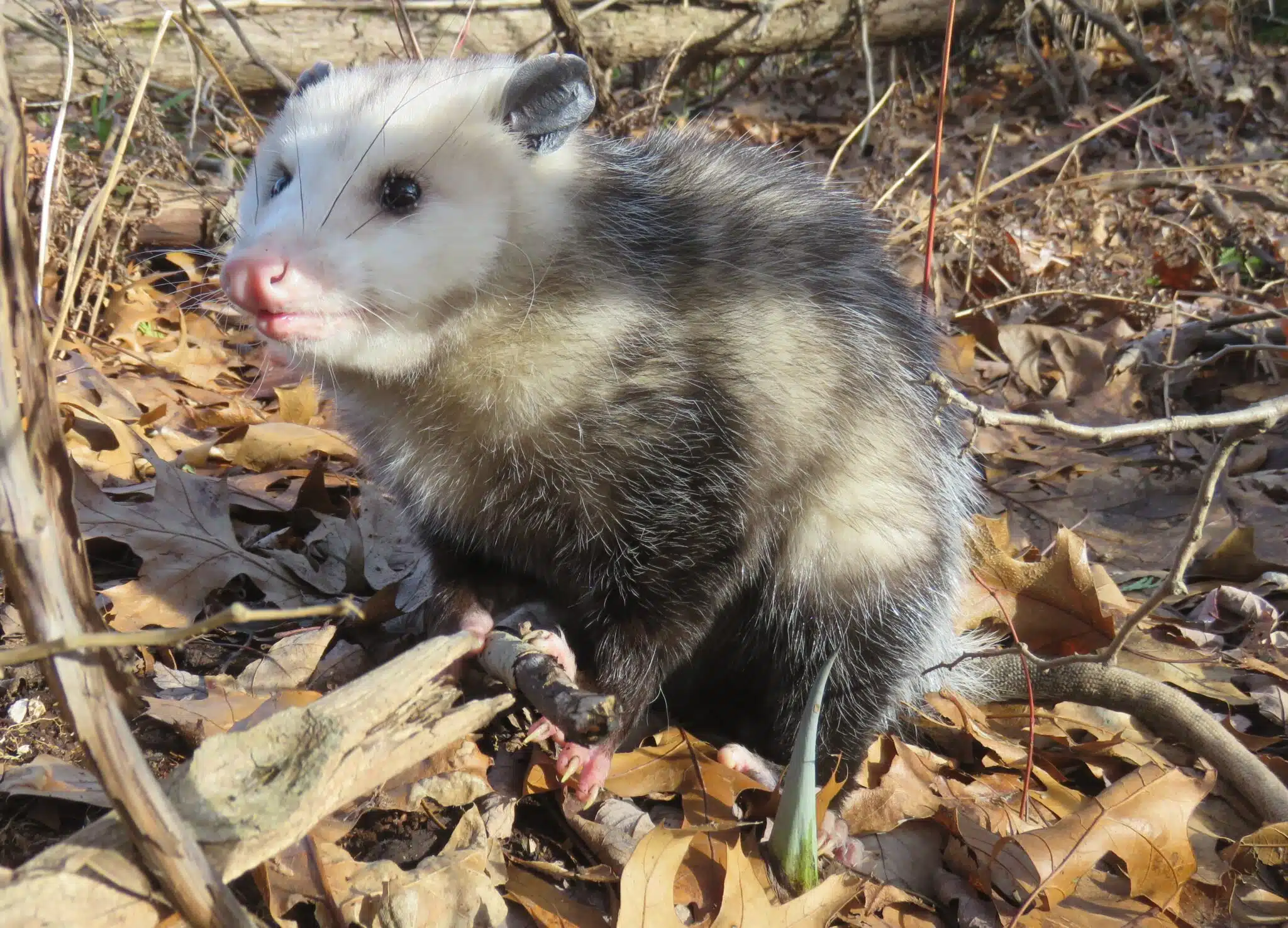
Yes — on balance, possums are good for your yard. They clean up carrion, fallen fruit, and food waste; they eat slugs, snails, beetles, and cockroaches; they take mice and voles; they kill venomous snakes; and they do almost no damage of their own — no serious digging, no plant destruction, no den commitment beyond a few nights. The famous tick-eating claim is shakier than the internet suggests, but the opossum doesn’t need it: the honest ledger still comes out well in the animal’s favor.
The Virginia opossum has undergone one of the great PR rehabilitations in backyard wildlife — from “giant rat in the trash” to social-media darling credited with vacuuming up ticks by the thousand. The truth sits between the old slander and the new hype. Here’s a clear-eyed audit of what an opossum actually contributes to a yard, what it costs, and how to be a good host if you decide you want one around.
The Case for the Opossum
Start with what an opossum is: a four-to-twelve-pound scavenging marsupial that patrols a nightly circuit of a mile or more, works alone, claims no permanent den, and lives fast — most wild opossums survive only a year or two. Every service below follows from that job description: an animal built to find and remove whatever the landscape leaves lying around, then move along before it wears out its welcome.
Sanitation: the night shift cleanup crew
Opossums are the suburb’s most underrated scavengers. Carrion, windfall fruit rotting under trees, spilled garbage, grease drippings, dropped sandwich — the opossum’s eat-anything diet means organic mess gets found and removed, usually the same night. Carcass cleanup in particular matters more than it sounds: fewer rotting attractants means fewer flies, less smell, and less draw for rats and other scavengers you’d like even less.
Pest control you can actually count on
Set ticks aside entirely and the pest-control résumé still reads well. Stomach-content studies consistently show heavy consumption of beetles, crickets, caterpillars, snails, and slugs — the last two being genuine garden villains with few other nighttime predators. Opossums also take mice and voles and raid their nests, and they kill and eat snakes, including copperheads and rattlesnakes, thanks to a well-documented natural resistance to pit-viper venom. A slow, methodical omnivore working your beds every few nights adds up over a season.
They’re self-limiting guests
The opossum’s third virtue is the one homeowners appreciate most in hindsight: they don’t move in. Opossums are semi-nomadic, rotating among borrowed dens — brush piles, hollow logs, spaces under sheds, old burrows — and rarely sleeping in the same spot more than a few consecutive nights. They don’t excavate, don’t chew wiring as rodents do, don’t establish latrines like raccoons, and don’t produce lingering odor like skunks. Most “opossum problems” resolve themselves in under a week because the opossum has already left.
The Tick Question, Handled Honestly
The claim: one opossum destroys 5,000 ticks a season. The source: a 2009 study in which captive opossums, dosed with larval ticks in a lab, groomed off and apparently ate the vast majority — the authors then extrapolated what that grooming rate could mean in the wild. The complication: when researchers in 2021 examined stomach contents of wild-caught opossums, they found effectively no tick remains, and follow-up commentary has left the question genuinely contested. The reasonable middle: opossums are meticulous groomers and certainly destroy some of the ticks that board them, but the 5,000 figure is a lab extrapolation, not a field count, and no one should adopt an opossum strategy as their Lyme-disease plan. If tick reduction is the goal, the proven levers are landscape management, host-targeted treatments, and repellents — with any opossum contribution as an unquantified bonus.
There is also a quieter, better-supported point buried under the viral tick number. In field research on Lyme disease ecology, opossums have repeatedly ranked among the least competent reservoir hosts for the Lyme bacterium — ticks that feed on opossums are less likely to pick up the infection than ticks feeding on mice and other small hosts. In landscape terms, an opossum on the nightly circuit is, at worst, a dead end for the pathogen. That’s a subtler service than “eats 5,000 ticks,” and unlike the headline number, it has held up.
The Case Against (Such as It Is)
| Drawback | How serious? | The fix |
|---|---|---|
| Raids pet food and garbage | Minor and universal among night visitors | Feed pets indoors; secure can lids |
| EPM parasite risk to horses | Serious for horse owners specifically | Seal feed, hay, and grain; exclude wildlife from the barn |
| Eggs stolen from coops | Occasional | Hardware cloth and closed pop doors — raccoon-grade security covers it |
| Dens briefly under decks/sheds | Cosmetic; they move on in days | Skirt structures if you’d rather not host anyone |
| May carry fleas into the yard | Same as any wild mammal | Routine pet flea/tick prevention |
| Startling encounters, hissing display | Harmless bluff | Give it space; it leaves |
Notice what isn’t on the list: aggression, rabies-level disease risk, structural damage, garden destruction. The genuinely serious row is EPM for horse owners — covered in detail in our guide to whether possums are dangerous — and it’s managed with feed hygiene rather than opossum removal, since new opossums simply replace removed ones on a landscape that feeds them.
One more entry for the credit column: opossums displace worse tenants. The niches an opossum works — carrion, garbage spill, fallen fruit — are the same ones that feed rats, and a yard whose organic waste gets cleaned nightly by a transient marsupial is a yard offering less to the rodents that would happily colonize it instead. No one should overstate this (rats thrive in plenty of opossum territory), but as neighbors go, the one that eats the mess and leaves beats the one that eats the mess and multiplies.
How to Be a Good Host (If You Want Possums Around)
- Leave wild structure: a brush pile in a back corner, a hollow log, unmanicured fence line — free lodging for a rotating guest.
- Skip the poisons: rodenticides and slug baits kill the animals that eat the poisoned pests; an opossum-friendly yard is an unpoisoned yard.
- Water helps: a ground-level birdbath or pond edge serves the whole night shift.
- Don’t put out food: feeding turns a healthy transient into a dependent regular and draws every other omnivore in the neighborhood; the wild yard is the whole gift.
- Drive gently after dark in opossum season — cars are the species’ great killer, and a scavenger that works road shoulders pays a heavy toll.
And if you’d rather not host? That’s legitimate too — the exclusion playbook is mild: remove ground-level food, skirt the deck with hardware cloth, and the naturally transient opossum simply keeps walking. Either way, the beds themselves are better protected from the animals that actually eat plants; our guides to keeping deer out of the garden and the deer-proof garden cover that battle.
A Year of Opossum Services
The contributions track the calendar. Spring: nest-season cleanup of winter’s carrion, plus early insect patrol as beds warm up. Summer: peak slug, snail, and beetle consumption in gardens, with mothers ferrying joeys along the fence lines. Fall: windfall-fruit removal that would otherwise feed wasps and rats, plus acorn and rodent gleaning. Winter: the season you’re most likely to actually see your opossum — cold-driven daytime foraging — and the season its scavenging matters most, when carcasses keep and other cleanup crews are denned up. A yard on an opossum rotation gets this cycle for free, year after year, from a rotating cast of animals you’ll rarely meet twice.
The Verdict
It’s fair to ask why, if opossums are this benign, the removal industry still fields calls about them. The answer is mostly mistaken identity and mistaken attribution: the opossum is the visitor people see — slow, white-faced, caught flat in the flashlight beam — while the raccoon that actually emptied the trash and the skunk that actually drilled the lawn left before the porch light came on. Being visible is not the same as being guilty, and half of opossum rehabilitation as a species is simply teaching homeowners which animal did what.
Score it honestly and the opossum finishes comfortably in the black: meaningful sanitation and pest-control services, near-zero damage, self-limiting visits, minimal disease risk to households without horses — minus an overhyped tick statistic it never needed. It is probably the lowest-cost, lowest-drama wild mammal your yard will ever host. The fair response to finding one on the fence at midnight is the one the animal has waited two hundred years of bad press for: let it be, and let it work.
And the cost of hosting is genuinely near zero. An opossum asks for no maintenance, no infrastructure, and no tolerance of damage — the entire price of the arrangement is occasionally meeting a hissing houseguest on the back steps and knowing enough not to take the theater personally. Compare that with the going rate for the yard’s other regulars — the raccoon’s latrines and attic ambitions, the skunk’s chemistry, the groundhog’s excavations, the deer’s appetite for everything you planted — and the opossum starts to look less like a pest you tolerate and more like the best deal in backyard wildlife.
Common Questions About Possums in the Yard
Should I encourage a possum to stay in my yard?
Encourage visits, not residence. The healthy arrangement is a yard on the animal’s nightly rotation — wild edges, no poisons, no handouts — rather than a dependent opossum bedded permanently under the deck. Opossums naturally rotate dens every few nights; a yard that provides habitat rather than handouts gets the services without the conflicts.
Do possums keep snakes away?
They genuinely kill and eat snakes, venomous ones included, and their presence likely exerts some pressure on local snake numbers — but no wild predator “keeps away” a prey species entirely. Treat snake reduction like tick reduction: a real but unquantifiable bonus, not a control program. Habitat management (mowing, sealing rock piles near the house) remains the reliable lever.
Will a possum dig up my lawn or garden?
No — this is one of the clearest differences among the night shift. Skunks drill cone-shaped holes after grubs and raccoons roll back sod, but opossums forage on the surface, gleaning what’s exposed. If your turf is being excavated, your visitor isn’t the opossum, even if the opossum is the one you happened to see.
Is it legal to relocate a possum?
Often not without authorization. Wildlife regulations vary by state, and many prohibit or restrict trapping and relocating wildlife — including opossums — both because relocation spreads disease and because translocated animals fare poorly. Since opossums move on naturally within days, the legal question is usually moot: patience outperforms the trap. For an animal that must be removed (trapped in a window well, injured), call a licensed wildlife rehabilitator or wildlife control operator.
Related Reading
- The Wonderful World of Opossums — the full story of North America’s only marsupial
- What Do Skunks Eat? — the night shift’s other underrated pest controller