The life cycle of deer begins in the fall during the rutting season, with gestation occurring during the winter months and the arrival of fawns in the spring. Spring is the best time for deer to bear young because the weather is beginning to warm up after the cold winter months, and food is just beginning to become abundant. Female deer must have a plentiful and rich supply of food if they are to produce enough milk for their young.
In this guide I’ll answer the questions “how do deer give birth?”, “when do deer give birth?”, and “where do deer go to give birth?” – covering the months leading up to and following the arrival of the fawns.
When Do Deer Give Birth?
Most deer species give birth in the spring, as the entire mating and reproductive cycle is timed to match the weather and seasonal changes. During late summer and early fall bucks finish growing their antlers and compete for breeding rights, and the does begin their estrus as days get shorter and cooler. Delivering fawns in spring provides ample food and cover to improve their chance of survival.
There are over 90 different species in the deer family (Cervidae) located across all regions of the world, so there will be some variation in your local deer population. Despite the differences, different deer species share many similarities in their reproduction and breeding cycles because they’re so closely related to each other.
Deer Are Seasonal Breeders
Most deer are seasonal breeders, which means they time their mating and birth cycles each year. The exception is some deer species residing in the tropics, where daylight and temperature rarely change. For all other deer, everything about the mating season is timed to perfection – breeding starts long before buck and doe ever come into contact, when males engage in the rut and compete, sometimes violently, for dominance and mating access.
Deer respond to changing seasons – not dates on a calendar, but differences in daily temperature and, more importantly, day length. Deer are polyestrous following puberty (around 16 months of age), meaning they come into heat more than once per year, yet they only mate through specific months. When daylight shortens, estrus behavior starts.
Most deer species complete mating rituals and breeding through late summer and early fall. October and November are the most common months for mating across deer species, though some species breed earlier in summer (such as reindeer and roe deer, due to the colder climates in which they live) and others as late as December. Cervidae have relatively long gestation periods, so fawns are not born until late in the spring of the next year.
Birth Cycles for Common Deer Species
Different deer live in different regions, so knowing which species is in your area helps you know when local deer give birth:
- Whitetail Deer – One of the most widespread deer in the world (Bambi is a whitetail!). Females are ready to mate in November, with the full mating season including the rut running October to December. Following a gestation of about 200 days, the doe births one to three fawns during April, May, or June.
- Mule Deer – Follow a slightly different ritual: the male and female spend several days together before and after breeding, engaging in chase rituals. After peak mating in November and December, females carry their fawn for around 7 months and give birth in early summer. First-time mothers birth a single fawn but often produce twins in following years.
- Red Deer – Found in Europe, Africa, Asia, and parts of the Americas (the similar Elk or Wapiti lives in North America). Stags famously use low roars to compete for females. Following a late autumn breeding cycle, hinds give birth to one to three fawns in late spring (May and June).
- Reindeer – Also called caribou in some parts of the world, and perhaps the most unique deer species. Because polar regions present different seasonal changes, reindeer may enter the mating season as early as late August, though September is the usual start of a roughly 4-week breeding window. After a seven-month gestation, calves arrive from early April to June.
- Roe Deer – European roe deer start mating in mid-August, at the height of summer. Uniquely, the fertilized egg does not implant and begin developing until months after mating, usually between October and early January – this way they avoid winter births. Roe deer give birth to 1-3 fawns in May and June.
- Fallow Deer – Widespread across the United States, Europe, and Asia. Mating season lasts September to November, with breeding typically in October. After a gestation of seven and a half months, fawning starts in late May and runs through June. A single fawn is usual, but twins are not uncommon.
Gestation in Deer
For most deer species the length of the pregnancy, otherwise known as the gestation period, is anywhere between 200 and 250 days long. This varies for different types of deer, often reflecting the size of the animal – larger deer tend to have longer gestation periods, though the white-tailed deer averages 201 days while the smaller Roe Deer averages 290 days thanks to its delayed implantation.
Gestation takes up the whole duration of the winter season, and the fawn is ready to be born by spring.
How Do Deer Give Birth?
Just before deer are due to give birth, the females become increasingly restless and unable to settle down. Deer have innate instincts that let them know when birth is coming – about 1 to 3 days beforehand, the doe senses it and finds her spot.
Females prefer to be alone to give birth. If they are living in a herd or with other deer they will leave them and find a quiet, secluded spot where they can be on their own, often departing 2 to 3 days before they actually give birth.
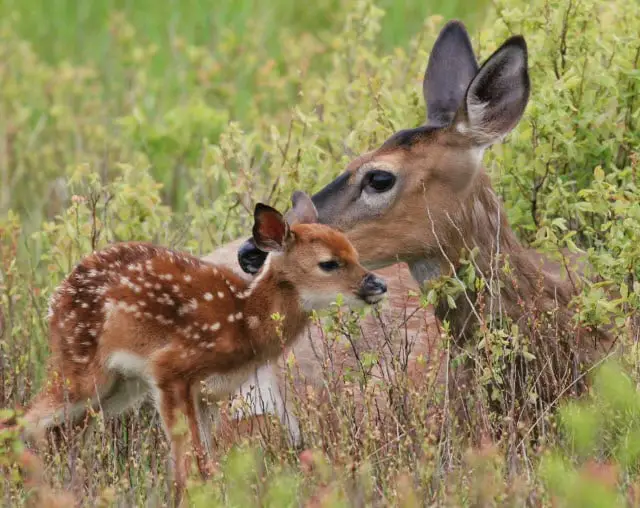
At the beginning of labor the vulva opens as the uterine fluids are released. While giving birth the female may stand and sit repeatedly, but when the young is actually on the way, most deer stand so that gravity will help the fawn emerge. In nearly all deer births the young is born head first, as if the fawn is diving toward the ground.
After the fawn is born the female licks it to clean it and dry it off. The afterbirth is usually delivered about half an hour later, and most does eat it for the energy it provides. By eating the afterbirth the doe reabsorbs valuable nutrients and also lessens the risk of predators finding the young – the afterbirth is very bloody and would be easy for a predator to find. Licking the fawn dry serves the same purpose, eliminating the smell that could give away its location.
Female deer usually have between 1 and 3 offspring at a time, sometimes as twins. This varies across different types of deer, with some smaller species having more offspring and the largest species tending to carry just a single fawn to term.
Where Do Deer Go to Give Birth?
Someplace secluded, with excellent cover – usually a meadow with tall grasses that hide the doe while in labor and conceal the fawn once it has been born.
Unlike animals that lay eggs and can hide their offspring tucked away, deer have to be strategic about where they give birth so that predators will not strike their offspring during their most vulnerable days. Does almost universally find secluded areas away from their herd – areas of thick vegetation or undergrowth such as high grass stands or bracken – which reduces the risk of predation to their young.
Every part of the reproductive cycle of deer is done to ensure the health and safety of the offspring:
- Mating – deer choose the strongest mate (through sparring and mating rituals) so offspring will be more likely to thrive,
- Gestation – does carry young to term so that they are born when adequate cover and food are available, and
- Birth – deer choose the perfect location, allowing the fawn to remain concealed until strong enough to run from predators.
A poor location with inadequate cover is virtually the only factor that could expose a young fawn to a predator – fawns are born with natural camouflage and are essentially unscented, making them almost impossible to detect. Many domestic dogs running in fields will step on a fawn before they discover it through scent.
First Days After a Fawn Is Born
Young deer are generally well developed at birth, but still extremely vulnerable to predators. Fawns are born with their eyes open and their fur already developed. They usually stand a few minutes after being born and can walk around within the first hours of life.
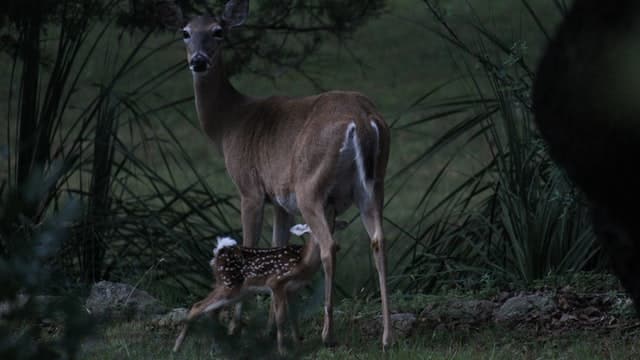
Often the mother will lead her new young away from the birthing area to a new, uncontaminated area where there is less chance of it being discovered.
The weight of newborn deer varies greatly by species. In the gigantic European Elk (Moose in America) the young can weigh over 10 kilograms at birth, and North American Elk calves can be quite large too, while the Southern Pudu, one of the smallest deer species, can bear young weighing less than 350 grams.
From a few days of age young deer are able to run, but only for short distances. It is therefore necessary for them to hide somewhere safe from predators until they are able to accompany their mother.
How Baby Deer Hide Until They Gain Strength
The mother remains with the fawn and suckles it every 2 or 3 hours during the first few days of its life. Thereafter she normally leaves it in a safe hiding place amongst thick vegetation, such as long grass or a dense stand of bracken.
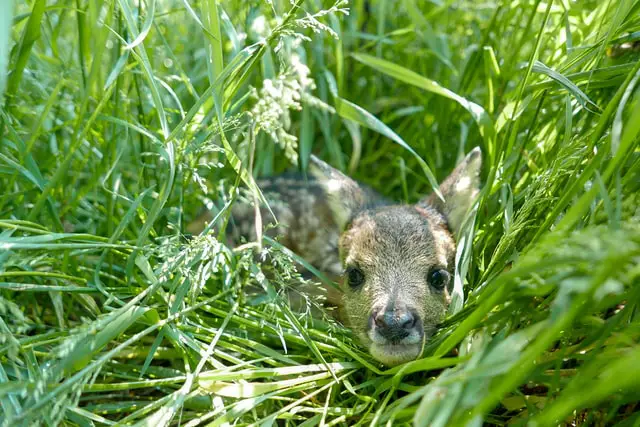
She can then go off and feed so that she can make more milk. If she remained with the fawn she might draw the attention of predators to it, so it is better for her to retreat and let the young deer hide alone. While hiding, the fawn remains perfectly motionless, often curled up in a tight ball. The mother returns to suckle it several times a day until it can run well and is capable of joining the herd.
How Many Babies Do Deer Give Birth To?
In the Fallow Deer twins are fairly common. In this case, instead of hiding together, the young hide separately, lying some distance away from each other. By doing this, each fawn’s chance of survival increases: even if a predator finds and kills one fawn, the other may evade detection and survive. If they both hid together and were discovered, both would be lost. The mother does not want to place all her young ‘in one basket’.
Camouflage in Young Deer
In many species young deer have spots or distinct white markings. These white spots camouflage the young animal by breaking up its outline while it hides in long vegetation.
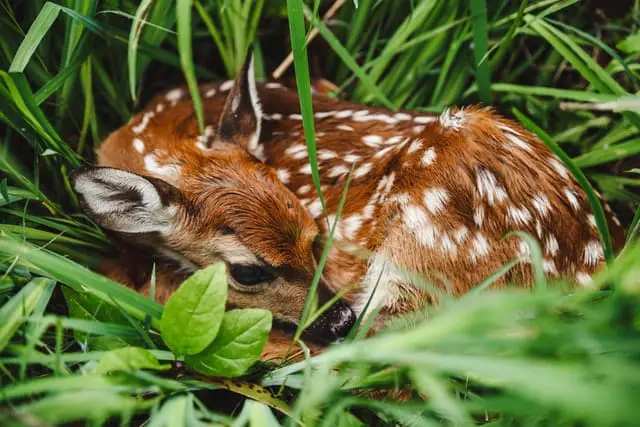
The white markings usually fade once the young animal is 2 to 3 months old. From this age the young are normally old enough to accompany their mother and no longer need the spots to hide them amongst thick vegetation.
What to Do if You Find a Baby Deer Alone
Many people who find a young deer make the mistake of assuming it has been abandoned by its mother. This is nearly always not the case. The fawn is waiting, hidden, until its mother returns to feed and care for it.
Anyone finding a young deer on its own should simply leave it. Avoid touching the fawn – there is a danger that when the mother returns and smells foreign scents on her young, she may abandon it.
As the Baby Deer Grows Up
For the first few weeks of its life, milk from the mother is the only food the fawn takes. From about 2 weeks of age it begins to take small amounts of green food, and from about a month of age it feeds more regularly and in greater quantity on green matter, while still relying to a high degree on its mother’s milk.
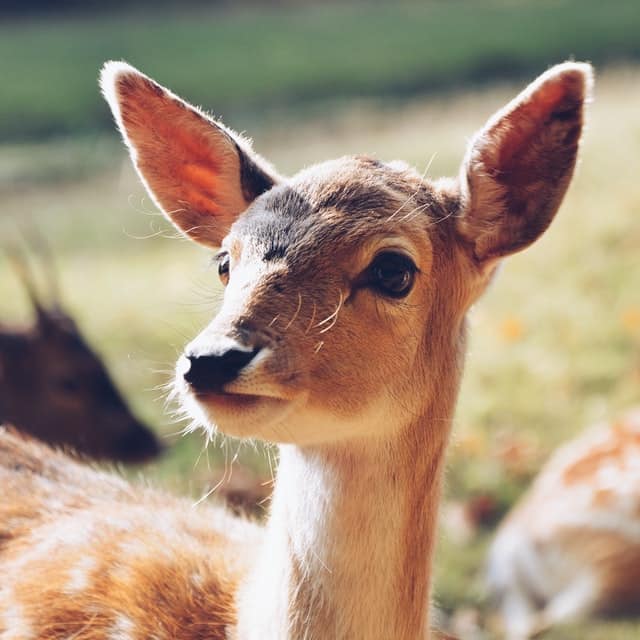
Weaning begins at around 6 months of age. The number of times the young suckles each day declines, as does the quantity of milk the mother produces.
Although they are capable of living independently from about 6 to 8 months of age, the young usually remain with their mother until she gives birth to another baby deer, usually a year after they were born. If a female fails to conceive, the young from the previous year may remain with her for some months longer.
In most species of deer the young reach sexual maturity at about 12 months of age, but they do not normally breed until they are older. Females usually mate from 18 months of age, while males may have to wait a number of years until they are strong and dominant enough to win the right to breed.