
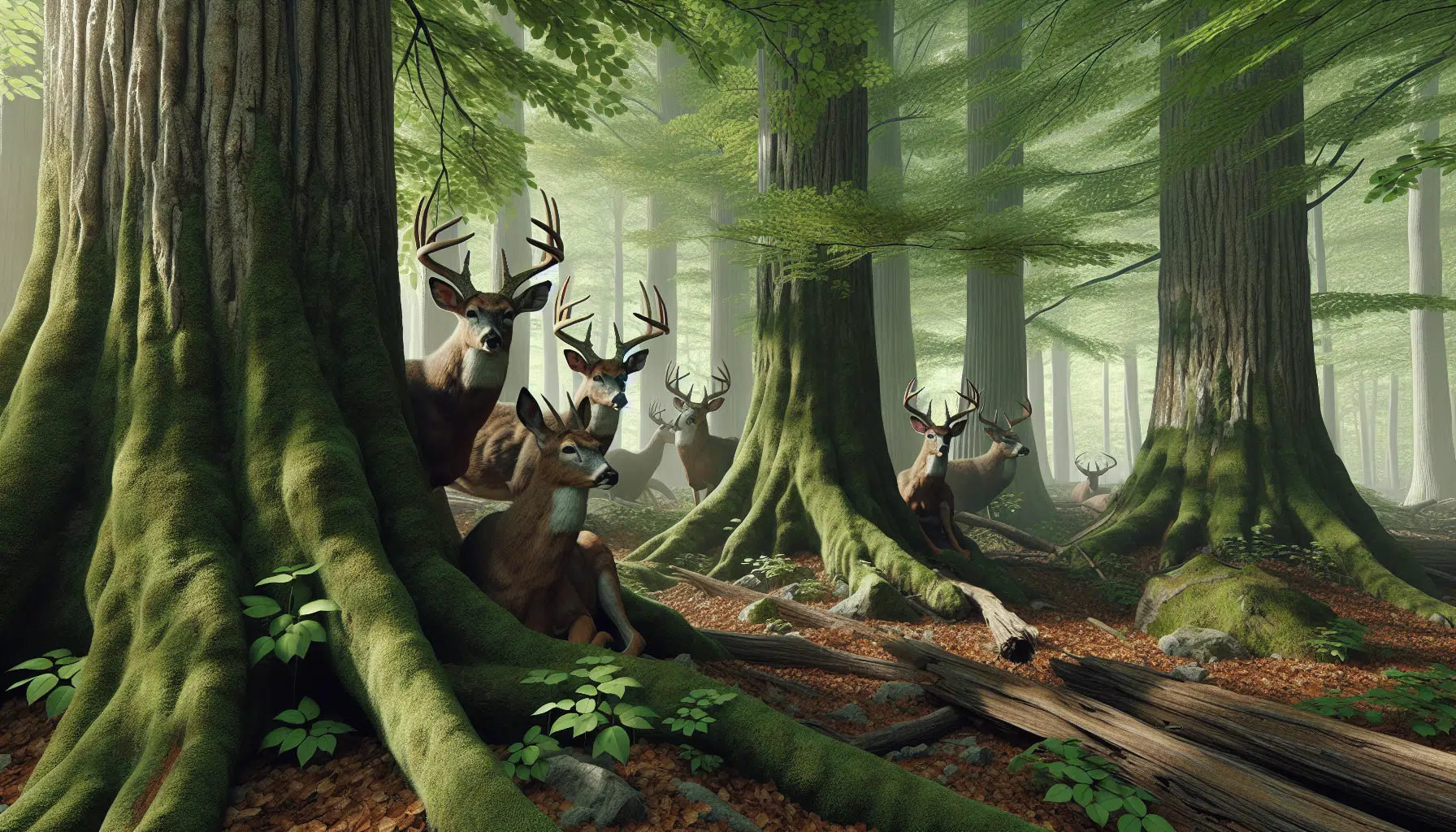
Make the Call Right Now. Are Big Bucks Leaving, Or Just Hiding.
Big bucks do not “disappear” during gun season.
They slide into the nastiest cover they can reach without crossing open ground, and they move at times you are not watching.
I have hunted 30 plus days a year for two decades, and gun season always feels like somebody flipped a switch.
Back in November 2019 in Pike County, Illinois, I watched a 156 inch typical show up the morning after a cold front, and he did it by using cover like a thief.
Decide If Your Area Has “Pressure Refuge” Or Not.
The first decision is simple.
Is there a place nearby where a buck can hide from people, dogs, and trucks, or is the whole neighborhood getting hammered.
On my 65 acre lease in Pike County, the refuge is usually a ditch line, a brushy creek bend, and a little strip of nasty honeysuckle nobody wants to crawl through.
In the Missouri Ozarks on public land, the refuge is distance and misery, like steep hollers, laurel thickets, and benches below the trail where hikers never drop down.
I learned the hard way that “good summer bedding” can turn into “dead zone” the first Saturday of gun season.
If your best buck bed is 120 yards off a logging road, that buck is not bedding there once the orange army shows up.
When I am trying to predict movement shifts, I start with habitat basics from deer habitat because thick cover beats fancy theories every time.
Don’t Chase Food First. Choose Cover First.
Most guys start gun season by sitting the biggest food plot or corn field edge they can see.
That can work in places like Southern Iowa where ag is king, but it gets you busted in pressured timber.
Here is what I do on pressured ground.
I pick the ugliest cover within 300 yards of food, then I hunt the travel choke that lets a buck scent check without stepping into the open.
My buddy swears by sitting a standing corn corner all day during gun season.
I have found that works best only if the corn is also the cover, and the access lets you sneak in without shining a headlamp across the field.
When I am trying to time that quick “last light” slip, I check feeding times because pressured bucks still have a clock, they just tighten it up.
Expect Big Bucks To Shift Bedding 80 To 600 Yards, Not 3 Miles.
People love saying big bucks “leave the county” during gun season.
Sometimes they do, but most of the time they shift just far enough to stop getting bothered.
Back in 2007 when I was hunting the Missouri Ozarks, I watched a heavy 10 point vanish after opening morning shots.
Three days later I cut his track in a saddle 420 yards from his usual sign, tucked into a cedar and briar mess nobody could walk through quiet.
If you have ever hunted Buffalo County, Wisconsin hill country, you know this move.
They drop off the easy ridge and bed on a point with wind advantage where they can watch downhill and smell uphill.
This connects to what I wrote about do deer move in the wind because wind is the buck’s security camera during gun season.
Mistake To Avoid. Hunting The Same Stand You Bowhunted In October.
I get it because I do it too if I am not careful.
You killed a nice 8 point there once, and it feels right.
I learned the hard way that gun season turns “patternable” bucks into “survival” bucks.
If your stand is on a pretty oak flat with 60 yard visibility, you are hunting where deer feel exposed.
Here is what I do instead.
I move closer to bedding cover, and I accept shorter shots, like 40 yards with a shotgun or 80 yards with a rifle, because I would rather see one deer at 80 than zero deer at 250.
If you are trying to put a deer down fast during gun season chaos, go read where to shoot a deer to drop it in its tracks
Big Buck Hideouts I See Over And Over During Gun Season.
These are not magic spots.
They are spots that punish humans and reward deer.
1. The “third ridge” effect on public land.
In the Missouri Ozarks, the first ridge has boot tracks, the second has a few, and the third starts getting quiet.
Big bucks slide to the first place that feels calm, even if it is only 900 yards from a parking lot.
2. Steep side hills with blowdowns.
In Buffalo County style terrain, a buck beds with his back to a log and watches below.
You can walk right over him on the ridge top and never know.
3. Tiny cover pockets on private.
In Pike County, Illinois, I see mature bucks pile into a 1 acre briar patch if it is the only place nobody walks.
They will lay there all day and get up at 11:40 a.m. to stretch and scent check.
4. Creek bottoms and ditch lines with overhead cover.
Not wide open bottoms.
I mean those nasty tangles with grapevine, downed limbs, and a tunnel you have to crawl to enter.
My Quick Rule of Thumb
If opening weekend pressure is heavy and you hear more than 12 shots before 9:00 a.m., do a midday move to the thickest cover within 400 yards of food.
If you see fresh big tracks and beds on the downwind side of a point, expect the buck to rise between 10:30 a.m. and 1:30 p.m. to scent check without showing himself.
If conditions change to a calm high pressure day after a cold front, switch to a bedding edge sit with a quiet entry, because that is when the old boys stand up earlier.
Tradeoff. Hunt All Day Or Hunt Only The First And Last Hour.
This is where most guys blow it.
They hunt daylight only, then complain bucks went nocturnal.
Here is what I do during gun season if I can manage it.
I pack a real lunch, two hand warmers, and I sit from legal light to 2:00 p.m. on day one and day two.
I have killed and seen more mature bucks between 11:00 a.m. and 1:00 p.m. during gun season than most people believe.
The tradeoff is you need a stand spot that does not get you winded.
If your wind is wrong and your access crosses the deer’s bedroom, an all day sit just educates them longer.
Gear I Trust In Gun Season, And Gear I Regret Buying.
I am not a pro staff guy, and I have burned money on junk.
My most wasted money was $400 on ozone scent control that made zero difference.
I still got busted at 18 yards by a doe that hit my ground scent, and that was the day I quit believing in magic boxes.
Here is what I do now.
I play the wind hard, I keep my access clean, and I focus on quiet gear instead of “scent force fields.”
My best cheap investment is $35 climbing sticks I have used for 11 seasons.
They are ugly, they squeak a little if I do not tape them, but they keep me mobile which matters most when bucks shift beds.
For taping noisy gear, I use genuine 3M cloth friction tape, and I burn through about one $9 roll a season.
Find This and More on Amazon
If I am sitting long in cold wind, I still trust my old sit pad more than any heated gimmick.
I have used the Therm-a-Rest Z Seat, about $35, and it keeps my butt from freezing and it stays quiet.
Find This and More on Amazon
For a simple drag, I keep 50 feet of paracord in my pocket because it costs $7 and saves my back.
This matters more than people admit once you realize how much does a deer weigh
Decision. Still Hunt Funnels, Or Switch To Escape Routes.
During bow season, I love funnels between bedding and feeding.
During gun season, I like funnels too, but I love escape routes more.
Escape routes are those skinny lanes deer use to slide away from pressure while staying in cover.
Think ditch lines, the downwind edge of a cedar thicket, and the backside of a ridge that keeps them out of sight.
Here is what I do when shots start popping.
I set up where two pieces of thick cover pinch together, and I face the direction I expect deer to flee, not the direction I wish they would come from.
If you are hunting open ag like Southern Iowa, the escape route might be a grass waterway or a fence line nobody can see into.
If you are hunting big woods like the Missouri Ozarks, it might be a bench that wraps around a point and stays hidden from the top.
Mistake To Avoid. Following The Crowd To The “Best” Parking Lot.
Public land gun season teaches you about humans more than deer.
In Mark Twain National Forest, my best public land spot is not “better deer.”
It is fewer people, and that changes everything.
I learned the hard way that walking in behind another hunter at daylight is like honking your horn all the way to the stand.
Here is what I do.
I pick the access route nobody wants, like the longer loop, the creek crossing, or the uphill climb that burns your lungs.
If you want a reality check on how sharp deer get under pressure, read are deer smart
How I Think About Deer Groups During Gun Season.
I do not talk about deer like a biologist.
I talk about them like targets that have habits.
Does group makeup matter during gun season.
When I am glassing edges, I like seeing does first because it tells me the food is safe enough for deer.
But I do not expect the biggest buck to walk with them at 5:15 p.m. on opening weekend.
If you are new and still sorting out terms, it helps to know what is a male deer calledwhat is a female deer called
And if you are trying to explain it to a kid, I point them to what is a baby deer called
I Learned The Hard Way. Bad Shots Get Worse In Gun Season Chaos.
My worst mistake was a gut shot doe in 2007.
I pushed her too early, never found her, and I still think about it.
Gun season pressure makes that problem worse because other hunters can bump your deer, and you can feel rushed.
Here is what I do now if I am not 100 percent sure.
I back out, I mark last blood, and I give it time even if it hurts, because recovering the deer matters more than filling the tag fast.
If you need a refresher for after the shot, I keep this bookmarked, how to field dress a deer
FAQ. Real Questions I Hear Every Gun Season.
Do big bucks leave the property during gun season?
Most of the time they shift to the closest security cover that lets them smell danger and avoid crossing open ground.
I see moves of 80 yards to 600 yards far more than moves of 2 miles.
Where should I sit if I only have one day to hunt gun season?
Sit the downwind edge of the thickest bedding cover you can access quietly, within 400 yards of a food source.
If you sit the food, you are betting the buck feels safe enough to show in daylight, and that is a bad bet on opening weekend.
Why do I see lots of does but no mature bucks during gun season?
Does will accept more exposure and keep feeding, especially if pressure is moderate.
Mature bucks often watch those does from cover and wait until the last 5 minutes of light or they move midday inside thick stuff.
Should I still rattle or grunt during gun season?
I grunt more than I rattle during gun season because pressure makes bucks cautious about running to a fight.
I will rattle only if I have thick cover nearby and I can see 80 yards max, because a buck may circle downwind and never step into the open.
What wind is best to kill a big buck during gun season?
I want a steady wind that lets me sit just off the bedding edge without my scent dumping into the cover.
If the wind is swirling in hill country like Buffalo County, I drop lower on the slope and hunt where thermals are predictable.
How far will a big buck run if I hit him well with a rifle or slug?
I have seen them drop in sight and I have seen them run 120 yards with a perfect heart shot.
That is why I care about angles and shot placement more than caliber debates.
Make One More Call. Are You Hunting For Sightings, Or Hunting For A Kill.
If your goal is to see deer, sit the field edge.
If your goal is to kill a mature buck during gun season, sit where you can smell his bedroom without letting him smell you.
That sounds blunt, but it is the whole deal.
Big bucks go where they feel boring and safe, and most hunters refuse to sit those spots because they look “dead.”
Decision. Push Into The Bedroom, Or Set Up On The Edge.
This is the line you have to walk in gun season.
Get too aggressive and you blow the whole ridge for the week.
Stay too safe and you watch spikes and does while the old boy listens from the thicket.
Here is what I do on my Pike County, Illinois lease when the first weekend pressure hits.
I set up 60 to 120 yards off bedding cover on the downwind side, and I do not step into the thickest part unless I have snow or rain to cover my noise.
I learned the hard way that “just peeking in” to bedding at 9:30 a.m. can ruin your next three sits.
Back in November 2019, the morning I killed my 156 inch typical in Pike County, I was not deep in the sanctuary.
I was on the edge where he could stand up, scent check, and still feel like he had an exit.
Tradeoff. Get Close Enough To Win, But Not Close Enough To Get Winded.
Gun season is loud, and that makes guys think wind does not matter.
Wind matters more, because bucks are on red alert and using their nose like a radar dish.
Here is what I do if I am hunting hill country like Buffalo County, Wisconsin style terrain.
I stay off the very top and I stay off the very bottom, and I set up about one third down where the wind is steadier.
If you are hunting steep ground and your wind is swirling, forget about “perfect sign” and focus on “predictable air.”
This connects to what I wrote about do deer move in the wind
Mistake To Avoid. Walking Your Way Into Educating Every Deer You Want To Kill.
I see this every year on public land in the Missouri Ozarks.
Guys still hunt fast through the prettiest timber because it feels like hunting.
I am not against still hunting, but most people do it like they are late for work.
Here is what I do if I still hunt during gun season.
I move 20 yards, then I glass for 2 minutes, and I scan for pieces of deer like an ear, a leg, a tine tip, or a horizontal back line.
I learned the hard way that crunching leaves at a steady pace just pushes bucks in front of you, and usually right to the next guy.
If you still hunt thick stuff, forget about seeing full bodies and focus on catching movement in a 6 inch window.
Decision. Hunt The Midday “Lull,” Or Go Eat Breakfast.
If you want to kill a big buck in gun season, you need to stop treating 10:00 a.m. to 2:00 p.m. like dead time.
That is when pressure forces deer to relocate, check escape routes, and stand up to re-bed.
Back in 1998 when I shot my first deer, an 8 point in Iron County, Missouri with a borrowed rifle, it happened late morning after shots started echoing.
That buck was not “out feeding.”
He was slipping through cover trying to find quiet.
Here is what I do now with two kids and limited time.
I hunt hard early, take a quick lunch in the stand if I can, then I hunt again until at least 1:30 p.m. before I even think about getting down.
Tradeoff. Sit High To See More, Or Sit Low To Get Seen Less.
A lot of gun hunters want a high perch so they can watch 300 yards.
That is great for seeing deer, and terrible for killing big bucks that are moving in tight cover.
Here is what I do in the Missouri Ozarks big woods.
I will sit low, sometimes on the ground against a white oak or cedar, because it keeps my silhouette small and lets me tuck into shadows.
My buddy swears by climbing 25 feet up in a big straight tree to “get above them.”
I have found mature bucks pick off that skyline look fast, especially after opening weekend when every deer has been shot at once.
Decision. Do You Hunt The “Quiet Side” Of Pressure, Or The “Pretty Side” Of Sign.
The best gun season buck spots are often the places with less sign.
That sounds wrong until you remember why the sign is light, because deer are surviving, not living easy.
Here is what I do on public land.
I find where the crowd parks, then I hunt the direction people do not want to go, even if it means a 1.2 mile walk and a nasty climb.
In Mark Twain National Forest, I have had sits where I saw zero rubs and killed deer anyway because the whole ridge was a pressure funnel.
If you are hunting public land gun season, forget about the perfect rub line and focus on where deer are getting pushed.
Mistake To Avoid. Setting Up Where You Can’t Recover A Deer Fast.
Gun season has other hunters, dogs in some places, and lots of movement in the woods.
If your deer runs, it can get bumped again, cross lines, or disappear into the worst stuff.
I learned the hard way on that gut shot doe in 2007 that time matters, and so does discipline.
Here is what I do now.
I pick a shot lane that gives me a clear angle to the vitals, and I do not force a Texas heart shot just because I am holding a rifle.
If you want the quickest kills and the easiest tracking jobs, I keep coming back to where to shoot a deer to drop it in its tracks
Tradeoff. Track Right Away, Or Back Out And Let Him Die.
I hate waiting, and you probably do too.
But a rushed track job is how good hits turn into lost deer.
Here is what I do after the shot in gun season.
If I saw a mule kick and heard a crash within 6 seconds, I give it 15 minutes and go slow.
If I saw hunching, slow walk off, or the shot felt “off,” I back out and I wait at least 3 hours, even if other shots are going off.
I know that is hard, but I would rather risk another hunter seeing him than guarantee I push him into the next county.
Once you find him, have your plan ready, and I keep this saved on my phone, how to field dress a deer
Decision. Do You Want To See More Deer, Or Learn Where The Old Buck Sleeps.
If you only hunt gun season, you can still learn a ton by paying attention to where deer flee.
Those escape routes are the map to mature buck bedding.
Here is what I do the day after I hunt a spot and see deer blow out.
I mark the exact line they used on OnX, then I come back after season and walk it to find the thick pocket they were headed to.
This ties into why I like thinking in simple deer terms, and it helps to know what you are actually looking at, like deer species
If you ever find yourself second guessing tracks and body size, it also helps to remember how much does a deer weigh
My Kids Changed How I Hunt Gun Season.
Taking kids means I can’t just death march into a laurel thicket every time.
It forced me to simplify.
Here is what I do when I have my kids with me.
I pick a spot with a safe backstop, good visibility, and a high odds doe trail, then I save the nasty buck hideout sits for my solo hunts.
I still want them to understand buck behavior though.
So when they ask why the big one isn’t showing, I point out tracks, beds, and how deer act under pressure, and I show them stuff like what is a baby deer called
Here’s The Real Answer I Give My Buddy Every Year.
Big bucks go to security cover close to their normal life, and they move in short bursts when people are least likely to be watching.
They are not magic.
They are just disciplined.
In Pike County, Illinois, that might be a 1 acre briar patch behind a farmhouse, and you will never see him from the road.
In the Missouri Ozarks, that might be the third ridge over, bedded below a bench with the wind in his nose and the downhill in his eyes.
FAQ. Real Questions I Hear Every Gun Season.
Do big bucks hole up and not move at all during gun season?
No, they still stand up, stretch, and reposition, especially midday.
They just do it inside cover where you cannot see 40 yards.
Should I hunt closer to bedding even if I might bump deer walking in?
Yes, but only if you can access without crossing the main trail into the bed.
If your entry is noisy or your wind blows into the cover, back off and hunt the first downwind choke instead.
What is the single best sign that a big buck is hiding nearby during gun season?
Fresh large tracks and a worn bed on the downwind side of thick cover, especially if the area looks hard to hunt.
If it also has a quick escape route like a ditch or a sidehill bench, I treat it like a loaded gun.
Do big bucks use the same trails during gun season as bow season?
Some do, but many shift to parallel trails just inside cover so they can travel without being seen.
If you keep sitting the obvious trail in the open timber, you will watch smaller deer and miss the buck by 40 yards.
Is it better to hunt after a cold front during gun season?
Yes, if the cold front comes with high pressure and a steady wind you can hunt.
That is the exact setup that got my biggest buck in November 2019, because he stood up earlier and made a mistake.
Why do deer seem “smarter” during gun season?
Because the dumb ones get shot early and the survivors adjust fast.
If you want a blunt reminder of that, I still tell people to read are deer smart
My Last Word On Where They Go.
Big bucks go where you will not follow.
If you are willing to sit ugly cover, hunt midday, and treat wind like it matters, you will start seeing deer that other guys swear “vanished.”
I am not a guide, and I still mess up plenty.
But after 30 plus days a year for two decades, I can tell you this is the pattern that keeps repeating, from Pike County to the Missouri Ozarks to hill country that feels like Buffalo County.