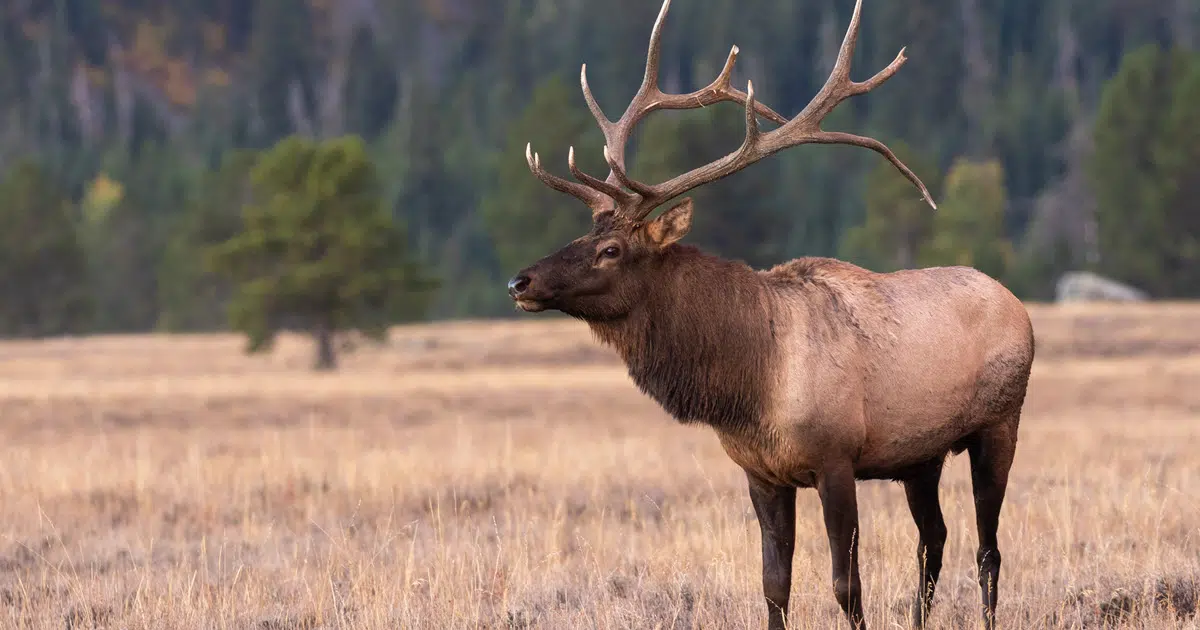
An adult elk typically stands around 4.5 to 5 feet tall at the shoulder and measures 6.5 to 8.5 feet from nose to tail. Mature bulls usually weigh around 700 to 1,100 pounds, while cows are smaller at roughly 500 to 600 pounds. Add a big bull’s antlers, which can stretch about 4 feet above his head, and you’re looking at an animal that can top 8 to 9 feet tall from hooves to antler tips. That makes the elk the second-largest deer species on Earth, behind only the moose.
Numbers on a page are one thing; standing near an elk is another. Many people who see their first bull elk up close are shocked that “a deer” can be the size of a horse. Let’s put real dimensions on the animal, look at how size varies by sex, age, and subspecies, and compare elk with the deer and moose you might be picturing.
Elk Size at a Glance
| Measurement | Bull (male) | Cow (female) |
|---|---|---|
| Weight | Around 700–1,100 lbs | Around 500–600 lbs |
| Shoulder height | Around 4.5–5 ft | Around 4–4.5 ft |
| Body length | Around 7–8.5 ft | Around 6.5–7.5 ft |
| Antlers | Up to around 4 ft long, 20–40 lbs per pair | None |
These are typical ranges rather than hard limits. Exceptional Roosevelt elk bulls have been recorded well beyond 1,100 pounds, and small-bodied tule elk cows can weigh under 400 pounds. Like most deer species, elk show strong sexual dimorphism: bulls run notably heavier than cows and carry the antlers.
How Tall Is an Elk?
Shoulder height is the standard way biologists measure hoofed animals, and a mature bull elk stands around 5 feet at the shoulder, about the height of an average adult’s chin. But shoulder height undersells the visual impression. An elk carries its head high on a long neck, so the top of a bull’s head sits well above 6 feet, and his antler tips can reach 8 to 9 feet off the ground.
That’s why a bull elk standing in a meadow can look eye to eye with someone in a pickup truck, and why photographers who get too close during the rut find themselves looking up at an animal that suddenly seems enormous.
How Much Does an Elk Weigh?
A good rule of thumb: a mature bull elk weighs about as much as four or five adult white-tailed deer put together. Bulls typically hit their peak body weight in early fall, just before the rut, when they’ve spent all summer grazing on rich grasses and forbs. During the rut itself, a herd bull may eat very little for weeks and can burn off a substantial share of that weight chasing and defending cows.
Cows follow a different curve. They’re heaviest in late fall, then draw down fat reserves through winter and pour energy into pregnancy and milk production in spring and summer. Calves weigh around 30 to 40 pounds at birth and can pass 200 pounds by their first winter when forage is good.
Size by Subspecies: Not All Elk Are Equal
North America’s surviving elk subspecies differ noticeably in size:
- Roosevelt elk – the heavyweight champion. Found in the coastal Pacific Northwest, Roosevelt bulls commonly reach 900 to 1,100 pounds or more, though their antlers tend to be shorter and stouter than a Rocky Mountain bull’s.
- Rocky Mountain elk – the classic elk of the interior West and the most numerous subspecies. Bulls typically weigh around 700 to 900 pounds and grow the longest, most impressive antlers.
- Tule elk – California’s compact native, adapted to hot, open country. Bulls often weigh only 400 to 550 pounds, roughly half the size of a big Roosevelt.
- Manitoban elk – found in the northern Great Plains and parkland of Canada, generally similar to or slightly heavier in body than Rocky Mountain elk.
Elk vs. Deer: A Big Step Up
If your mental reference point is a white-tailed deer, roughly double the height impression and quadruple the weight. A big whitetail buck might weigh 200 to 300 pounds and stand around 3 to 3.5 feet at the shoulder; even an elk cow dwarfs him. Mule deer run a bit bigger than whitetails but are still far below elk size. You can see a fuller side-by-side in our deer vs elk comparison, and our guide to how much deer weigh covers the smaller species in detail.
Beyond raw size, the body shapes differ. Elk are built like distance athletes: long legs, deep chest, and a frame made for covering miles of open country. Their tan body with a dark brown neck mane and pale rump patch also reads very differently from a whitetail’s gray-brown coat.
Elk vs. Moose: Who’s Bigger?
Moose win, and it isn’t close. A mature bull moose typically weighs 800 to 1,500 pounds or more and stands 5.5 to 6.5 feet at the shoulder, a full head taller than a bull elk. Moose also carry broad, palmate (open-hand shaped) antlers, while elk grow long, sweeping beams with pointed tines.
At a distance, the easiest tells are color and profile: moose are dark chocolate brown with a drooping snout and a dewlap under the chin, while elk are tan with a dark mane and a light rump. Our full elk vs moose comparison walks through every difference, from size to behavior.
How Big Are Elk Antlers?
A mature bull’s antlers are a major part of his size. Each antler can reach around 4 feet in length, and a big pair together typically weighs 20 to 40 pounds. A healthy mature bull usually carries six tines per side, the classic “6×6” or “royal” configuration. Bulls regrow this entire rack from scratch every single year, one of the fastest examples of bone growth in the animal kingdom.
Frequently Asked Questions
Is an elk bigger than a horse?
They’re in the same general size class, which surprises many people. A mature bull elk’s 700 to 1,100 pounds overlaps with the weight of many light horse breeds, though a typical riding horse still stands a bit taller at the shoulder. An elk cow is closer to the size of a large pony.
How big is a full grown bull elk?
A full-grown bull typically weighs around 700 to 1,100 pounds, stands about 5 feet tall at the shoulder, and stretches 7 to 8.5 feet long. With antlers, his total height can approach 9 feet. Bulls generally reach their maximum body size around 6 to 8 years of age.
What is the biggest elk subspecies?
The Roosevelt elk of the Pacific Northwest is the largest-bodied subspecies, with big bulls commonly exceeding 1,000 pounds. Rocky Mountain elk are lighter in body but tend to grow longer, larger antlers, which is why they dominate the record books for antler size.
Related Reading
Keep going with our complete elk profile, see the full breakdown in elk vs moose and deer vs elk, or learn what elk eat to fuel all that body mass.