
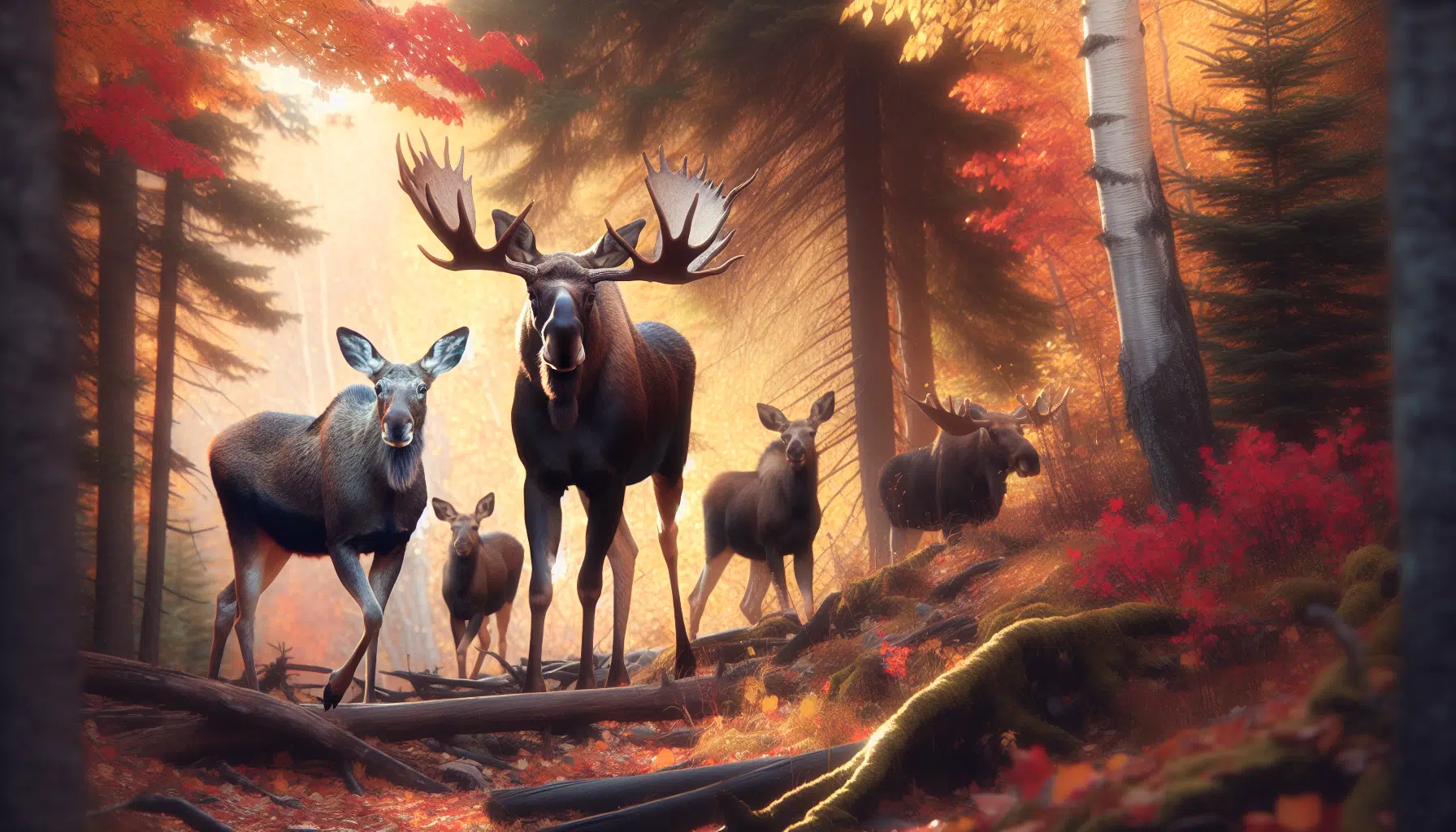
Moose grow the largest antlers of any living deer. A mature bull’s rack commonly spans 4 to 5 feet from tip to tip, and the biggest Alaska-Yukon bulls can exceed 6 feet of spread, with a full-grown pair of antlers weighing roughly 25 to 40 pounds. Even more impressive than the finished size is the speed: a bull grows that entire rack from nothing in about five months, every single year.
Here’s a closer look at how big moose antlers get, how their distinctive shovel shape works, how fast they grow, and what separates a modest rack from a record-book one.
How Wide and Heavy Do Moose Antlers Get?
Antler size varies enormously with a bull’s age, nutrition, genetics, and subspecies, but rough benchmarks look like this:
- Young bulls (1–3 years) — small spikes, forks, or modest palms, often under 30 inches of spread
- Mature bulls (5–10 years) — typically around 40 to 60 inches of spread; this is a bull’s prime, when racks are at their biggest
- Big Alaska-Yukon bulls — spreads over 60 inches are the benchmark of a truly large bull, and exceptional animals have exceeded 70 inches, with record spreads approaching 80 inches reported
- Weight — a mature pair commonly weighs about 25 to 40 pounds, with the heaviest racks reported somewhat above that
Subspecies matters a great deal. The Alaska-Yukon moose grows the biggest antlers, Canadian and eastern moose come next, and the smaller Shiras moose of the US Rockies typically carries a rack well under 55 inches. Eurasian moose overlap the middle of the range, and some populations grow simpler, less palmated antlers.
To put those numbers in context: a 6-foot antler spread is wider than the height of most adult humans — sitting on top of an animal that already stands about 6 feet at the shoulder. Our guide to how tall a moose is covers the full picture.
The Palmate Shape: What Makes Moose Antlers Different
Most deer grow branched antlers — a main beam with tines forking off it, like a red deer or whitetail. Moose antlers are palmate: broad, flattened plates of bone (the “palms” or “paddles”) fringed with points, connected to the skull by a short, thick beam.
A big bull’s palm can be several feet long and more than a foot wide, with a dozen or more points around its edge. The palm typically divides into a large upper portion and a forward-jutting brow palm over the face. Among living deer, only the fallow deer shares strongly palmated antlers — at a fraction of the scale. The extinct Irish elk carried even wider palmate racks, which is one reason moose are its closest living visual echo.
Why the shovel shape? The leading explanations are display and combat mechanics: broad palms make a bull look enormous head-on, and during the rut bulls lock antlers palm-to-palm and shove, so a wide, many-pointed rack both intimidates rivals at a distance and binds safely in a pushing contest. Researchers have also noted the palms may help reflect and gather sound toward the ears, though this idea is debated rather than settled. Only bulls grow them at all — see do male and female moose have antlers.
How Fast Do Moose Antlers Grow?
Moose antlers are among the fastest-growing structures in the animal kingdom. Growth begins in spring from pedicles on the skull and finishes by late summer — roughly five months to build up to 40 pounds of bone.
At the midsummer peak, a big bull’s antlers can lengthen by as much as an inch a day. During this period the growing rack is covered in velvet — living skin dense with blood vessels that ferries minerals and nutrients to the growing bone. The metabolic bill is steep: a bull must eat mineral-rich food all summer to fund construction, which is one reason antler size is such an honest signal of a bull’s health and his habitat’s quality.
In late August or early September the bone hardens, the velvet dries, and bulls thrash shrubs to strip it away, revealing the polished rack just in time for the rut. A few months later the whole structure drops off — we cover that annual cycle in when do moose shed their antlers, and the biology behind antlers generally in our antler guide.
What Determines How Big a Bull’s Antlers Get
- Age — antlers grow larger with each year until a bull’s prime, roughly ages 5 to 10, then decline in old age; a huge rack means a bull that has survived many winters
- Nutrition — abundant, mineral-rich browse builds big antlers; poor habitat caps them regardless of genetics
- Genetics — antler size and conformation run in bloodlines, which is why some regions consistently produce bigger-antlered bulls
- Subspecies and latitude — the giant northern forms simply grow bigger racks than southern ones
How Moose Antlers Compare to Other Deer
No living deer comes close. A big bull elk grows long, branched antlers that can each exceed 4 feet in length, but an elk rack typically weighs well under a moose’s and lacks palms entirely. Caribou grow the largest antlers relative to body size, with tall sweeping beams, yet still fall short of moose antlers in sheer mass. The all-time crown belongs to the extinct Irish elk, whose palmate spread could reach roughly 12 feet — but among deer walking the Earth today, the moose stands alone.
Frequently Asked Questions
What is the biggest moose antler spread ever recorded?
Record-class Alaska-Yukon bulls have produced spreads in the mid-70-inch range, with some reported racks approaching 80 inches — around 6.5 feet. Record measurements come from hunting record books such as Boone and Crockett, which score total antler size rather than spread alone, so “biggest” depends partly on how you measure.
How many points does a moose antler have?
There’s no fixed number. A mature bull commonly carries somewhere in the range of 8 to 15 points per side around the edge of each palm, and unlike some deer, point count isn’t a reliable indicator of age — palm size and spread say more about a bull’s maturity than the number of tines.
Do bigger antlers mean a stronger moose?
Broadly, yes. Because antlers are regrown annually from surplus nutrition, only a healthy, well-fed, mature bull can afford a huge rack — making antler size an honest advertisement of condition. Rival bulls read it that way: many rut confrontations are settled by display alone, with the smaller-antlered bull backing down before any contact.
Related Reading
Continue with our guides to when moose shed their antlers, which moose grow antlers, and the science of antlers across the deer family.


