
Updated on September 7, 2026. Ratings below are university lists, not a guarantee that a starving deer will never take a bite. Confirm the current lists on the linked extension pages before you order a crate of globes.
Rarely. Ornamental onion (Allium spp.) sits in Rutgers Cooperative Extension’s Rarely Damaged (A) column — the same four-tier survey Iowa State compiles from Rutgers, Cornell, and Michigan State. That is the opposite bucket from tulips and hostas. Cornell Cooperative Extension in Tompkins County is more honest than a catalog tag: alliums “may be sampled and then mostly avoided.” They are not daffodils. Daffodils carry lycorine. Alliums carry sulfur. A first nibble happens. A stripped bed of purple globes is not the pattern.
| Verdict | Rarely. Rutgers A. Cornell: sampled, then mostly avoided. Do not treat them as a fence around tulips. |
|---|---|
| Why | Onion-family sulfur compounds (thiosulfinates when tissue is crushed). Pungent leaf and bulb, not a daffodil alkaloid. |
| What they eat | Almost none of the plant. A desperate first bite on a new spear is possible. Culinary onions, garlic, and chives sit in the same skip list. |
| Peak window | Late spring into early summer — May–June globes after the tulip slot, on the same dawn/dusk circuit as deer feeding times. |
| What works | Plant alliums as the late-spring display. Fence or cage the tulips, hostas, and roses next to them. |
| What does not | A ring of globes as a “scent fence.” Wet clay. Treating yellow June foliage as browse. |
This is a garden-plant page, not a wild-diet page. For how deer actually feed in woods and fields, start with what deer eat. For the rest of the planting list, use the deer-proof garden guide.
One genus, four garden jobs
Allium is the onion genus. University deer lists rate the genus, not a named cultivar. Bloom time and height change. The skip rating does not.
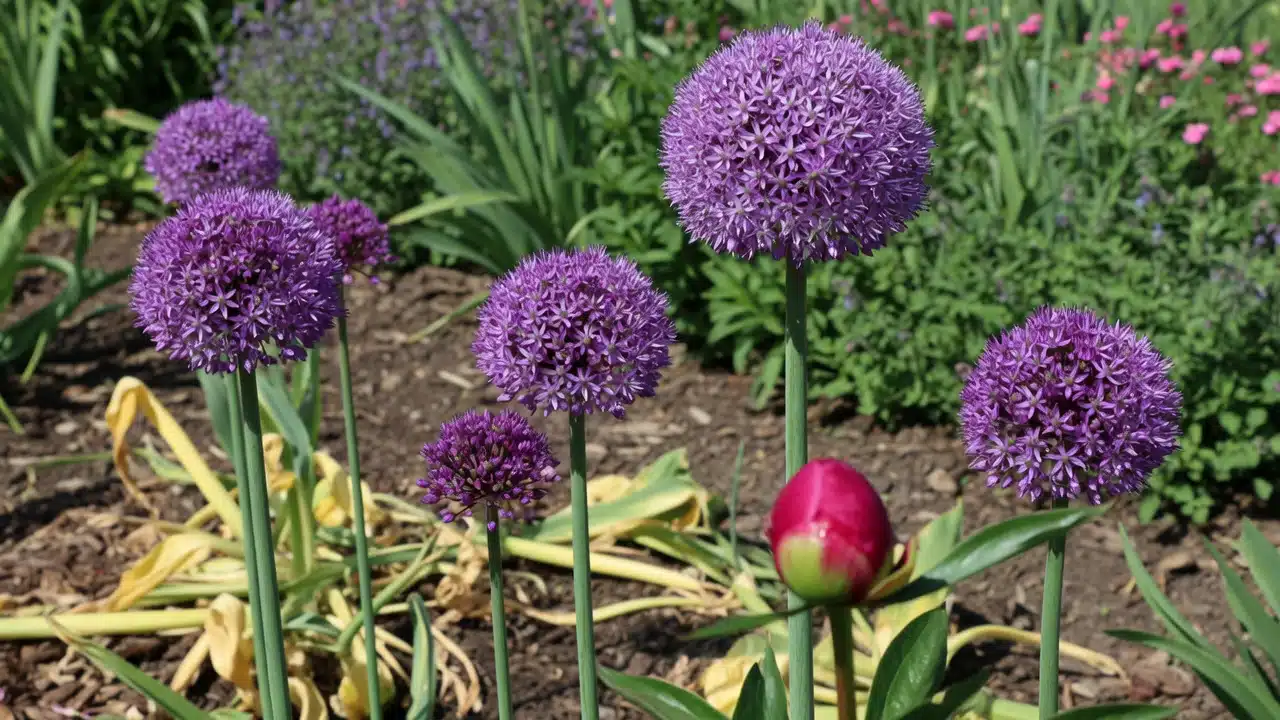
- Big ornamental globes — Allium giganteum, ‘Globemaster’, ‘Ambassador’, and A. hollandicum ‘Purple Sensation’. Fall-planted bulbs. Purple or white spheres on 2- to 4-foot stems in May and June. This is the plant most people mean.
- Smaller bulbs — drumstick allium (A. sphaerocephalon) in June–July; golden garlic (A. moly); Star of Persia (A. cristophii). Same sulfur, later or shorter show.
- Clump-forming types — chives (A. schoenoprasum), garlic chives (A. tuberosum), and summer cultivars such as ‘Millenium’. Michigan State Extension (June 26, 2026) notes these narrow-leaved types now show up in pots. Cornell’s Westchester Master Gardener survey files chives, ornamental onion, and garlic chives under plants rarely or never eaten.
- Kitchen onions and garlic — Iowa State puts onion and garlic with vegetables rarely damaged. Cornell Tompkins: between deer, rabbits, and woodchucks, the only crops they can grow without a fence are garlic, onions, and their relatives.
Native wild onion is a different job. Alabama Cooperative Extension rates American wild onion (Allium canadense) “excellent” for deer tolerance, and warns it is not nonnative wild field garlic (A. vineale) — solid, flat leaves versus hollow ones. Do not treat a suburban globe bulb as a forest ephemeral.
What deer skip, and why
Crush an allium leaf and you get the onion smell. That is alliinase converting S-alk(en)yl cysteine sulfoxides into thiosulfinates — allicin in garlic, related compounds in onion and chives. White-tailed deer do not need the lab name. They sample once, if they sample at all, and they walk on. Clemson Extension’s HGIC bulb note on Allium giganteum is the Southern version of the same fact: strong flavor and an oniony flower fragrance that deer skip. Michigan State: deer dislike allium because of pungent scent and taste.
The lists agree, with one hedge. Rutgers E271 rates ornamental onion Rarely Damaged in both the bulb and perennial columns. Iowa State files it under bulbs rarely damaged, and onion/garlic under vegetables rarely damaged. UGA Circular 985 lists Allium spp. among herbaceous plants deer rarely browse; Bulletin 1424 repeats ornamental onion on the “generally avoided” perennial table. Minnesota’s deer-resistant table puts Allium spp. at 1 to 4 feet — “tough and may self-seed.” Iowa State’s bulb FAQ (November 3, 2022) groups ornamental onions with daffodils as bulbs rabbits and deer seldom bother. UNH Extension (2018) puts allium with daffodils and snowdrops as usually safe without extra protection.
Cornell Tompkins is the line that keeps this from being a daffodil clone. Narcissus they call “practically immune.” Allium they call sampled, then mostly avoided. Sulfur is a taste aversion. Lycorine is a poison. Do not swap the two in a planting plan.
A 2010–2017 Cache County, Utah, garden survey in the Wildlife Society Bulletin (Conover 2018) found mule deer hitting tulips in about 70 percent of gardens and allium in about 10 percent (10 percent of greenhouse trials). The number is not zero. It is not a tulip.
Deer vs rabbit vs vole
If the bed is a wreck, diagnose the animal before you skip alliums because “something dug.”
- Deer. Ragged, shredded browse (Minnesota Extension: no upper incisors, so they tear). On alliums you should see intact stems and globes, plus hoof prints and pellets on the way to the tulips. A whole clump of ‘Purple Sensation’ mowed overnight is rare enough to question the ID.
- Rabbit. A clean 45-degree clip, usually low. Iowa State’s FAQ is the useful line: rabbits seldom bother ornamental onions either. If only the lowest greens on some other plant are gone, see how to keep rabbits out of the garden.
- Squirrel, chipmunk, vole. The diggers. Cornell’s Flower Bulb Research Program vole trial is more precise than a catalog “rodent-proof” claim. Allium cristophii sat in the little-or-no-injury group. Drumstick allium had about 30 percent digging and 10 percent bulb damage. ‘Purple Sensation’ had digging in every pot, 25 percent shoot damage, and no bulb damage. Voles can rummage. They often still leave the onion. A hole in a mixed bed in October is usually a tulip or a crocus.
Where they earn their keep
Alliums matter most in the gap after tulips. In New Jersey, Pennsylvania, New York, southern New England, Michigan, Wisconsin, and Minnesota, Darwin hybrids are already gone or caged by the time ‘Purple Sensation’ opens. Plant the globes in the same sun and the same fall window as the tulips you keep losing — then let the alliums stand uncaged.
Iowa State’s spring-bulb sheet is the depth table: large bulbs such as A. giganteum go 6 inches deep and 12 to 18 inches apart; small bulbs such as A. moly go 3 to 5 inches deep and 6 to 8 inches apart. Pointed end up. Well-drained soil. Full sun. The main way you kill an allium is rot in soggy clay, not a deer. Clemson’s South Carolina note is the heat caveat: dry to medium soil, full sun to part shade, and some light afternoon shade in that climate. Pollinators work the globes. Spent heads are architecture, not browse.
Foliage yellows after bloom. That is the plant shutting down, not a herd. Interplant later sun perennials — salvia, catmint, hardy geranium — so the hole is covered. Do not spray egg solids on a dormancy problem.
What actually works
Use alliums as the late-spring display, not as a security system.
- Swap the niche. If the point of the bed is a vertical purple ball in May, stop replacing Darwin hybrids. Cornell’s bulb Q&A: confine tulips and crocus to low-wildlife corners. Alliums take the next slot. The longer list lives on deer-resistant bulbs.
- Still fence the rest of the yard. Alliums will not save the hosta bed or the roses. Minnesota’s woven-wire standard for a real enclosure is at least 8 feet. A 4-foot picket is a step. Deer clear that without thinking. Layout and the rest of the defense stack: how to keep deer out of garden beds.
- Plant chives as an edge, not a wall. Cornell Westchester puts chives and garlic chives on the rarely-eaten list. That is a kitchen border. It is not a fence. Keep the culinary patch if you want it; cage the lettuce.
Find allium bulbs on Amazon Amazon associate tag checkcheck-20. We may earn a commission.
Purple Sensation allium bulbs on Amazon Amazon associate tag checkcheck-20. We may earn a commission.
8-foot deer fence on Amazon Amazon associate tag checkcheck-20. We may earn a commission.
What does not work as a strategy
A ring of alliums around tulips is not a fence. Michigan State treats allium as a plant deer avoid and as part of a mixed “buffer” bed, not a magic perimeter. Cornell is honest that deer food habits vary by yard. Plant alliums because you want alliums.
Do not read “deer-resistant bulbs” as “these will police the hostas.” UGA’s circular calls soap, human hair, and animal dung unreliable. Repellents belong on the plants deer actually eat; see which organic repellents actually hold up. Do not feed the herd to “distract” it — what to feed backyard deer is the page that says don’t. Drainage is the allium problem. Deer are the tulip problem.
Keep dogs and cats off the bulbs and the chopped leaves. The onion family is a pet-toxicity issue (hemolytic anemia from organosulfur compounds). The ASPCA onion entry is the sheet for the dog, not the herd.
Plant these with them
Alliums cover May and June. They do not cover April, and they do not cover shade.
- Daffodils — the honest April substitute. Lycorine, Rutgers A, Cornell “practically immune.” Same fall planting window, earlier bloom, actual staying power while the allium foliage is still low.
- Peonies — Rutgers-class rarely damaged perennial. Takes the same May–June sunny border as the globes, with a different silhouette.
- Lavender — scent, dry sun, Minnesota’s avoid list. Summer, not spring. Use it on the gravel edge once the allium foliage has gone yellow.
Fritillaria (crown imperial) is Cornell’s “generally animal-proof” bulb if you can stand the musk. Longer menus: deer-resistant perennials and flowers deer don’t eat. If the alliums are standing and everything else is gone, you have a herd, not an allium problem. Tulips go the week the spears show. Pansies take the window boxes. Hostas take the next shift in shade. Protect those; do not spray the onions.
Common questions
Will deer ever eat alliums?
Yes, once. Cornell’s “sampled, then mostly avoided” is the working sentence. Penn State’s ornamentals-and-deer compilation is the same caution the whole genus gets: no plant is safe under all conditions. Treat a single chewed tip as pressure, not as a reason to cage every globe.
Do deer dig up allium bulbs?
Almost never. Deer browse what they can grab. Squirrels, chipmunks, and voles are the diggers. Cornell’s vole pots show rummaging around some cultivars and little bulb loss on ‘Purple Sensation’. A hole in a mixed bed is usually a tulip or crocus.
Are chives or garlic more deer-proof than ornamental globes?
No sourced list splits them. Same genus. Iowa State puts culinary onion and garlic with vegetables rarely damaged. Cornell Westchester puts chives and garlic chives with ornamental onion on the rarely-or-never list. Pick the plant for the job — salad, edging, or a 4-foot purple ball — not for a secret rating.
Will planting alliums keep deer out of the rest of my garden?
No. They keep deer off the alliums. Hostas, tulips, roses, and pansies still need a fence, a cage, or a different plant. That is the point of the deer-proof garden list.
Sources
- Rutgers Cooperative Extension — Landscape Plants Rated by Deer Resistance (Ornamental onion, Allium sp., Rarely Damaged — A; E271)
- Rutgers NJAES E271 — Landscape Plants Rated by Deer Resistance
- Iowa State Extension — Susceptibility of plants to deer damage (ornamental onion, bulbs rarely damaged; onion and garlic, vegetables rarely damaged; last reviewed July 2022)
- Iowa State Extension — Spring-flowering bulbs rabbits and deer won’t eat (updated November 3, 2022)
- Iowa State Extension — Selecting and planting spring-blooming bulbs (planting depth and spacing for large and small Allium)
- Cornell Cooperative Extension, Tompkins County — Bulb Choices Q&A (“may be sampled and then mostly avoided”)
- Cornell Cooperative Extension, Tompkins County — Gardening With Deer Q&A
- Cornell Cooperative Extension — Deer Resistant Plants (ornamental onion, chives, garlic chives among herbaceous plants rarely damaged)
- Cornell Flower Bulb Research Program — vole feeding notes on Allium cultivars
- UGA Extension Circular 985 — Deer-Tolerant Ornamental Plants (Allium spp., herbaceous perennials and bulbs deer rarely browse)
- UGA Extension Bulletin 1424 — Landscape Basics: Success with Herbaceous Perennials (ornamental onion among perennials generally avoided by deer)
- University of Minnesota Extension — White-tailed deer damage (Allium spp. on the deer-resistant table; 8-foot fence)
- Clemson HGIC — Planting deer-resistant bulbs (Allium giganteum)
- Michigan State University Extension — Smart gardening with deer: summer bulbs (June 26, 2026)
- Alabama Cooperative Extension — Deer-tolerant native flowers (Allium canadense, excellent deer tolerance)
- University of New Hampshire Extension — How can I keep wildlife from eating my new bulbs? (October 10, 2018)
- Conover, M. R. 2018. “Susceptibility of spring-flowering garden plants to herbivory by mule deer.” Wildlife Society Bulletin 42: 321–326. doi:10.1002/wsb.864
- ASPCA — Onion (Allium cepa) toxic to dogs, cats, and horses
Part of the Deer-Proof Garden Guide. Wild diet lives on what deer eat.


