
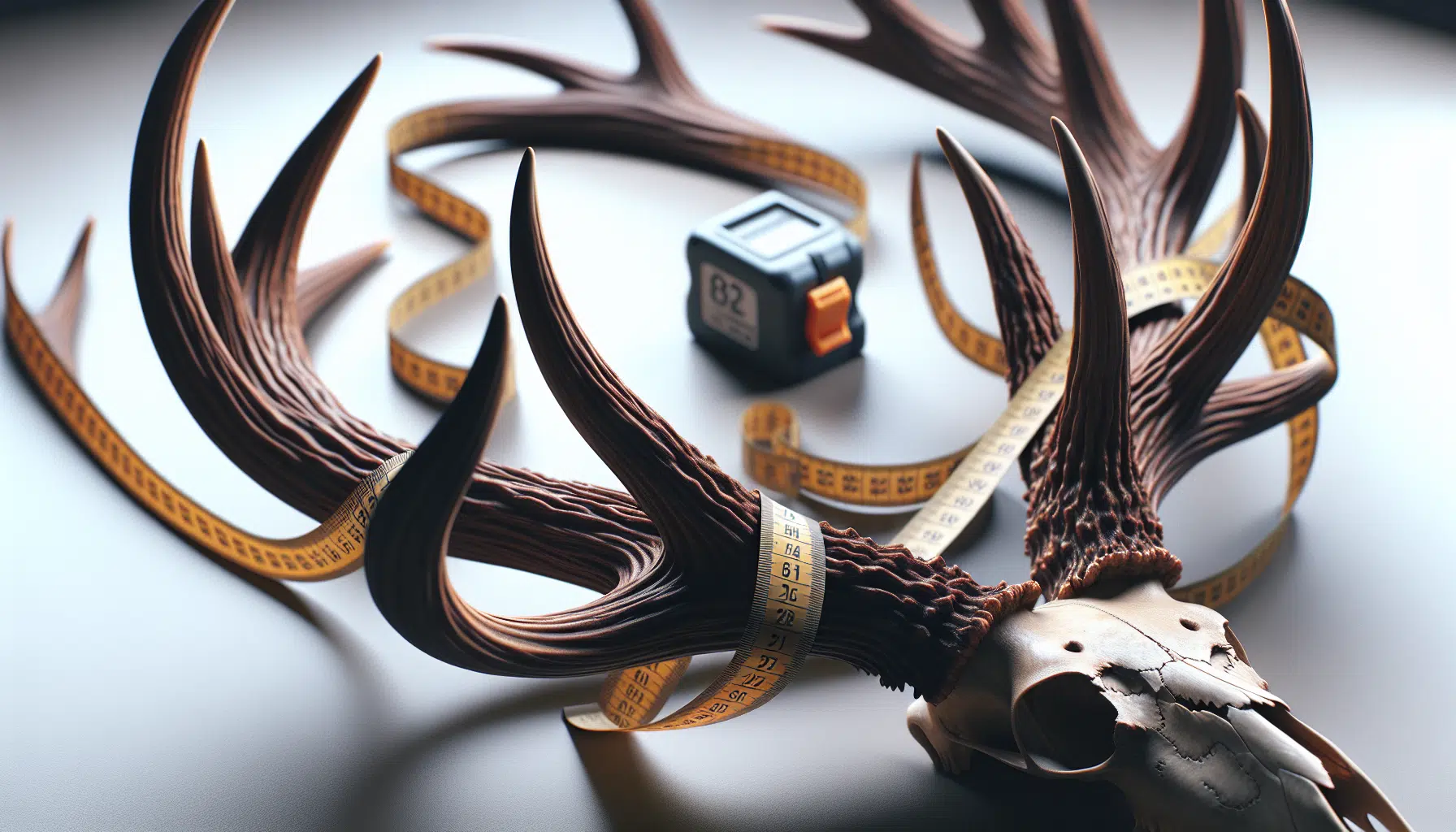
Make the Call Fast. Inside Spread Is Simple If You Measure It the Same Way Every Time.
To measure inside spread on deer antlers, I measure the widest point between the inside edges of the main beams, at a right angle to the skull, using a tape or a spreader ruler.
If the tips are the widest part, I measure tip-to-tip on the inside edges. If the beams flare widest at the “ears,” I measure there instead.
I have been hunting whitetails for 23 years, starting with my dad in southern Missouri when I was 12.
I grew up broke and learned on public land before I could afford any lease, so I learned to judge racks fast and honestly.
Decide What You Are Measuring For. Scoring, Photos, Or Real-World Judging.
You need to decide if this inside spread is for a real Boone and Crockett style score, or just your own record book.
If you mix methods, you will lie to yourself without meaning to.
Here is what I do when I want a number I can compare year to year.
I measure it exactly like a scoring sheet expects, even if it makes the rack “smaller” than the hero photo angle.
Back in November 2019 in Pike County, Illinois, I killed my biggest buck, a 156-inch typical, the morning after a cold front.
I wrote the inside spread down the same day because I knew by the next weekend I would start rounding up in my head.
My buddy swears by using ear-tip width as a shortcut and calling it good.
But I have found the ear trick gets you close on some bucks and way off on others, especially in the Missouri Ozarks where genetics and age make goofy head shapes.
Mistake To Avoid. Do Not Measure Outside Spread And Call It Inside Spread.
I see this mistake all the time at camp and on social media.
Outside spread looks bigger, but it is not the number anyone means by “inside spread.”
Inside spread is the distance between the inside edges of the main beams at the widest point.
If you hook your tape on the outside edge, you are measuring a different thing and you will inflate it by 1 inch to 3 inches on a lot of bucks.
I learned the hard way that little “fudges” turn into big lies once you have a few racks on the wall.
Back in 2007 I made a mistake that still sticks with me, gut shot a doe, pushed her too early, and never found her.
That was about tracking, not antlers, but it taught me the same lesson about honesty and discipline with deer.
Pick Your Tool. Tape Measure Works, But A Spreader Ruler Is Faster.
You can measure inside spread with a normal soft tape, a steel tape, or a spreader ruler.
The “best” one depends on whether the rack is on a skull plate, on a European mount, or still on the deer.
Here is what I do in my garage when I am processing a deer and the head is still fresh.
I use a basic 25-foot Stanley tape because it is already in my toolbox, and I can read it in low light.
If I am scoring a rack on a table, I like a dedicated rack ruler like the Allen Antler Ruler because it sits straight across the beams.
I wasted money on gimmicky scoring kits with plastic parts that bent the first season, then I went back to simple tools that do not lie.
If you want one tool that works every time, buy a good metal tape and learn the method.
Find This and More on Amazon
My Quick Rule of Thumb
If the rack is still on the deer, do the inside spread measurement before you cut the head off.
If you see the beams flare widest above the brows, expect the widest inside spread to be mid-beam, not at the tips.
If conditions change to a dried skull or mount, switch to a spreader ruler or a stiff tape so it stays straight.
Step-By-Step. How I Measure Inside Spread In The Garage.
I process my own deer in the garage, and my uncle who was a butcher taught me to do things clean and repeatable.
Measuring antlers is the same deal, so I do it in the same order every time.
Here is what I do, step by step, on a buck head or a skull plate.
I set the head on a flat table with the nose pointed forward and the skull level.
I look straight down from above and find the widest point between the inside edges of the main beams.
I do not guess where it “looks” widest from the side, because that is where people cheat without realizing it.
I hold the tape so it crosses at a right angle to the skull, not diagonally.
Then I touch the tape’s edge to the inside of the left main beam, and read where it hits the inside of the right main beam.
If the widest point is at the tips, I measure tip-to-tip on the inside edges, not the outside.
If the widest point is lower, I measure there, even if it makes the number smaller than the rack’s “feel.”
I write the number down right then, because memory turns a 16 3/8 into an 18 by next season.
Tradeoff. Measuring On The Deer Vs. After The Cape Job.
If you are caping for a shoulder mount, you can still measure inside spread, but you need to stay clean and not fight the hide.
The tradeoff is speed versus accuracy.
Here is what I do if the buck is laying in leaves and it is getting dark.
I do a quick inside spread measurement before caping, then I measure again later on the skull plate to confirm.
Back in the Missouri Ozarks on public land, I have dragged bucks 350 yards through brush and busted tines off doing it.
If you wait until after a hard drag, you might be measuring a rack that is not the same rack you shot.
If you are hunting thick cover and long drags are likely, forget about “perfect photos” and focus on protecting the antlers first.
Where Guys Mess Up. Angle And Contact Points Change The Number.
The easiest way to blow inside spread is to measure at a slant.
A diagonal tape will always read bigger than a true inside spread line.
Here is what I do to keep myself honest.
I make sure the tape crosses like a bridge, straight across, not following the curve of the beams.
I measure between the inside edges, not center-to-center and not “to the burr.”
I also measure the widest spot, not the spot that is easiest to reach with my hand.
On a lot of mature whitetails, the widest spot is not where you want it to be.
Some racks flare and then tuck back in at the tips, and guys still measure tip-to-tip because it feels right.
Use The Ear Trick For Field Judging, But Do Not Pretend It Is A Tape.
I do use ears to judge spread while hunting, and it has saved me from bad decisions.
But it is a quick check, not a real measurement.
Here is what I do in the stand when a buck gives me a 4-second look.
I compare the rack width to ear-tip-to-ear-tip when the ears are relaxed, not pinned back or cupped forward.
On a lot of whitetails, ear-tip width is around 14 inches to 16 inches, but that varies by deer and region.
In Southern Iowa farm country, I have seen big-bodied deer with heads that made average spread look wide.
In Buffalo County, Wisconsin hill country with pressure, I have watched bucks carry tight racks that looked small until they turned just right.
If you are hunting pressured public and a buck is skittish, forget about perfect judging and focus on getting a clean shot angle.
This connects to what I wrote about are deer smart because old bucks use your hesitation against you.
Inside Spread And Score. Do Not Overvalue It Compared To Mass And Tine Length.
Inside spread is the stat everyone talks about, but it is not the whole story.
A 17-inch inside spread can score less than a 15-inch rack with heavy mass and long tines.
Here is what I do when I am trying to decide if a deer is a shooter on my 65-acre lease in Pike County, Illinois.
I look at main beam length, G2 and G3 length, and how deep the forks are before I get hung up on spread.
My buddy swears spread is king because it shows up in photos.
But I have found the deer that score best usually have beams and mass that jump out, even if the inside spread is only ear-wide.
When I am thinking about what a buck might weigh and how mature he is, I also check how much does a deer weigh because big frames often carry antlers different.
When I want a reality check on why antlers even grow the way they do, I go back to why do deer have antlers because it keeps my expectations grounded.
How I Record Spread So I Can Trust It Years Later.
I keep a simple log, because I have two kids now and my brain is full of school dates and soccer schedules.
If I do not write it down, it is gone.
Here is what I do after the rack is measured.
I write the inside spread to the nearest 1/8 inch, and I note where it was measured, like “widest mid-beam” or “tip-to-tip.”
I take one straight-on photo from above with the tape in the frame.
I also write down the date, time, and weather, because that stuff matters to me as a hunter.
That is the same reason I track movement and check deer feeding times before I pick a sit.
If the wind was tricky, I note it, because it ties into do deer move in the wind and I can learn from it.
Tradeoff. Green Measurements Versus Dried Skull Measurements.
A fresh head has hide, hair, and sometimes swelling that can fool your tape placement.
A dried skull is cleaner but you might have already cut and moved things around.
Here is what I do so the number stays honest.
I measure once in the field for my notes, then measure again after the skull plate is cleaned.
If the numbers differ by more than 1/4 inch, I re-check my angle and contact points.
I do not average them, because averaging is another way hunters quietly cheat.
Common Scenarios. Which Point Should You Measure On Weird Racks?
Normal 8-points and 10-points are easy because the main beams are the reference.
Weird racks are where guys start making up their own rules.
Here is what I do when the rack is not symmetrical.
I still measure inside spread between the inside edges of the main beams at the widest point, even if one side is twisted.
I do not measure between tines, because inside spread is not “inside tine spread.”
If a tine curves inward and narrows the opening, I ignore it for inside spread, because it is not the main beam.
If the beams are palmated or lumpy, I pick the true inside edge line of the beam, not a random bump.
FAQ
Where exactly do I measure inside spread on a deer rack?
Measure the widest distance between the inside edges of the main beams, at a right angle across the skull.
Do not measure outside edge to outside edge, and do not measure diagonally.
Do I measure inside spread at the tips or the widest point?
Measure at the widest point between the main beams, even if that is not the tips.
If the tips are widest, then tip-to-tip on the inside edges is correct.
Can I use the ear-tip trick to estimate inside spread while hunting?
Yes, but it is only a quick check, not a real measurement.
Ears change position, and some deer have bigger or smaller heads depending on region and age.
Does inside spread add to a Boone and Crockett style score?
Yes, inside spread is part of the typical score, but it is only one line item.
Mass and tine length often matter more than hunters want to admit.
Should I measure inside spread before or after I cape the buck?
Measure it before you cut if you can, then confirm later on the skull plate.
If you wait until after a rough drag or caping job, you can break tines or shift things and change what you are measuring.
Next Decision. Do You Want A “Tape Correct” Number Or A “Camp Story” Number?
This is where guys have to be honest about why they are measuring.
If you want a legit number, you have to accept that some racks “look wide” but do not measure wide.
Here is what I do with my own bucks.
I record the tape-correct inside spread, and if it looks wider in photos, I just enjoy that part without changing the number.
If you are also trying to decide where to place your shot to protect the rack and still kill fast, I tie this to where to shoot a deer to drop it in its tracks.
If you want to handle the head clean after the shot so you can measure and process without a mess, this also connects to how to field dress a deer.
Next Decision. Do You Want A “Tape Correct” Number Or A “Camp Story” Number?
This is where guys have to be honest about why they are measuring.
If you want a legit number, you have to accept that some racks “look wide” but do not measure wide.
Here is what I do with my own bucks.
I record the tape-correct inside spread, and if it looks wider in photos, I just enjoy that part without changing the number.
If you are also trying to decide where to place your shot to protect the rack and still kill fast, I tie this to where to shoot a deer to drop it in its tracks.
If you want to handle the head clean after the shot so you can measure and process without a mess, this also connects to how to field dress a deer.
Back in November 1998 in Iron County, Missouri, I killed my first deer, an 8-point buck, with a borrowed rifle.
I had no clue what the inside spread was, and I still remember how easy it is for pride to start “measuring” for you.
I learned the hard way that if I do not measure the same way every time, the number becomes a story instead of a record.
So I keep it simple and repeatable, whether I am on my Pike County, Illinois lease or dragging one out of the Missouri Ozarks on public land.
If you want the same thing, measure inside edge to inside edge, at the true widest point, at a right angle to the skull, and write it down before your buddies start guessing.
That is how you end up with a number you can trust five seasons from now, even when the memory of that morning gets bigger than the rack.