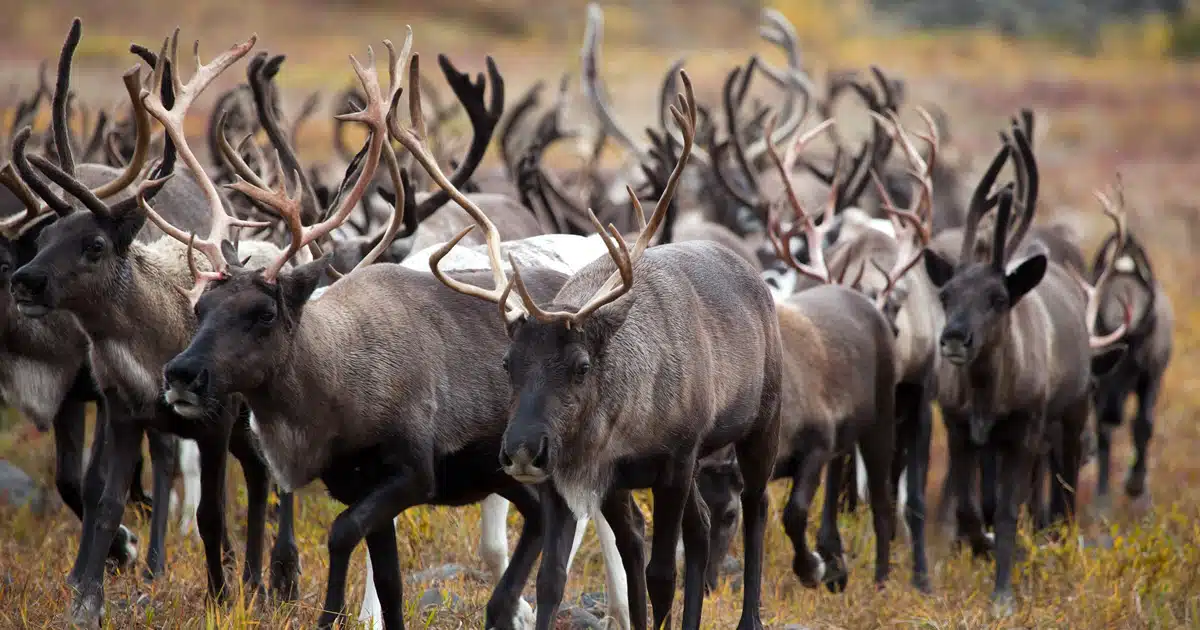
An adult caribou typically stands about 3 to 5 feet (roughly 0.9 to 1.5 meters) tall at the shoulder and measures 5 to 7 feet long. Mature bulls generally weigh somewhere between 250 and 400 pounds (about 110 to 180 kilograms), with exceptionally large males of some populations approaching 600 pounds, while cows are considerably smaller at roughly 130 to 260 pounds. Size varies a great deal by subspecies — from the compact Svalbard reindeer to big-bodied woodland caribou — so any single number is only a midpoint in a wide range.
Caribou and reindeer are the same species, Rangifer tarandus, so these figures cover both. In this article we’ll break down height, length, and weight, look at how the sexes and subspecies differ, and see how a caribou stacks up against the other big deer of the north.
Caribou Size at a Glance
| Measurement | Typical Range |
|---|---|
| Shoulder height | 3–5 ft (0.9–1.5 m) |
| Body length | 5–7 ft (1.5–2.1 m) |
| Bull (male) weight | 250–400 lbs (110–180 kg), exceptional bulls larger |
| Cow (female) weight | 130–260 lbs (60–120 kg) |
| Weight at birth | Roughly 10–20 lbs (4.5–9 kg) |
Treat these as honest ranges rather than precise targets. Caribou sizes are measured across wild populations spread over half the globe, and the difference between a small island reindeer and a big boreal bull is dramatic.
Bulls vs Cows: How Much Bigger Are Males?
Like most deer, caribou are sexually dimorphic — bulls are noticeably larger than cows. A mature bull may weigh half again as much as a cow from the same herd, sometimes nearly twice as much. Bulls also carry much larger antlers and develop thick necks and a prominent white mane heading into the fall rut.
That said, the size gap between the sexes is smaller in caribou than in some other big deer, and the two sexes share one famous feature: in caribou, cows regularly grow antlers too — the only deer species where that’s the norm. The antlers of a bull are far larger, but an antlered female caribou is completely ordinary.
Size Differences Between Caribou Subspecies
Where a caribou lives says a lot about how big it will be. A few broad patterns stand out:
- Woodland caribou of Canada’s boreal forest are generally the largest-bodied caribou, with big bulls at the upper end of the species’ weight range.
- Barren-ground caribou, the great migratory herds of Alaska and northern Canada, are mid-sized — lighter-built animals that travel enormous distances every year.
- Peary caribou of Canada’s High Arctic islands are small and pale, an economy-sized caribou for a landscape with very little food.
- Svalbard reindeer are the most compact of all — short-legged and stocky, often weighing about half as much as their mainland cousins.
- Domesticated reindeer in Scandinavia and Siberia tend to run somewhat smaller than wild tundra reindeer.
This pattern — smaller bodies on colder, poorer island ranges and bigger bodies in productive forests — is a nice example of how food supply shapes body size in deer. Knowing where a caribou lives gets you a long way toward guessing its size.
A Caribou’s Weight Changes with the Seasons
One reason published caribou weights vary so much is that the same animal can weigh dramatically different amounts at different times of year. Caribou fatten through the brief, rich Arctic summer, hitting their heaviest in early fall. Then the drawdown begins: bulls burn through much of their fat reserve during the exhausting fall rut, sometimes losing a striking share of their body weight in a few weeks, and every caribou loses condition over a long winter of low-protein lichen. By spring, a caribou may be a notably lighter animal than it was in September.
So when you see a weight quoted for a caribou, it’s worth asking: weighed when? A fall bull and a spring bull are almost two different animals on the scale.
What About Those Antlers?
Caribou carry the largest antlers relative to body size of any deer. A big bull’s rack can sweep back and up well over three feet, with the distinctive forward-reaching “shovel” over the face. Antlers are grown and shed every year, and a bull’s headgear can account for a meaningful share of the impressive silhouette that makes caribou look even bigger than they are.
How Does a Caribou Compare to Other Big Deer?
The caribou is a genuinely large deer — but it sits in the middle of the northern heavyweight lineup.
Caribou vs moose
No contest here. A moose is the largest deer on Earth, standing 6 feet or more at the shoulder and commonly weighing two to three times as much as a caribou. Seen together, a caribou looks almost dainty next to a moose — our full moose vs caribou comparison covers the differences in detail.
Caribou vs elk
An elk is also bigger than a caribou. Bull elk typically stand around 5 feet at the shoulder and often weigh 700 pounds or more — taller and heavier than nearly any caribou. The caribou’s advantage isn’t bulk; it’s cold-weather engineering.
Caribou vs white-tailed deer
Compared with a whitetail, a caribou is a giant. Most white-tailed deer weigh between 100 and 300 pounds, so even an average caribou bull outweighs almost any whitetail, and stands taller on longer, sturdier legs.
Why Caribou Are the Size They Are
Caribou size is a balancing act. A bigger body holds heat better in Arctic cold — but a migratory animal that may travel thousands of miles a year can’t afford to haul moose-sized bulk across the tundra on a diet of lichen and sedges. The caribou’s build — big enough to endure the cold, light enough to keep moving — is a compromise tuned by its environment. Add snowshoe hooves, a dense double coat, and that heat-exchanging nose, and you get an animal sized precisely for its way of life.
Frequently Asked Questions
How tall is a caribou compared to a human?
At the shoulder, a large caribou stands about chest-high on an adult person — roughly 4 to 5 feet. Add the head and antlers, though, and a bull can look you straight in the eye and then some. Standing next to one, most people are surprised by how substantial these animals feel in person.
Is a caribou bigger than a reindeer?
They’re the same species, so this is really a question about populations. On average, wild North American caribou — especially woodland caribou — do tend to be larger than the domesticated reindeer of Scandinavia and Siberia, and much larger than island subspecies like the Svalbard reindeer. So “caribou are bigger than reindeer” is roughly true in practice, even though biologically they’re one animal.
How much does a baby caribou weigh?
Caribou calves generally weigh somewhere around 10 to 20 pounds at birth — and they grow fast. Nursing on extremely rich milk and grazing within weeks, a calf can double its birth weight remarkably quickly, which it needs to do to be ready for its first migration and its first Arctic winter.