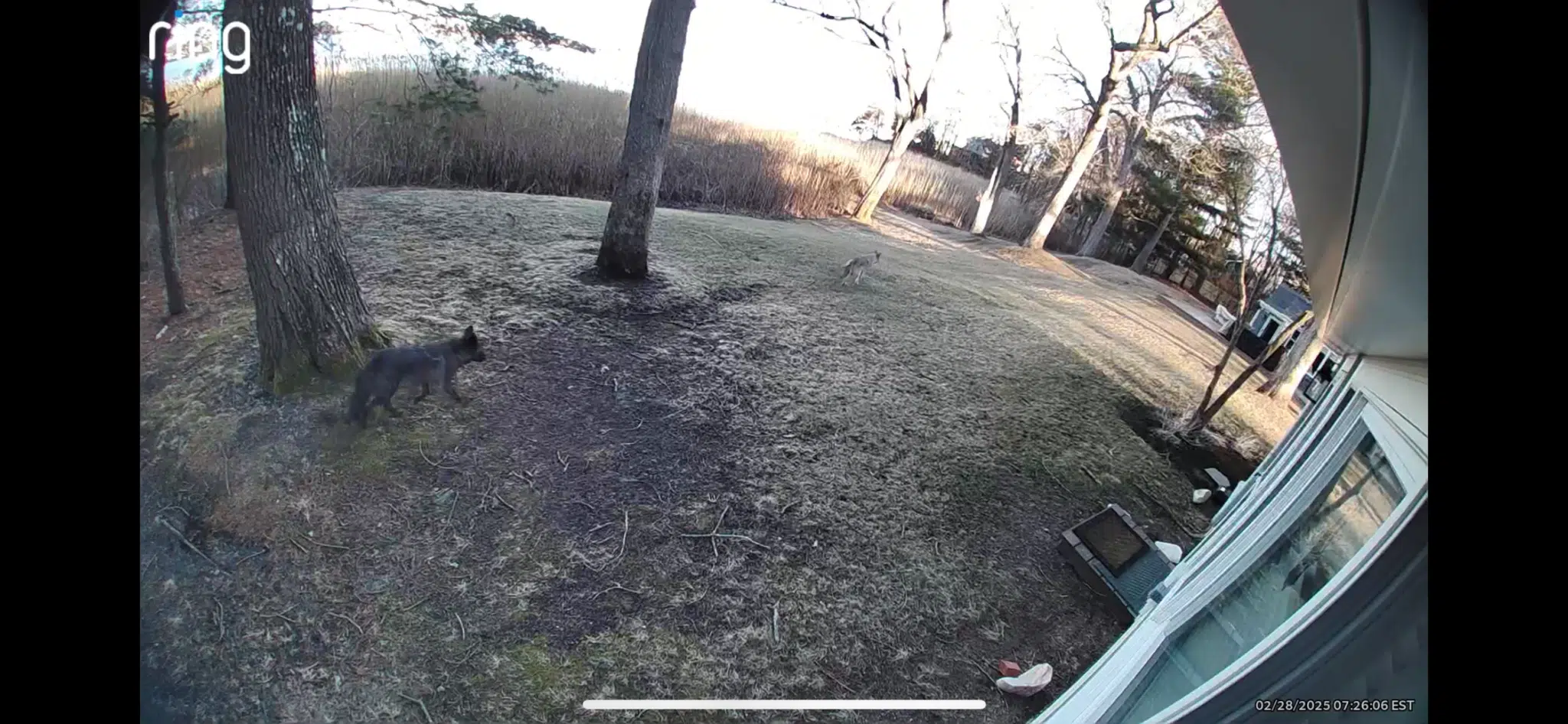
That chorus of howls and frantic yips you hear at night is almost always ordinary coyote conversation: family members announcing their territory, calling each other back together, or answering a siren — not celebrating a kill, and not gathering to hunt. Coyotes use roughly a dozen distinct vocalizations, but the ones people hear most are the lone howl (“I am here”), the group yip-howl (“we are here, this is our territory”), and sharp barks (alarm). And thanks to a well-documented acoustic illusion, two or three coyotes routinely sound like a pack of ten.
The coyote’s scientific name, Canis latrans, literally means “barking dog,” and it is the most vocal wild canid in North America. Once you can tell a territorial chorus from an alarm bark or a pup’s practice howl, a night of coyote sound goes from eerie to genuinely readable. Here is what each sound means, when you are most likely to hear them, and what — if anything — you should do about it.
The Main Coyote Sounds and What Each One Means
| Sound | What it sounds like | What it usually means |
|---|---|---|
| Lone howl | A long, rising-and-falling wail from one animal | Location broadcast: announcing presence, contacting family, advertising territory |
| Group yip-howl | Several voices howling with rapid yips, barks, and squeals layered in | Family reunion or territorial chorus: “this range is occupied” |
| Bark / bark-howl | Sharp, dog-like barks, sometimes ending in a short howl | Alarm or threat warning — often aimed at an intruder, person, or dog near a den |
| Yips and squeals | High, excited chatter, often from multiple animals | Greeting and social excitement, especially at family reunions; also pup play |
| Huffs and growls | Low, close-range sounds | Threat or defensiveness at close quarters — back away and haze |
| Whines | Soft, high sounds at close range | Submission and contact between family members; pups begging |
Why Do Coyotes Howl at Night?
Coyotes are most active from dusk to dawn, especially near people, so that is when they talk. Howling serves the same purposes for coyotes that scent-marking and patrolling do: it announces occupancy of a territory to neighboring families without anyone having to fight, it lets separated family members find each other across miles of ground (a howl carries far — commonly a mile or more, and much farther on still nights), and it reinforces bonds when the family reunites. Most choruses happen in the first hours after dark and again before dawn, bracketing the night’s hunting, and activity peaks seasonally during the January-to-March breeding season and again in late summer and fall when that year’s pups start finding their voices and families begin to disperse.
Why Two Coyotes Sound Like Ten: The “Beau Geste” Effect
The single most common question people ask after a night chorus is how large the pack must be, and the honest answer is: far smaller than it sounds. Coyotes rapidly vary pitch and switch between howls, yips, barks, and warbles mid-chorus, and each shift can register to the human ear — and to rival coyotes — as a different animal. Researchers call this the “beau geste” effect, after a novel in which defenders propped up dead soldiers to look like a larger garrison. Add in echoes off hillsides and buildings, and a mated pair with two pups can convincingly impersonate a dozen animals. Studies of known, radio-collared groups confirm that most howling “packs” are simply a family: two parents and their current young.
Do Coyotes Howl When They Make a Kill?
This is one of the most persistent myths about coyote sound, and it runs exactly backwards. Coyotes are generally quiet around a kill — advertising a fresh carcass would invite competitors, from neighboring coyotes to eagles, and in some regions wolves or bears. Nor do the excited yips mean a pack is “celebrating” a takedown of someone’s pet. Choruses are social and territorial, full stop. It is also worth remembering that coyotes are not pack-hunters in the wolf sense: as we cover in what coyotes eat, most hunting is a solitary business of mousing and rabbit-chasing, with occasional pair work on larger prey — nothing like the coordinated group pursuits described in how wolves hunt.
For the curious, coyote sound rewards actual listening. Keep a window cracked on still winter nights in January and February, when breeding-season conversation peaks, and note the pattern: a lone howl, an answer from another direction, then the full family chorus — the same call-and-response structure, night after night. Phone apps and simple audio recorders capture choruses well enough to compare against reference recordings, and many nature centers and extension offices run winter “coyote listening” walks for exactly this reason. Families with kids can turn an eerie noise into a science project: log the time, direction, and length of each chorus for a month, and you will map your neighborhood pack’s routine better than most residents ever do.
Coyotes Answering Sirens, Trains, and Each Other
If a fire truck rolls through coyote country at night, the neighborhood chorus often erupts within seconds. A siren’s rising wail sits close enough to a howl’s acoustic profile that coyotes treat it as a strange animal announcing itself, and they answer reflexively — pups especially. The same goes for train horns, certain dog howls, and even harmonica notes. One family’s chorus also frequently triggers answers from neighboring territories, so a single siren can set off a relay of choruses across a whole valley. None of it signals distress or danger; it is roll call.
Weather runs the volume knob as much as season does. Sound carries best on cold, still, humid nights — classic January conditions — and choruses seem to double in number when a temperature inversion bends the sound down along the ground. Windy nights suppress both the howling and your ability to hear it, which is why coyotes can seem to “disappear” for a week and return without ever leaving.
Coyote Sound vs. Fox, Wolf, and Dog
Coyote howls are higher-pitched and more warbling than the low, sustained, mournful howl of a wolf, and a coyote chorus is busy with yips where a wolf chorus stays comparatively smooth and deep. Domestic dogs bark repetitively and monotonously; coyote barks come in short, purposeful bursts, usually with howl elements mixed in. Foxes are the other common night-screamer people confuse with coyotes: a red fox produces a raspy, single-note scream repeated at intervals, with none of the coyote’s rolling group chatter. If what you heard was one repeated shriek rather than a layered chorus, you likely had a fox rather than a coyote.
What Should You Do When You Hear Coyotes?
Usually nothing — a night chorus is no more a threat than birdsong at dawn, and it usefully tells you a territory-holding family lives nearby, which actually keeps transient coyotes away. The sensible responses: bring cats in and supervise small dogs at night, since the chorus confirms coyotes are active; do not let dogs “answer” from the yard, which can draw a territorial visit during breeding season; and if barking or bark-howling seems aimed at you on a walk, you are probably near a den — leash your dog and leave the area calmly. Persistent close-range daytime boldness, not sound, is the sign worth reporting; our guide on whether coyotes are dangerous covers exactly where that line sits and how to haze effectively.
The Full Repertoire: A Dozen Calls, Three Jobs
Researchers who have catalogued coyote vocalizations typically describe roughly eleven to thirteen distinct call types, but every one of them serves one of three jobs: contact (find me / I am here), threat (back off), or greeting (we are together again). Lone howls, group howls, and group yip-howls carry the contact and territorial load across distance. Barks, bark-howls, huffs, and growls carry threat at closer range, with intensity scaling from a single warning bark to sustained bark-howling at a persistent intruder. Whines, yelps, squeals, and the giddy chatter of a reunion carry the social side, most of it at close range within the family. Pups complicate the soundscape delightfully from midsummer on: their early attempts crack, warble, and overshoot, and a family chorus in August often sounds chaotic precisely because half the voices are teenagers still finding pitch. By the time young disperse in fall, they carry the full adult songbook with them into new territory.
How Close Are They? Reading Distance and Direction
Coyote choruses reliably sound closer than they are. The yip-howl is pitched to carry, night air bends sound downward toward listeners, and hard surfaces — hillsides, tree lines, houses — bounce it until a chorus half a mile off seems to come from the back fence. A few practical calibrations help: if you can hear discrete, crisp yips between howls, the animals are usually within a few hundred yards; if the chorus smears into a wail with the high notes rounded off, it is likely much farther. Direction is even less trustworthy than distance in a neighborhood full of echo, so resist the certainty that they are “right behind the shed.” And remember what the sound actually tells you: where coyotes are advertising, not where they are hunting — a family that howls from the same drainage every night is telling you the stable center of its territory, which is useful intelligence for deciding where the dog does and does not roam after dark.
How many coyotes are actually howling?
Almost always fewer than you think — typically a mated pair and their pups of the year. The rapid pitch-shifting of the group yip-howl, plus echo, reliably doubles or triples the apparent number. True gatherings larger than a family group are uncommon and usually brief, such as several animals converging on a large carcass.
Why do coyotes howl in the middle of the day?
Daytime howling is normal, if less common than at night. Families answer sirens at noon just as they do at midnight, parents call to pups, and neighboring groups trade territorial choruses at any hour. Daytime sound alone does not indicate a sick or dangerous animal.
Do coyote sounds mean pets are in danger right now?
Not in the immediate sense — howling coyotes are communicating, not hunting; hunting coyotes are silent. But the chorus does confirm active coyotes within a mile or so, which is a good nightly reminder to bring cats indoors, accompany small dogs on late-night yard trips, and secure attractants like pet food and unsecured garbage.
What does it mean when a coyote barks over and over?
Repeated barking or bark-howling is alarm, not hunting: the coyote perceives a threat it wants gone — often a person or dog too close to a den or a food cache. Take the hint, leash up, and walk away; the barking nearly always stops once you put distance between yourself and whatever it is defending.