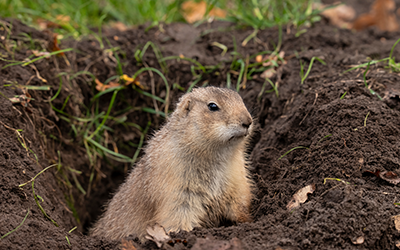
A groundhog is a large marmot — a 5-to-14-pound member of the squirrel family that grazes above ground in daylight and digs burrows with big, open, soil-fanned entrances. A gopher (properly, a pocket gopher) is a much smaller rodent from an entirely different family, half a pound or so, that lives almost its whole life underground and announces itself only through crescent-shaped dirt mounds with no visible hole. If you can watch the animal eating your plants, it’s almost certainly a groundhog; if you never see an animal at all — just fresh mounds and plants pulled down into the earth — you have a gopher.
The confusion is understandable. Both are stocky, burrowing, garden-raiding rodents, and in parts of the Midwest “gopher” is used loosely for everything from ground squirrels to groundhogs (Minnesota, the “Gopher State,” is actually named for the thirteen-lined ground squirrel). But the two animals overlap barely at all in biology, and — more to the point for a frustrated gardener — the damage they cause and the fixes that work are completely different. Here is how to tell them apart quickly and what to do about each.
| Feature | Groundhog (woodchuck) | Pocket gopher |
|---|---|---|
| Family | Squirrel family (Sciuridae); a true marmot | Pocket gopher family (Geomyidae) |
| Size | 16–27 inches, 5–14 pounds | 5–10 inches, typically under a pound |
| Where it feeds | Above ground in daylight, near the burrow | Almost entirely underground, rarely surfaces |
| Burrow sign | Open entrances 10–12 inches wide with a fan of soil | Crescent- or fan-shaped mounds, hole plugged with soil |
| Signature damage | Plants mowed to stubble; digging under sheds and slabs | Plants wilting or pulled down by the roots; ridges and mounds in turf |
| Winter | True hibernation, October–February/March | Active all winter underground |
| Range | Eastern and central North America into Canada and Alaska | Roughly 40 species across western and central North America |
Two Very Different Rodents
The groundhog (Marmota monax) is a marmot — the same genus as the yellow-bellied marmots of western mountains — and one of the largest members of the squirrel family. It is built like a small badger, grazes sitting up in the open, whistles an alarm call (hence “whistle-pig”), climbs low trees, and swims competently. Pocket gophers are something else entirely: roughly 40 species of specialized digging machines named for the fur-lined external cheek pouches (“pockets”) they use to carry food. A gopher’s lips actually close behind its ever-exposed incisors so it can gnaw through soil and roots without eating dirt, and its whole anatomy — tiny eyes and ears, sensitive whiskers, a touch-sensitive tail it uses to “see” while running backward through tunnels — is tuned for a life spent underground. Our companion overview of gophers and how they live covers that remarkable anatomy in more depth.
Even the names tell the story of the confusion. “Woodchuck” is an English mangling of an Algonquian word (often given as wejack or similar) that had nothing to do with wood or chucking; “whistle-pig” describes the alarm call; and “gopher” likely derives from the French gaufre, “honeycomb,” for the way pocket gophers riddle the ground with tunnels. Settlers spread “gopher” across whatever burrowing animal was local — pocket gophers, ground squirrels, even tortoises in the Southeast (the gopher tortoise carries the name to this day). The result is that “gopher” is a folk category, not a species, which is precisely why sorting your actual animal matters before you spend money on fixes.
Reading the Dirt: Burrows vs Mounds
You will usually diagnose the animal from its earthworks long before you see fur, and the earthworks are wonderfully diagnostic. A groundhog burrow has a main entrance you could fit a softball into — 10 to 12 inches across — with a conspicuous fan or porch of excavated soil, plus one or more cleaner “plunge holes” dug from below, often tucked under a shed, stoop, brush pile, or fence line. The tunnels behind it commonly run 20 to 30 feet, with a nest chamber and even a separate latrine chamber.
A pocket gopher leaves no open hole at all. It pushes soil out sideways as it digs, creating a crescent or fan-shaped mound with a visible soil plug at the off-center “horseshoe” — distinct from a mole’s volcano-shaped mound centered over its hole. One gopher can build one to three mounds a day and several dozen in a month, so a lawn can look bombarded in a few weeks. If your mounds appeared explained by neither animal, our article on why gophers build mounds walks through mound identification in detail.
Damage Patterns: Mowed vs Vanished
Groundhog damage happens above ground and looks like grazing: beans, greens, and hostas mowed to stubble in a patch near cover, a bite taken out of several ripe tomatoes or melons, young fruit trees gnawed in early spring, and structural digging under sheds, decks, and foundations. It happens in daylight, and a morning of watching from a window usually catches the culprit in the act — the full menu is covered in what groundhogs eat.
Gopher damage is stranger and more ghostly. Plants wilt for no visible reason because their roots have been eaten from below; a gardener occasionally watches an entire plant tremble and disappear downward into the soil, pulled by an animal nobody sees. Root crops are hollowed out, drip lines and buried cables get gnawed, and turf develops soft ridges and fresh mounds. Certain plantings pull gophers in — moist, well-tilled beds full of fleshy roots are effectively bait — while a handful of plants seem to be avoided; both sides of that ledger are covered in our gopher guides.
The scale of the earthworks differs as much as their shape. A groundhog’s burrow system is deep and architectural — commonly 20 to 45 feet of tunnel reaching several feet down, with a grass-lined sleeping chamber, a hibernation chamber below frost line, and a separate latrine — and estimates of the soil moved run to several hundred pounds per burrow. A pocket gopher moves even more dirt over time but spreads it shallow and wide: its feeding tunnels run just 6 to 12 inches below the surface (deeper for nesting), and a single animal can shift more than a ton of soil in a year, one small mound at a time. Ecologically both are soil engineers whose abandoned works shelter rabbits, foxes, snakes, salamanders, and burrowing owls — a reminder that neither animal is a villain outside the property line.
Behavior and Life Cycle
Groundhogs are true hibernators on a strict calendar: fatten hard through late summer, disappear underground around October, and emerge between early February and March — the biology behind Groundhog Day. They are mostly solitary outside the breeding season, and a female raises one litter of two to six young that disperse by late summer. Pocket gophers never hibernate; they work their tunnel systems year-round, even tunneling through snow in winter (leaving behind the distinctive soil-filled “eskers” that appear on the lawn at snowmelt). They are fiercely territorial and solitary — one gopher per tunnel system except when breeding — and how they get through the cold months without hibernating is a story of its own, told in how gophers survive winter.
Control: Why the Fix Depends on the Animal
Misidentifying the animal wastes a season, because the standard fixes barely overlap. Groundhog control is an above-ground project: perimeter fencing with a floppy top and buried apron, hardware-cloth exclusion under structures, habitat cleanup, and — where legal — carefully regulated trapping, all covered step by step in our guide to getting rid of groundhogs. Gopher control is an underground project: wire baskets around root balls, buried-mesh bed liners, and management focused on the tunnel system itself; the humane playbook is laid out in humane ways to control gophers. In both cases the same legal caution applies — wildlife regulations vary by state, many states restrict relocating trapped animals, and a licensed wildlife control operator is the right call when you are unsure. Poison baits deserve special skepticism in any yard with pets, children, or owls overhead.
The Rest of the Lineup: Other Burrowers People Mix In
Two more diggers routinely crash this identification, so it is worth clearing them out of the way. Moles are the commonest false positive for gophers: they also mound soil and never show themselves, but a mole is an insect-eater, not a rodent — it tunnels for earthworms and grubs, leaves round volcano-shaped mounds centered over the hole, and raises the shallow surface ridges you can press down with a foot. Plants beside mole runs die from root disturbance, not from being eaten; if the plant itself was consumed, think gopher. Ground squirrels are the commonest false positive for groundhogs, especially in the Midwest and West: they dig open holes and sit up alertly like miniature woodchucks, but they are far smaller, often striped or dappled, and forage in bounding daylight groups. The thirteen-lined ground squirrel — the original Minnesota “gopher” — is a ground squirrel, not a pocket gopher, which is roughly where two centuries of naming confusion began.
A quick sorting rule handles nearly every backyard case: open hole plus visible daytime animal means groundhog or ground squirrel (size settles it); plugged crescent mounds with no animal means pocket gopher; ridges and volcano mounds with no plant loss means mole. Get that one diagnosis right and every downstream decision — fencing height, mesh placement, trap type, and whether any action is needed at all — falls into place.
Is a groundhog just a big gopher?
No. They are not even in the same family. Groundhogs are marmots in the squirrel family (Sciuridae); pocket gophers form their own family (Geomyidae). The shared “gopher” nickname is folk usage — in parts of the Midwest it has historically been applied to ground squirrels and groundhogs alike — but biologically the two are as different as a fox and a ferret.
Which one is tearing up my lawn?
Count the holes. Fresh crescent-shaped mounds with plugged centers and no open entrance mean pocket gopher (a volcano-shaped mound over a central hole means mole). An open, softball-sized hole with a fan of soil — especially under a shed or stoop — means groundhog. Chewed plants in daylight point to groundhog; plants wilting or vanishing from below point to gopher.
Are gophers and groundhogs dangerous?
Neither is aggressive toward people, and both prefer flight to fight. The practical risks are indirect: burrow holes can trip people and livestock, tunneling can undermine slabs and walls, and like all wild mammals both can carry parasites and, rarely, disease — another reason handling and DIY relocation are poor ideas. A cornered groundhog can bite hard, so leave trapped animals to licensed professionals.
Do groundhogs and gophers ever share territory?
Their ranges overlap in the central United States and parts of Canada, but they rarely share the same patch of ground in a meaningful way. Groundhogs favor field edges, fencerows, and structure-adjacent banks with grazing nearby; pocket gophers favor open, workable soil in lawns, meadows, and fields. Even where both occur, the sign in your yard will almost always belong clearly to one or the other.