
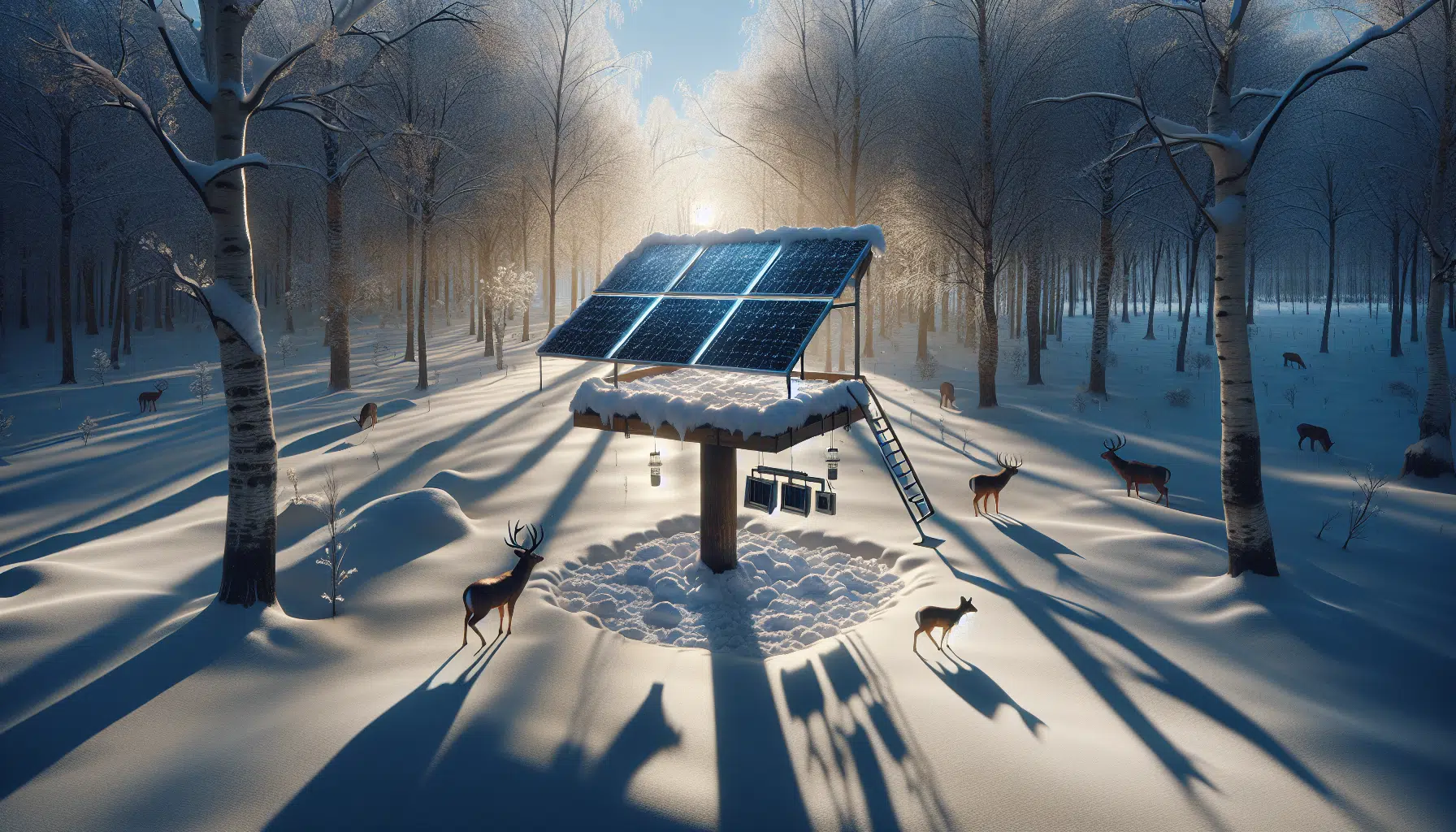
Yes, Solar Panels Still Work in Winter, But Only If You Set Them Up Right
Yes, solar panels can work on deer feeders in winter, but only if you have enough sun hours and you mount the panel where snow, shade, and weak batteries do not kill it.
If you are in thick timber like the Missouri Ozarks or you get long cloudy stretches like Buffalo County, Wisconsin, the panel is usually not the problem, the battery and placement are.
I have run feeders and cameras long enough to watch “solar” setups fail for dumb reasons.
Here is what I do in winter so my feeder does not turn into a $300 raccoon buffet that quits spinning on day 9.
Decide If You Have Winter Sun, Or If You Are Just Hoping
If your feeder sits under oaks and cedars, forget the panel size and focus on moving the setup 40 yards to a sun hole.
I learned the hard way that “it gets some light” is not a plan, it is an excuse.
Back in 2016 on public land in the Missouri Ozarks, I hung a small gravity feeder setup near a bench because the deer sign was hot.
It was also shaded from 9 a.m. to 3 p.m., and the solar panel never caught up after two cloudy days.
If you are hunting thick cover, you need either a bigger panel, a bigger battery, or a totally different plan like packing in feed by hand.
If you are on open edges like Pike County, Illinois field corners, solar is usually fine because winter sun can actually hit the panel for hours.
Make One Choice: Bigger Battery Or Bigger Panel
If you ask me, battery capacity matters more than panel wattage once the days get short.
A small 5W panel can maintain a good battery in December, but it cannot revive a tired one after a cold snap.
Here is what I do when I want reliability.
I run a fresh 12V sealed lead acid or lithium feeder battery at the start of winter, then let the panel maintain it.
My buddy swears by tiny panels because “the sun will get it,” but I have found the panel is just a trickle charger in real winter weather.
If you are hunting in snow country like the Upper Peninsula Michigan, plan for days where the panel does nothing because it is covered or the sky is dead gray.
Do Not Mount the Panel Flat, Or Snow Will Win
Flat-mounted panels look clean and they fail fast in winter.
Snow sits, freezes, and you get zero charge until it melts.
Here is what I do.
I tilt the panel steep, around 45 degrees or more, and I point it south if I can.
Back in November 2019 in Pike County, Illinois, the morning after that cold front when I killed my 156-inch typical, I noticed something.
The feeder on the edge of a picked bean field still ran, and the one tucked into the timber line did not.
The working one had the panel angled and clear, and the dead one was flat with a crust of ice on it.
Tradeoff: Put the Feeder Where Deer Want It, Or Where the Sun Can Hit It
This is the part people hate, because deer do not always stand in your “solar friendly” spot.
If you are hunting tight cover in the Missouri Ozarks, deer want the thick stuff, and the sun wants the open.
Here is what I do to split the difference.
I place the feeder where the sun can hit it, then I hunt the trails leading into it, not right on top of it.
If you are hunting public land, I also keep it subtle because feeders draw eyes as much as they draw deer.
When I am trying to decide where deer will stage and filter in, I use what I wrote about deer habitat to pick the bedding-to-feed route, not just the prettiest opening.
Mistake To Avoid: Trusting a Bad Battery Because the Panel “Should” Charge It
Cold exposes weak batteries fast.
If your battery is 3 years old and has been deep-cycled a bunch, winter will finish it off.
I learned the hard way that a solar panel cannot fix a battery that is already cooked.
In 2020 I tried to limp a cheap battery through late season, and the feeder timer started missing spins like a tired old dog.
The panel was fine, the battery was junk, and I wasted two sits thinking deer “just weren’t coming.”
If you care about keeping feed on the ground, start winter with a known-good battery and stop guessing.
Pick Your Timer Settings Like You Pay For Corn
Winter is not the time for six long feeds a day.
More run time means more amps pulled, and that means the solar setup has to work harder with less sunlight.
Here is what I do.
I run 1 to 2 short feeds per day, usually 3 to 6 seconds, and I adjust based on what is left on the ground.
If you are trying to time daylight movement, I check deer feeding times first, then I set the feeder to match the window I actually hunt.
If you are hunting after work, set one spin for 30 minutes before last light, not at midnight.
My Quick Rule of Thumb
If you are getting more than 3 straight days of clouds and temps under 25 degrees, do not trust solar alone and swap in a fresh battery.
If you see snow crust sitting on the panel at noon, expect the feeder to miss spins within 24 to 48 hours.
If conditions change to a clear cold high-pressure stretch, switch to shorter feed times because deer will show and you do not need to dump extra corn.
What I Actually Run: A Basic Solar Setup That Does Not Drive Me Crazy
I am not loyal to brands, I am loyal to stuff that works in real weather.
I also burned money on gear that did nothing before I learned what mattered.
Most wasted money was $400 on ozone scent control that made zero difference, and I would rather put that into batteries and sticks.
My best cheap investment was $35 climbing sticks I have used for 11 seasons, because they keep paying me back.
On feeders, I keep it boring.
A decent 12V battery, a solar panel that is not tiny, and wiring connections that are not corroded.
Product I Trust More Than “Off Brand” Panels: Moultrie Solar Charger Kit
I have used the Moultrie solar charger kits on and off, and they do what they claim if you mount them right.
The plastic housing is not bulletproof, but I have had them survive rain and single-digit mornings without quitting.
Price is usually around $40 to $70 depending on the kit, and that is cheaper than burning a weekend driving back to fix a dead feeder.
My buddy swears the cheapest Amazon panel is the same thing, but I have found the connectors and mounts on the Moultrie kits last longer.
Find This and More on Amazon
Where People Mess Up: Shade, Angle, And Dirty Connections
Shade is obvious, but people still ignore it because the deer sign is good there.
Angle matters because winter sun is low, and flat panels do not catch much even when they are clean.
Dirty connections matter because corrosion adds resistance, and resistance steals charging power.
Here is what I do every time I hang a winter feeder.
I clean terminals, I use dielectric grease, and I zip-tie wires so they do not flap in the wind and loosen up.
This connects to what I wrote about do deer move in the wind, because windy days are also the days wires shake loose and panels get twisted.
Cold Weather Reality: Solar Works, But Deer Feeders Pull More Power Than You Think
The motor draw is a punch of amps, not a gentle sip.
Cold batteries also deliver less power, so the same feeder that spun fine in October can grunt and stall in January.
If you are hunting places with long winters like the Upper Peninsula Michigan, assume your battery is weaker at 10 degrees than it was at 55 degrees.
That is not theory, that is what happens.
Decision: Are You Feeding Deer, Or Are You Feeding Raccoons And Hogs
In East Texas, feeders can turn into a hog dinner bell fast.
In Pike County, Illinois, raccoons can still clean up corn like vacuum cleaners if you throw too much.
If you are hunting a place with hog pressure, forget about long feed windows and focus on short daylight spins so deer get first crack.
When I am trying to keep costs down, I point guys to my own take on an inexpensive way to feed deer because buying corn all winter gets old fast.
Use the Feeder As a Tool, Not a Crutch
I hunt 30 plus days a year, and I am telling you straight that feeders do not replace scouting.
They can help inventory, they can help hold deer, and they can help a kid get a shot.
I take two kids hunting now, so I like feeders for keeping them engaged and keeping sits shorter.
But if your feeder quits, you better still know where the trails and beds are.
If you are trying to read how deer react to weather shifts, this ties into where deer go when it rains, because rain and clouds can cut your solar charge for days.
Mistake To Avoid: Checking the Feeder Too Much And Burning the Spot
The fastest way to ruin a winter pattern is stomping in every weekend to “see if it is working.”
I learned the hard way that deer will tolerate a feeder, but they will not tolerate you.
Back in 2007, after I gut shot that doe and pushed her too early and never found her, I changed how I act in the woods.
I got more patient, and I quit forcing fixes in the moment that made things worse.
Same deal with feeders.
If you must check it, do it midday, fast, with rubber boots, and get out.
FAQ
Will a solar panel charge a deer feeder battery in freezing temperatures?
Yes, it can charge in freezing temps, but the battery accepts charge slower and delivers less power when cold.
If you want it to be reliable, start with a healthy battery and keep the panel angled and snow-free.
How many watts do I need for a solar panel on a deer feeder in winter?
I like 5W minimum for light use, and I prefer 10W to 20W if you have cloudy weeks or longer feed times.
If your feeder motor is stiff or your battery is old, no panel size fixes that for long.
Why does my feeder work in October but quit in January?
Your battery is weaker in cold weather and your panel gets less sun because days are short and the sun angle is low.
Also check for snow cover and corroded terminals because both kill charging.
Should I run a deer feeder at night in winter?
I do not, because it wastes power and it feeds raccoons more than deer.
I set a short spin 30 to 60 minutes before last light so deer hit it during legal shooting time.
Can a solar panel overcharge a deer feeder battery?
Most feeder solar kits are low output trickle chargers, so overcharge is not common.
If you rig a bigger panel and a lithium battery, use a real charge controller so you do not cook something.
Two Signs I Watch On The Ground To Know If The Feeder Is Actually Helping
I do not judge a feeder by how empty the barrel is, because raccoons can do that.
I judge it by tracks, timing, and where deer stage before they step out.
Here is what I do when I scout it.
I look for fresh deer tracks that are longer and more pointed than coon tracks, and I look for droppings that are still shiny.
If I am trying to decide if it is does or bucks using it, I keep the basics straight, and I lean on what I wrote about what a male deer is called and what a female deer is called when I am teaching new hunters and kids.
I also watch how cautious they are, because deer are not dumb.
If you want a gut-check on that, this connects to are deer smart, because winter deer that have been shot at for months act like it.
Now Decide What Kind of Winter You Actually Hunt
If you hunt open farm edges like Southern Iowa style country, solar is usually easy because you can find sun.
If you hunt big timber and shaded hollows like the Missouri Ozarks, solar is a constant fight unless you place it for light first.
Tell me where you hunt and what feeder you run, and I will tell you if you need a bigger panel, a better battery, or a new location.
My Straight Answer Before You Waste a Weekend
Solar panels work on deer feeders in winter if you have 4 to 6 hours of real sun on the panel and a battery that is not worn out.
If you are in shaded timber like the Missouri Ozarks or you hit a 5-day gray stretch like Buffalo County, Wisconsin, plan on swapping batteries or you will miss spins.
Here is what I do in December and January to keep corn on the ground and keep my camera from going dead the same week.
I treat solar as a helper, not a promise.
Decision: Are You Trying To “Set It And Forget It,” Or Do You Want It To Run No Matter What
If you want true set-it-and-forget-it in winter, you need more battery than you think and a panel that actually sees sun.
If you just want it to run most of the time, you can get by with a basic kit and smart feed times.
Here is what I do when reliability matters.
I start winter with a fresh 12V battery, then I let solar maintain it instead of trying to resurrect a tired battery.
Mistake To Avoid: Assuming “Bright Overcast” Counts As Solar Time
Overcast light looks bright to you, but it does not charge like sun.
I learned the hard way that two “nice gray days” can still put you behind if your feeder runs twice a day and your battery is already half cooked.
Back in 2016 on public land in the Missouri Ozarks, I left a panel in what I thought was an “open enough” spot.
It was open enough to fool me and shaded enough to kill the battery by the next weekend.
Tradeoff: Bigger Panel Or Bigger Battery
If I can only upgrade one thing for winter, I pick a bigger, healthier battery first.
A panel helps slow the drain, but the battery is what carries you through 72 hours of clouds and 18-degree mornings.
Here is what I do to keep it simple.
I run a known-good 12V sealed lead acid battery for most feeders, and I replace it before winter if it is older than about 2 seasons of real use.
Decision: Put The Feeder In Deer Cover, Or Put It In Sun
Deer love edge cover, and solar loves open sky.
If you try to “compromise” too hard, you usually end up with a feeder that is in the shade and deer that still show after dark.
Here is what I do on my Pike County, Illinois lease where I can pick my spots.
I put the feeder where the panel gets sun, then I hunt the downwind trail where deer stage, not the barrel itself.
When I am picking that staging area, I lean on what I wrote about deer habitat because bedding cover and travel routes matter more than a spinning plate.
Mistake To Avoid: Mounting The Panel Flat
Flat panels look clean, and they fail the first time you get 2 inches of snow or a sheet of ice.
Here is what I do every time.
I tilt the panel steep, about 45 degrees or even more, and I point it south if the terrain allows it.
Back in November 2019 in Pike County, Illinois, the morning after that cold front when I killed my 156-inch typical, I noticed the same thing again.
The feeder with the angled, clear panel ran fine, and the flat one at the timber edge was dead with an ice crust on it.
Tradeoff: Feed More, Or Keep Your Battery Alive
Winter is not the time for “just a little extra” feed schedule.
Every extra spin is amp draw, and winter is when your battery is weakest and the sun is shortest.
Here is what I do for most winter feeder setups.
I run 1 to 2 short feeds per day at 3 to 6 seconds, and I only add time if the deer clean it up fast and my battery stays strong.
When I want deer moving during the hours I can actually hunt, I check deer feeding times and set my spin for the window I sit.
My Quick Rule of Thumb
If you are getting more than 3 straight days of clouds and temps under 25 degrees, do not trust solar alone and swap in a fresh battery.
If you see snow crust sitting on the panel at noon, expect the feeder to miss spins within 24 to 48 hours.
If conditions change to a clear cold high-pressure stretch, switch to shorter feed times because deer will show and you do not need to dump extra corn.
Decision: Do You Want A Name Brand Kit, Or Are You Fine Fixing Stuff Mid-Season
I am not a brand fanboy, but winter is when cheap connectors and weak mounts get exposed.
I wasted money on off-brand solar leads that cracked after one season, then I went back to kits with better mounts and better plugs.
Product I Trust More Than “Off Brand” Panels: Moultrie Solar Charger Kit
I have used Moultrie solar charger kits on feeders and they do what they claim if the panel sees sun.
The plastic housing is not indestructible, but mine have lived through rain, 15-degree mornings, and wind without quitting.
Price is usually $40 to $70, and that beats driving 2 hours to find a dead battery on a Saturday.
My buddy swears the cheapest Amazon panel is the same thing, but I have found the connectors and mounts on the Moultrie kits last longer.
Find This and More on Amazon
Mistake To Avoid: Corroded Terminals And Loose Wires
Winter kills weak connections, and feeders shake more than people think in wind.
Here is what I do before I ever pour corn.
I clean the battery terminals, I add a dab of dielectric grease, and I zip-tie wires so nothing flaps and loosens up.
This connects to what I wrote about do deer move in the wind
Cold Weather Reality: The Motor Draw Is The Problem, Not The Sun
Feeder motors pull a hard hit of amps when they start.
Cold batteries deliver less power, so that same motor that ran fine at 55 degrees can stall at 12 degrees.
If you hunt places with long winters like the Upper Peninsula Michigan, assume your battery is weaker every morning until midday.
That is why I treat solar as maintenance, not as a rescue plan.
Decision: Are You Feeding Deer, Or Are You Feeding Everything Else
In East Texas, feeders can become hog magnets fast.
In Pike County, Illinois, raccoons can clean up corn like little thieves if you feed heavy.
If you are hunting hogs or heavy coon pressure, forget long feed windows and focus on short daylight spins so deer get first crack.
When I am trying to keep costs from getting stupid, I send guys to my write-up on an inexpensive way to feed deer because burning $18 bags of corn all winter adds up fast.
Mistake To Avoid: Checking The Feeder So Much You Blow The Spot
The fastest way to ruin a winter pattern is stomping in every 4 days to “make sure it is working.”
I learned the hard way that deer will tolerate a feeder, but they will not tolerate steady human pressure in the same entry trail.
Back in 2007 I gut shot a doe, pushed her too early, and never found her, and it still eats at me.
That screw-up changed how patient I am, and it changed how I handle any situation where I want to rush in and “fix it.”
Here is what I do if I have to check a feeder in winter.
I go midday, I move fast, I wear rubber boots, and I leave the same way every time so the rest of the area stays clean.
Use The Feeder As A Tool, Not A Crutch
I hunt 30 plus days a year, and I still scout like the feeder does not exist.
A feeder helps hold deer and helps kids get a shot, but it does not replace knowing where they bed and how they enter.
I take two kids hunting now, so I like feeders for keeping sits shorter and keeping them interested.
But if that feeder quits, I still need deer travel lanes I can hunt.
If you are trying to predict movement after bad weather, I tie it to where deer go when it rains because the same storms that shift deer also cut solar charging for days.
Two Signs I Watch To Know If The Feeder Is Helping Or Just Taking My Money
I do not judge a feeder by an empty barrel because raccoons and hogs can do that.
I judge it by deer sign and daylight timing.
Here is what I do on the ground.
I look for fresh tracks with longer, more pointed toes, and I look for droppings that are still shiny and wet.
If I am trying to sort out bucks versus does for a kid or a new hunter, I keep the words straight using what a male deer is called and what a female deer is called.
I also watch how they enter, because pressured deer act like they have been shot at, because they have.
If you want a gut-check on that, I still agree with what I wrote on are deer smart.
FAQ
Will a solar panel charge a deer feeder battery in freezing temperatures?
Yes, it can charge in freezing temps, but the battery accepts charge slower and delivers less power when cold.
If you want reliability, start with a healthy battery and keep the panel angled and snow-free.
How many watts do I need for a solar panel on a deer feeder in winter?
I like 5W minimum for light use, and I prefer 10W to 20W if you have cloudy weeks or longer feed times.
If your battery is old or your motor is stiff, no panel size fixes that for long.
Why does my feeder work in October but quit in January?
Days are shorter, the sun angle is lower, and your battery is weaker in the cold.
Also check for snow cover and corroded terminals because both kill charging.
Should I run a deer feeder at night in winter?
I do not, because it wastes battery and feeds raccoons more than deer.
I set a short spin 30 to 60 minutes before last light so deer hit it during legal shooting time.
Can a solar panel overcharge a deer feeder battery?
Most feeder solar kits are low output trickle chargers, so overcharge is not common.
If you rig a bigger panel and a lithium battery, use a real charge controller so you do not cook something.
Now Make The Call For Your Ground
If you hunt open farm edges like Southern Iowa style country, solar is usually easy because you can find sun and keep snow off the panel.
If you hunt shaded big timber like the Missouri Ozarks or hill country pockets like Buffalo County, Wisconsin, solar can still work but only if you pick a sun hole and keep your battery fresh.
My honest advice is to decide which problem you want to solve first, dead batteries or bad deer movement, because they are not the same thing.
If you tell me your state, your feeder brand, and how many seconds per day you run it, I can tell you if you need a better panel, a better battery, or just a better spot.


