
Camels
Camel is a hoofed mammal belonging to the Camelidae family, in which Lamma, Alapacca, and Vicuna also exist. They are known for their long-lasting surviving nature (without food and water in the desert) and the physical appearance of humps. They are the domestic animals. It dates back to 3000 years when humans domesticated the camels for travel in arid environments. Other uses are food (meat and milk) and textiles (fibre and felt).
Scientific Classification
Kingdom | Animalia |
Phylum | Chordata |
Class | Mammalia |
Order | Artiodactyla |
Family | Camelidae |
Genus | Camelus |
Species of Camel
There are three extant species of Camel found in one genus, the Camelus. The other five species were extinct thousands of years ago. Following are the species of camels.
Names | Description |
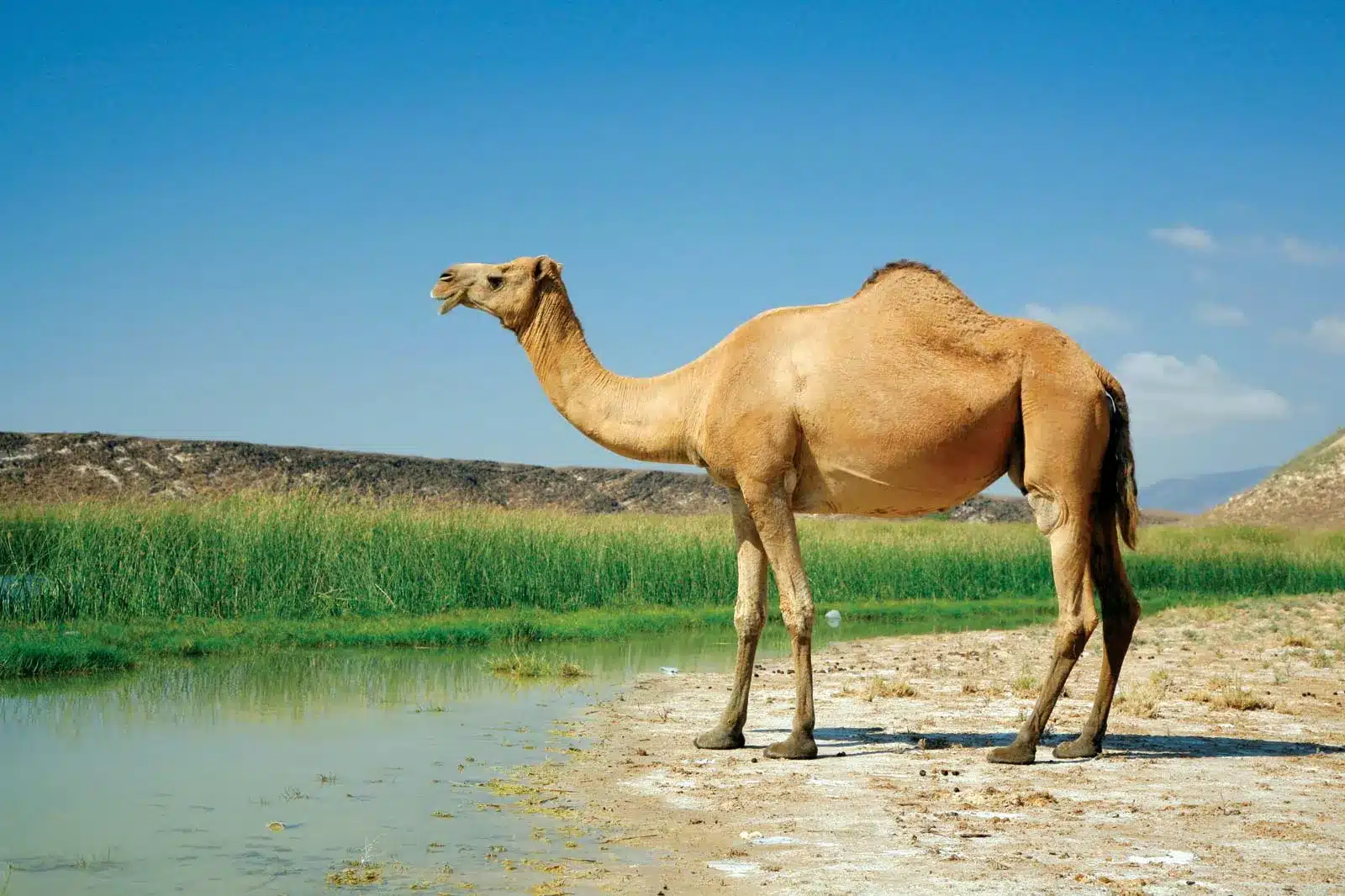
Arabian Camel (Camelus dromedarius) | Arabian camels, usually known as dromedary camels, are one-humped camels. It comprises 90% of the world’s camel population. But they are only domesticated, and no wild breed exists. |
Bactrian Camel (C. bactrianus) | These are the two-humped and heavily furred camels. They are smaller in length than their dromedary cousins. |
Wild Bactrian Camel (C.ferus) | These are the wild type of Bactrians. They are less hairy, less trimmed, and low-humped than domesticated Bactrians. (Critically Endangered) |
Fact: There is a 40 million population of camels in the world, out of which only 950 are Wild Bactrian Camels.

Physical Characteristics
Size and Weight: The height of Arabian camels is 7 feet tall at the hump and weighs around 1400 pounds. In contrast, the Bactrian camels are also 7 feet tall at the hump and weigh around 1800 pounds. Females are slightly smaller than males.
Speed: These arid mammals can run in short bursts at 65 km per hour.
Body and Tail: They are even-toed mammals with long curved necks, elongated faces, humps, and tufted tails. They have extra long legs to keep their body far from the hot desert. They have thick, broad foot pads that contract for walking in sand and expand for stepping out.
Eyes: The eyes of the camels are like horses with double rows of extra long eyelashes that keep sand out of the eyes.
Humps: There are one or two heights on the back of the Camel that are called humps. These are the fat stores of the Camel.
Fur Colouration: These furry mammals give different shades of brown and orange. White fur is the exception because the white Camel is a rare breed of Camel.

Size and Weight Camel

Camel Speed
Camel Body and Tail
Distribution and Habitat
These solid creatures tend to live in hot and dry regions like deserts. Geographically, Bactrian Camels are found in China’s Gobi desert and Mongolia’s steppes. Meanwhile, domesticated Dromedary Camels are found throughout North Africa, Southwestern Asia, and the Middle East. In the 19th century, they were introduced to Australia for pack purposes, and now, they live in a sufficient population.
Why are they called "Ships of the Desert"?
Once upon a time, a lion asked the Camel how an animal could be a ship. The Camel replied that Arab people called him a Ship of the desert because of its endurance power in the hot desert. A camel can run for about 25 kilometres an hour in the hot sand. It also carries more than 90 kilograms of extra weight. The Camel doesn’t sink in the sand and is the only source of transport in the desert, like a ship, the only saviour in the middle of the sea.
Diet and Digestion
Camels are herbivores that prefer to eat hay grass, thorny plants, grains, wheat, and oats. They will eat meat, fish, skin, and even bones if food is scarce. A camel can drink 30 gallons of water in one sitting. However, they can live for 10 days without drinking water and lose 30 percent of their body weight due to dehydration. There is a high amount of salt in the Camel’s diet. The reason behind the presence of salt is to withstand substantial dehydration.
They are special desert ruminants that regurgitate their food back from the stomach and chew it again like cows. The stomachs of camels are three-chambered. Out of three, two chambers store water for a long time. The fat is stored in their humps, which they can divide in food and water on harsh days.
Behavioural Adaptations
Foraging Behaviour
Camels are both diurnal and nocturnal. They spend most of their time in search of food. They are selective feeders who can travel 70 km daily to obtain food during scarce days. They can spend forty percent of their time ruminating, thirty percent eating, and thirty percent relaxing and sleeping. They can sleep 6 hours a night.
Social Behaviour
These packed creatures are highly social animals. The group of camels is called a caravan or flock. A group comprises male, female and baby camels. Bachelor camels have their groups. They live in harems like Zebra. They are gathered around a water source in the wild.
Migration
Bactrian camels can migrate from the Gobi desert to its steppe during the snowy winters. It is the ecotone where many rivers are bordered. After winter, they get back to the desert.
Thermoregulation
Thermoregulation is maintaining body temperature within changes in the external environment. The average temperature of healthy camels varies between 34°C to 40°C. But these desert survivors can survive in hot and cold temperatures ranging from minus 20 degrees Fahrenheit to 120 degrees Fahrenheit.
Communication
Camels can communicate through vocalizations, such as grunting, growling, moaning, and loud bellows. They can greet in a friendly way by blowing on their faces. Mother Camel hums her young as an affection behaviour. They also use visuals. For example, erect ears indicate alertness.
Reproduction and Parenting
A male camel is called a bull, while a female camel is called a cow. The offspring camel produce are called calves. A female gets sexual maturity at 3 years. In comparison, a male becomes sexually mature at 5 to 6 years. When a female gets pregnant, she remains outside the flock and lives in private areas covered with vegetation. A gestation period lasts for 13 to 15 months. She gives birth to one calf per litter.
A calf is 45 kilograms in weight at birth. The calf is born without humps, but tiny peaks are present as a mark of humps. He starts walking within half an hour of birth. After two weeks, the female, with her young, returns to the flock. But a calf feed on his mother for 8 to 18 months.
Mortality Rate and Lifespan
The annual mortality rate of camels is 26 percent. The reasons for deaths are malnutrition, gases produced due to extra fat storage and some unexplained causes. The survival rate is 96 percent per year in adults older than one year. The overall life expectancy of camels is 40 to 50 years.
Ecological Importance
These incredible creatures are the keystone species of deserts. They play an essential role in seed dispersal through their feces. While browsing, they also inject a specific biome into the plants that boost the strength and resilience of desert flora.
Economic Importance
Camels are called Atta Allah (Gift of God) because they are animals that cater to humans for transportation, meat, milk, and textiles. Bedouine is an area in the Arabian Peninsula whose traditional economy depends on camel milk, meat, and fur.
As a Food
Camel’s meat and milk are present in North Africa, Southwestern Asia, and the Middle East cuisines. The nomad tribes often depend on Camel’s milk as it is digestible and low in cholesterol. It is also suitable for lactose intolerants. They can also ferment butter, cheese, and curd from Camel’s milk.
Annually, about 3.3 million camels are slaughtered for meat purposes in the world. The meat of Camel is salty enough; there is no need to add salt to it. Camel’s meat is mainly consumed in the following countries: Saudi Arabia, Dubai, Somalia, Sudan, Libya, Egypt, Syria, Kazakhstan, and Balochistan (a province of Pakistan). In Australia, Camel’s lasagna is served.
Female Camel’s urine is also used for medicinal purposes and is halal.
In Textiles
In Mongolian tribes, Camel’s fur and skin are used for making carpets, bedding, clothing, tents, and yurts. It is also used in Western culture to yawn garments. Its hair is used as a wool.
Conservation Status and Efforts
The Wild Bactrian Camels is listed as a critically endangered Species of the Camel in the Red list of the International Union of Conservation of Nature (IUCN). Other species are least concerned. Currently, only nine hundred and fifty individuals of the wild Bactrian remain. Out of these, 550 were found in China and 400 in Mongolia. In China, the Wild Camel Protection Organization was established and worked on the natural reservation of Bactrian Camels in their country.
Camel Fun Facts
- Camels have a unique pacing gait, moving both legs simultaneously from the same side.
- They are born without humps.
- They can easily carry 100 kg of extra weight for 20 miles.
- Do you remember Chewbacca’s voice from “Star Wars”? The noise of the Camel’s growling was used for that purpose.
Religious Value
In Islam
- In the Arabic language, 160 words are used for camels. According to Islamic teachings, Camel’sCamel’s meat is halal, but after its consumption, Muslims must perform ablution before Salat.
- In the Quran, we see a Story of the people of Thamud, in which Prophet Salih miraculously brings a pregnant camel out of the rock by the will of Allah.
- When Prophet Muhammad (PBUH) migrated from Makkah to Madina, he left his she-camel loose and determined that where she stayed, he built his house in that specific place in Medinah.
In Judaism
In Judaism, consuming Camel’s milk and meat is prohibited because it is not Kosher. According to their teachings, Kosher is the term used in Judaism for food regulation. They said it does not meet one of the kosher criteria of actual hooved mammals.
Religious Value
In Islam
- In the Arabic language, 160 words are used for camels. According to Islamic teachings, Camel’sCamel’s meat is halal, but after its consumption, Muslims must perform ablution before Salat.
- In the Quran, we see a Story of the people of Thamud, in which Prophet Salih miraculously brings a pregnant camel out of the rock by the will of Allah.
- When Prophet Muhammad (PBUH) migrated from Makkah to Madina, he left his she-camel loose and determined that where she stayed, he built his house in that specific place in Medinah.
In Judaism
In Judaism, consuming Camel’s milk and meat is prohibited because it is not Kosher. According to their teachings, Kosher is the term used in Judaism for food regulation. They said it does not meet one of the kosher criteria of actual hooved mammals.
Cultural Value
Camels possess a tremendous cultural value. Even portraits and camel carvings were discovered in caves and mountains in Suadi, Arabia, in 2018. But the exact age of this rock art is still mysterious.
FAQs- Frequently Asked Questions
Q: What is a female camel called?
A: A female camel is called a cow.
Q: What special abilities do camels have?
A: Camels have several special abilities:
- Survival in Harsh Conditions: They can survive up to 10 days without water and tolerate extreme temperatures ranging from -20°F to 120°F (-29°C to 49°C).
- Water Conservation: They can drink up to 30 gallons of water in one sitting and store it in their bodies.
- Fat Storage: Their humps store fat, which can be converted into energy and water when resources are scarce.
- Desert Adaptations: They have thick foot pads to walk on sand without sinking, long eyelashes, and closable nostrils to keep out sand.
- Efficient Digestion: With three-chambered stomachs, they can digest tough vegetation and ruminate like cows.
Q: What are camels best known for?
A: Camels are best known for their ability to:
- Survive in Desert Environments: Enduring long periods without food or water.
- Carry Heavy Loads: Serving as a primary mode of transportation in arid regions.
- Unique Physical Features: Having one or two humps that store fat for energy.
- “Ships of the Desert”: Their importance in desert travel and commerce.
Q: Are camels intelligent?
A: Yes, camels are considered intelligent animals. They have good memories, can recognize people, and can be trained for various tasks such as transportation and carrying loads.
Q: What are camels famous for their ability?
A: Camels are famous for their ability to:
- Endure Harsh Conditions: Surviving without water for extended periods.
- Transport Goods and People: Carrying heavy loads over long distances in deserts.
- Adapt Physically: Utilizing fat stored in their humps as energy.
- Regulate Body Temperature: Tolerating extreme temperature fluctuations.
Q: What is the importance of camel in human life?
A: Camels are important to humans for several reasons:
- Transportation: Essential for travel and trade in desert regions.
- Food Source: Provide meat and milk, which are staples in many cultures.
- Textiles: Their fur and skin are used to make clothing, carpets, and tents.
- Cultural and Religious Significance: Hold a special place in traditions and religions, especially in the Middle East and North Africa.
Q: Why is the camel an extremely useful animal?
A: Camels are extremely useful because:
- Adaptability: They thrive in harsh desert climates where few other animals can survive.
- Versatility: Serve multiple roles—from transportation to food to textile production.
- Endurance: Can carry heavy loads over long distances without much water.
- Economic Value: Support the livelihoods of many desert-dwelling communities.
Q: What are 2 benefits of camels over cattle?
A: Two benefits of camels over cattle are:
- Desert Adaptation: Camels can survive without water for longer periods and withstand extreme temperatures, making them better suited for arid environments.
- Transportation: Camels can carry heavy loads across sandy terrains where cattle would struggle.
Q: What are the disadvantages of a camel?
A: Disadvantages of camels include:
- Temperament: They can be stubborn and sometimes aggressive if not properly handled.
- Slow Reproduction: Long gestation periods and usually one offspring per birth slow population growth.
- Specialized Needs: Require specific habitats and may not adapt well to non-desert environments.
Q: What is the symbol of the camel?
A: The camel symbolizes:
- Endurance and Survival: Due to its ability to thrive in harsh conditions.
- Adaptability: Represents resilience and the capacity to adapt.
- Wealth and Prosperity: In some cultures, owning camels is a sign of wealth.
Q: What are three reasons why people use camels?
A: People use camels because:
- Transportation: They are ideal for traveling and transporting goods across deserts.
- Food Supply: Provide nutritious meat and milk.
- Material Resources: Their fur and skin are valuable for making textiles and shelter.
Q: What are three lines about camels?
- Desert Survivors: Camels can endure long periods without water, thanks to fat stored in their humps.
- Essential Transport: Known as the “Ships of the Desert,” they have been vital for trade and travel.
- Cultural Icons: Camels hold significant religious and cultural importance in many societies.
Q: What is the behavior of camels?
- Social Structure: Live in groups called caravans or flocks, which may include males, females, and young.
- Activity Patterns: Both diurnal and nocturnal; spend time foraging, ruminating, and resting.
- Communication: Use vocalizations like grunts and moans and visual signals such as ear positioning.
- Migration: Wild camels may migrate seasonally to access food and water.
- Temperament: Generally calm but can become aggressive if provoked or mishandled.
Learn More About Bats
Welcome to our page dedicated to the fascinating world of camels. Here, you’ll find articles that answer common questions about camels, such as their diet, desert adaptations, reproduction cycle, and how they interact with humans and their environment.
Scroll down to learn more about the unique behaviors of camels and discover the reasons behind their incredible adaptations and survival strategies.
Bactrian Camel
Home / Animal Types / Camel The Bactrian camel (Camelus bactrianus), also known as the two-humped camel, is one of

The Arabian Camel – A Desert Survivor
Home / Animal Types / Camel The Arabian camel, also known as the dromedary or one-humped camel, is one of
The Wild Bactrian Camel (Camelus ferus)
Home / Animal Types / Camel The Wild Bactrian Camel (Camelus ferus) is one of the most remarkable creatures that