
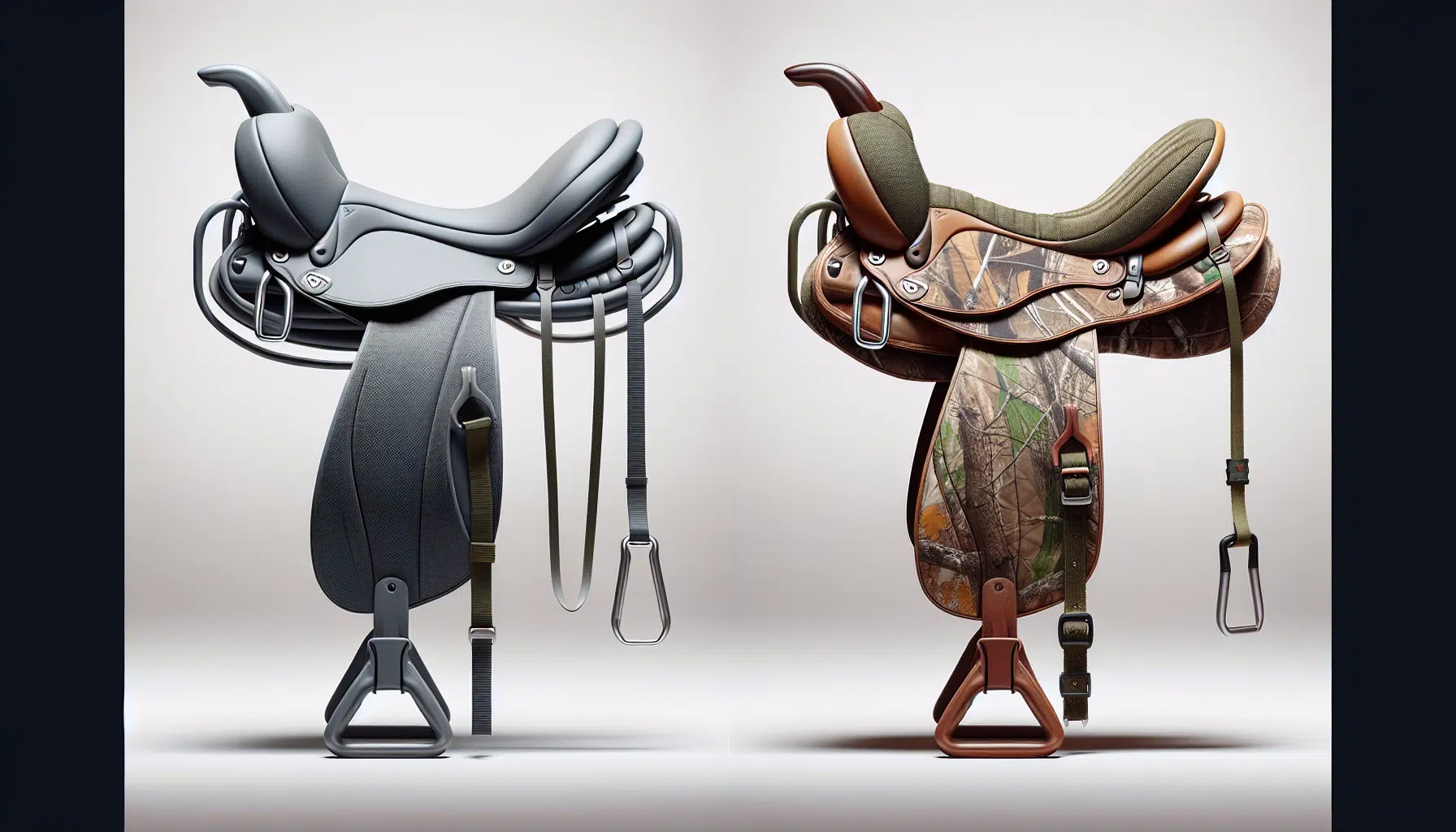
Pick the Right Saddle Based on What You Are Actually Doing
A rock climbing saddle is not a safe substitute for a hunting saddle for most whitetail sits.
A hunting saddle is built for long, quiet, mostly-still hangs with a tether and platform, while a climbing harness is built for short-duration fall protection while you move.
I have used both styles, and I am not guessing here.
Here is what I do when I am choosing gear for a new spot on public land in the Missouri Ozarks or a tidy tree on my Pike County, Illinois lease.
The First Decision: Are You Sitting Still for 3 Hours, or Moving for 30 Minutes?
If you are hanging in one tree for a morning sit, comfort and silence matter more than anything.
If you are moving on rope and may fall, impact rating and leg loop design matter more.
I learned the hard way that “comfortable for 20 minutes” and “comfortable for 4 hours” are two different worlds.
Back in 2016 on Mark Twain National Forest, I tried using a basic climbing harness as a cheap saddle, and my hips were screaming by 8:30 a.m. after climbing in at 6:10 a.m..
Here is what I do for whitetails now.
I pick a purpose-built hunting saddle for any sit longer than 60 minutes, and I only use a climbing harness for actual climbing or quick-and-dirty hanging trail work.
Big Difference #1: Weight Distribution Is the Whole Point
A climbing harness tends to load your leg loops hard when you hang.
A hunting saddle spreads load across your hips and seat so you can lean or sit without your thighs going numb.
If you are hunting cold, forget about “it feels fine in the garage” and focus on blood flow.
At 28 degrees in Buffalo County, Wisconsin, numb legs turn into sloppy shots fast.
Here is what I do on late season sits.
I set my bridge length so I can sit more than lean, and I run knee pads so I can rest against the tree without shaking.
Big Difference #2: Noise Is Not a Feature in Climbing Gear
Climbing gear is full of metal-on-metal contact points, stiff webbing, and buckles that love to click.
Hunting saddles are built to be quiet, or at least they try.
I wasted money on a $400 ozone scent control rig that made zero difference, and that taught me to stop chasing magic fixes.
Noise control is not magic, it is just not doing dumb stuff in the tree.
Here is what I do.
I tape or heat-shrink anything that can clink, and I avoid carabiners that rattle unless I can lock them down tight.
Big Difference #3: Your Attachment System Is Completely Different
A climber harness usually expects you to connect to a belay device, lanyard, or via loops that are meant for a different rope system.
A hunting saddle expects a tether at hunting height, plus a lineman’s belt while you climb, plus a platform or steps to stand on.
This connects to what I wrote about where to shoot a deer to drop it in its tracks because your shooting angles from a saddle change fast based on tether height and lean angle.
If you set your tether wrong, you end up aiming at the wrong hair and thinking it is a “bad broadhead day.”
I learned the hard way that bad systems create bad shots.
In 2007 I gut shot a doe, pushed her too early, and never found her, and I still think about it.
I do not blame that on saddles, but I do blame it on rushing and not setting up for a clean angle.
Big Difference #4: A Hunting Saddle Is Built Around a Platform
A climbing harness does not assume you will stand on a 12-inch platform and pivot around a tree to shoot behind you.
A hunting saddle does.
If you are hunting thick cover in the Missouri Ozarks, forget about huge platforms and focus on quiet, small moves.
If you are hunting field edges in Pike County, Illinois, I will go a bit bigger because I may need to hold a drawn bow longer.
Here is what I do.
I match platform size to shot opportunity, not comfort in the backyard.
Big Difference #5: Climbing Harnesses Can Create Dangerous “Chest Hang” Problems
If you fall in the wrong harness, you can end up upright with pressure in weird places, or folded in a way that is hard to recover from.
Hunting saddles are still fall protection, but the whole system is meant to keep you in a workable position with a tether you can adjust fast.
My buddy swears by using a climbing harness because “it is rated,” but I have found the real issue is suspension comfort and self-rescue.
If you cannot climb back onto your platform in 10 seconds, you are gambling with your day.
Here is what I do every season.
I practice a controlled “hang and recover” at 3 feet off the ground, with my pack on, before season starts.
Big Difference #6: Gear Loops and Storage Are Built for Different Tools
Climbing harness loops are meant for racking carabiners and protection, not a lineman belt, dump pouch, and bow hanger.
Hunting saddles usually have flat, quiet storage that keeps stuff from swinging.
When I am trying to time deer movement, I check feeding times first, and then I plan how much gear I really need for that sit.
If deer are likely to move in the first hour of daylight, I keep my kit simple so I am not fumbling with gadgets at 7:05 a.m..
Comfort Tradeoff: “Leaning” Sounds Nice Until Your Lower Back Disagrees
A lot of new saddle hunters think they will lean all day like a statue.
That is how you end up sore and shifting at the worst time.
Back in November 2019 in Pike County, Illinois, I shot my biggest buck, a 156-inch typical, on a morning sit after a cold front.
I was comfortable enough to sit still, and that buck gave me the extra 6 seconds I needed.
Here is what I do to stay comfortable.
I run a tether height that lets me sit with my knees slightly bent, and I keep my platform level so my calves do not burn.
My Quick Rule of Thumb
If you are planning to hang in a tree longer than 60 minutes, do not use a rock climbing harness as your main saddle.
If you see fresh rubs and tight tracks circling downwind of your tree, expect deer to try to scent-check you before showing themselves.
If conditions change to swirling wind or gusts over 15 mph, switch to a lower setup in thicker cover and hunt closer to bedding.
The Quiet Truth: Most “Differences” Show Up at Full Draw
In a saddle, you will take shots you never practiced if you do not train for it.
A climbing harness does nothing to help you shoot around a tree.
This connects to what I wrote about do deer move in the wind because wind makes deer cagey, and cagey deer force weird shot angles.
I have lost deer I should have found, and I have found deer I thought were gone.
A lot of that comes down to taking the shot you actually have, not the shot you wish you had.
What Actually Matters for Whitetails: Bridge, Tether, and Adjustability
A hunting saddle’s bridge is meant to rotate you smoothly and keep your hips square.
A climbing harness tie-in is not built for that kind of constant micro-adjustment.
Here is what I do on public land setups.
I keep my bridge short enough that I can pivot without drifting, and I use an adjustable tether so I can change my lean in seconds.
Product Reality: If You Buy Cheap Once, You Might Buy Twice
I grew up poor and hunted public land before I could afford leases, so I respect a tight budget.
But I also burned money on gear that did not work before learning what actually matters.
Most wasted money was $400 on ozone scent control that made zero difference.
Best cheap investment was $35 climbing sticks I have used for 11 seasons.
A Hunting Saddle I Trust: Tethrd Phantom
I have run the Tethrd Phantom, and it fits the “quiet and simple” thing I like.
Mine has held up for multiple seasons, and nothing important has frayed or loosened on me.
Here is what I do with it.
I keep the waist belt snug, set the bridge so I can sit, and I keep my tether knot or device in the same place every time so I am not thinking at daylight.
Find This and More on Amazon
A Platform That Does Not Make Me Cuss: Trophyline Mission
I have used small platforms that flex and pop, and that is a fast way to get busted at 18 yards.
The Trophyline Mission has been solid under me, and it stays quiet if I strap it tight.
If you are hunting pressured public in the Missouri Ozarks, forget about fancy moves and focus on silent footing.
Here is what I do.
I level it, then I step on every edge to check for noise before I ever clip in to hunt.
Find This and More on Amazon
The Cheap Part I Refuse to Skip: A Real Lineman Belt
A lot of guys try to “make do” with random rope and a knot they learned online.
I am not that brave anymore.
Here is what I do.
I run a lineman belt that is made for hunting, and I keep it on from the first step to the last step.
Safety Tradeoff: “Rated” Does Not Mean “Smart for Deer Hunting”
Climbing harnesses are rated for falls, and that matters.
But hunting is about controlled positioning, quiet movement, and hours of hang time.
My buddy swears a Petzl harness is all you need, but I have found saddle hunting systems are safer in practice because they are designed for how hunters actually move.
This connects to what I wrote about are deer smart because smart deer pick off little mistakes, like you shifting because your harness is cutting off your legs.
Tree Choice Changes: Hunting Saddles Let Me Hunt the Ugly Trees
One reason I love a hunting saddle is I can use trees a hang-on stand hates.
Crooked trunks, leaning trees, and multi-trunk junk are common in the Missouri Ozarks.
Here is what I do.
I pick the tree that gives me cover first, and I make the saddle work around it instead of forcing a “perfect” stand tree.
This connects to what I wrote about deer habitat because cover and travel routes beat “pretty trees” every time.
FAQs
Can I use a rock climbing harness as a hunting saddle?
You can, but I do not recommend it for real hunts because it is usually loud, uncomfortable for long hangs, and not designed for pivot shooting around a tree.
If you try it anyway, practice low to the ground and prove you can recover onto your platform fast.
What is the biggest comfort difference between a climbing harness and a hunting saddle?
A hunting saddle spreads pressure across your seat and hips, while a climbing harness often digs into your leg loops when you hang.
After 2 hours, that turns into constant shifting, and deer notice that.
Is a climbing harness safer than a hunting saddle?
Not automatically, because safety is also about staying attached correctly and being able to self-rescue.
A hunting saddle system with a lineman belt and tether used right is plenty safe for tree hunting.
What kind of tree setup mistakes make saddle hunting hard?
The biggest mistake is setting your tether too low and forcing an awkward lean that smokes your back and legs.
The second is using a noisy platform or loose straps that pop when you shift.
How do I practice saddle shots without screwing up during season?
Here is what I do in September.
I shoot from the saddle at 10 yards, 20 yards, and 30 yards on both strong side and weak side until I stop thinking about my feet.
Does a saddle help on pressured public land?
Yes, because it lets me set up in cover and odd trees where other guys will not bother.
That matters in places like Buffalo County, Wisconsin public where pressure makes deer skirt the obvious stand trees.
Next I am going to get into the exact parts that make a hunting saddle a hunting saddle, and what you can steal from climbing gear without doing something dumb.
I am also going to talk about shot angles, tether height, and how I set up when the wind is wrong but I only have one morning to hunt.
The Parts That Make a Hunting Saddle a Hunting Saddle
A hunting saddle is a whole system, not just a diaper you hang in.
If you try to copy it with random climbing parts, you usually miss the pieces that keep you quiet and stable at full draw.
Here is what I do before I ever hunt from a new saddle setup.
I lay out the tether, lineman belt, bridge, platform, and every connector on the garage floor and I ask one question.
Can I climb, set, shoot, and get down without doing anything loud, awkward, or unsafe.
If the answer is no, I fix it before I hunt it.
Decision: Do You Want a “Lean” Shooter Setup or a “Sit” Setup?
This is the decision that changes everything.
If you guess wrong, you will fidget all morning and swear saddle hunting is overrated.
Here is what I do for most whitetail sits.
I build a sit-first setup because I am in the tree 3 to 5 hours more often than I am taking 30-minute quick sits.
If I am hunting a tight funnel on public in the Missouri Ozarks, I will lean more because I may need to rotate and shoot fast.
If I am watching a field edge on my Pike County, Illinois lease, I sit more because I might be at full draw for 12 seconds waiting on a step.
I learned the hard way that “lean all day” is a lower back tax.
Back in 2016 on Mark Twain National Forest, I leaned too much in a harness setup and my lower back was toast before 9:00 a.m..
Mistake to Avoid: Mixing Climbing-Rated Parts That Are Loud or Hard to Adjust
Climbing gear is built to be strong and efficient.
It is not built to be quiet at 18 yards with a doe staring holes through the tree.
My buddy swears by a Petzl harness and “real climbing biners,” and yeah, it is quality stuff.
But I have found most of that hardware either rattles, shines, or forces me into slower adjustments than hunting gear.
Here is what I do.
I use hunting-friendly connectors where it matters, and if I do use climbing gear, I pick the quietest, simplest option and I tape what can clink.
Tradeoff: Rope and Tether Devices Versus Knots
You can run a mechanical tether device or you can run a knot.
Both work, but they each have a cost.
A device is faster and cleaner in the dark.
A knot is cheap and it never “breaks,” but you have to practice or you will fight it at the worst time.
Here is what I do.
I pick one method and I run it all season, because switching mid-season is how you make mistakes at 5:55 a.m..
I learned the hard way that “I saw it on YouTube” is not a system.
In 2007 I rushed decisions after a gut shot and paid for it, and I refuse to rush safety and setup choices now.
What You Can Steal From Climbing Gear Without Doing Something Dumb
Some climbing stuff works great for hunting.
Some of it is a headache.
Here is what I steal from climbing gear.
I use quality rope and I use real locking carabiners if they are quiet and they do not rattle on the bridge.
Here is what I do not steal.
I do not use a skinny leg-loop harness as my “saddle” for a long sit, because it is not built for that load and it will make me move too much.
If you are hunting in cold weather, forget about “minimalist” and focus on circulation.
In Buffalo County, Wisconsin, I learned fast that cold plus pressure points equals numb legs and bad decisions.
Decision: How High Should You Set Your Tether for Real Shots?
If your tether is wrong, your shot is wrong.
That is not a debate.
Here is what I do as a starting point.
I set my tether about forehead height when I am standing on the platform, then I adjust up or down based on whether I want to sit more or lean more.
If I am leaning too hard and my feet feel light, I raise the tether a few inches.
If I feel “stuck” and cannot rotate, I lower it a few inches and shorten my bridge a touch.
When I am trying to build consistent shot angles, I use the same logic I wrote about in where to shoot a deer to drop it in its tracks.
Your aiming point changes when your body angle changes, and saddles exaggerate that if your tether is sloppy.
Mistake to Avoid: Hunting Too High in a Saddle Just Because You Can
Saddles make it easy to climb higher than you need.
That can be a mistake on pressured deer.
Here is what I do most of the season.
I hunt 15 to 20 feet up in straight trees, and 10 to 14 feet up in crooked cover trees where branches break my outline.
If I am hunting thick Ozark timber, forget about 25 feet and focus on getting in tight to bedding cover without being seen.
If I am hunting an open edge in Pike County, Illinois, I will go a little higher, but only if I can still get a clean weak-side shot.
This connects to what I wrote about deer habitat because height is not the point.
Cover and access are the point.
Shot Angles: The Stuff That Bites People New to Saddles
Weak-side shots are where saddle hunting either shines or ruins your day.
A climbing harness will not teach you this, and neither will backyard practice if you only shoot strong side.
Here is what I do to keep it simple.
I pick two shot lanes I can cover strong side and two I can cover weak side, and I do not try to cover the whole woods.
I learned the hard way that trying to “cover everything” makes you move too much.
Back in 2018 in the Missouri Ozarks, I spun like a top trying to cover a third lane, and a buck caught the motion and ghosted at 40 yards.
When I am thinking about deer reacting to tiny movement, I think about what I wrote in are deer smart.
They do not need to be geniuses, they just need to notice the one wrong thing.
Decision: Platform Only or Platform Plus Steps?
Some guys run just a platform.
Some guys add a ring of steps for more angles.
Here is what I do.
I run a platform only on most hunts because it is faster, quieter, and I have fewer straps to mess with in the dark.
If I know I will need a hard weak-side shot, like a tight pinch in hill country, I add one step on my weak side.
That one step gives me a clean pivot without turning into a Christmas tree of gear.
If you are hunting pressured public, forget about extra gadgets and focus on fewer, cleaner moves.
The deer in Buffalo County, Wisconsin public do not forgive fidgeting.
Wind Is Wrong but You Only Have One Morning
This is real life hunting.
It is also where a saddle can save the day.
Here is what I do if the wind is not what the forecast promised.
I drop closer to bedding, pick a tree with more cover, and I set up so my worst wind angle points into the thickest junk I can find.
This connects to what I wrote about do deer move in the wind because gusty wind makes deer use cover and move in short windows.
I do not fight that with a long sit over open woods, I ambush closer and accept shorter shots.
When I am trying to time those short windows, I look at feeding times and I hunt the first 45 minutes of daylight like it is the whole day.
I keep my pack light and my movements smaller.
Safety Habit I Never Skip: Climb Attached, Hunt Attached, Descend Attached
I am not a professional guide.
I am a dad with two kids now, and I am not rolling dice in a tree.
Here is what I do every single climb.
I use my lineman belt from the first stick, I set my tether before I step onto the platform, and I stay clipped in until my boots hit the ground.
I also do a quick check that sounds dumb until you forget it once.
I look at every gate on every carabiner and I physically touch it before I leave the ground.
One More Money Lesson Before You Go Buying Stuff
I grew up poor and I still hate wasting cash.
I also know cheap can get expensive fast.
I wasted $400 on ozone scent control that made zero difference.
That taught me to spend money on things that change outcomes, like comfort, quiet, and safe attachment.
If you want a beginner-friendly place to learn deer basics before you start buying gear, start with deer species so you know what you are hunting and why they act the way they do.
And if you are trying to keep your freezer plan realistic, I lean on how much meat from a deer before I decide if I want to shoot the first legal deer or hold out.
FAQs
Can a rock climbing harness pass safety standards and still be a bad hunting choice?
Yes, because “safe for a fall” is not the same as “comfortable and stable for 4 hours with a bow in your hand.”
If it makes you shift every 3 minutes, it will cost you deer even if it is rated.
What is the one thing I should practice before hunting from a saddle?
Practice weak-side shots and practice rotating around the tree without your feet leaving the platform.
I do it at 10, 20, and 30 yards until my pin settles without a bunch of extra movement.
How do I know if my tether height is wrong?
If your hips feel jammed and you cannot rotate, your tether is probably too high or your bridge is too long.
If you feel like you are doing a plank and your feet feel light, your tether is probably too low.
What is a common rookie mistake that gets people busted in a saddle?
Turning their whole body to look behind the tree instead of moving their head first and then rotating slowly.
Deer pick off that big shoulder swing at 25 yards all the time.
Is a saddle better than a hang-on stand on public land?
It is better for me because I can hunt ugly trees and set up in cover without needing a perfect straight trunk.
That matters on pressured ground in the Missouri Ozarks where the obvious trees get hunted hard.
What deer sign should make me expect a buck to circle downwind of my saddle setup?
If I see a tight line of tracks that hook downwind plus fresh rubs on wrist-thick saplings, I expect a scent-check loop.
I set up so that loop puts him in my first 20-yard shot lane.
What I Want You to Take From This
A climbing saddle and a hunting saddle can both keep you off the ground.
Only one is built for staying still, staying quiet, and making a clean shot after hours of hanging.
Here is what I do if I am trying to keep it simple.
I use climbing gear for climbing jobs, and I use hunting saddles for hunting, because I like stacks of clean sits more than I like “saving” $180 and hating my life at 8:20 a.m..
If you are dead set on trying a climbing harness in a tree, do it close to the ground first.
Prove you can recover, prove you can shoot weak side, and prove it is quiet enough to not blow out the first doe that steps into range.